OCR · A-Level · Chemistry
Course version: H432 · Version from Sept 2017
(ii) ions, given the atomic number and ionic charge, limited to s- and…
Full specification wording
Electron structure: (ii) ions, given the atomic number and ionic charge, limited to s- and p-blocks up to Z = 36.
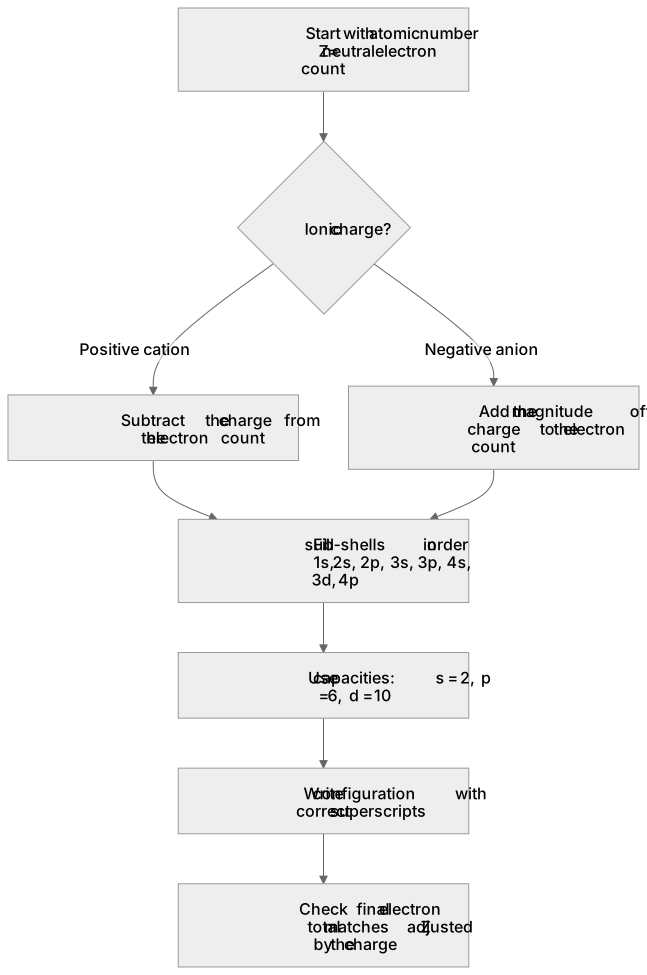
Start from the neutral atom's electron count, which equals the atomic number, then adjust for the ionic charge.
- Point 12 of 12
- 3 key terms
Study notes
From the teaching notes for this specification point.
The idea
Start from the neutral atom's electron count, which equals the atomic number, then adjust for the ionic charge. A positive ion has lost electrons, so subtract the charge from the electron count; a negative ion has gained electrons, so add the magnitude of the charge. For example, Mg (Z = 12) as Mg²⁺ has 10 electrons: 1s² 2s² 2p⁶, the same configuration as Ne. Cl (Z = 17) as Cl⁻ has 18 electrons: 1s² 2s² 2p⁶ 3s² 3p⁶, matching Ar. The scope is s- and p-block elements up to Z = 36, so you handle ions such as Na⁺, Mg²⁺, Al³⁺, O²⁻, F⁻, S²⁻ and Cl⁻. Note that removing electrons from a p-block atom takes them from the highest-energy occupied sub-shell first.
What earns the marks
- Calculates the ion's electron count by subtracting positive charge or adding negative charge to Z.
- Fills sub-shells in the order 1s, 2s, 2p, 3s, 3p, 4s, 3d, 4p.
- Assigns correct capacities of 2, 6 and 10 to s, p and d sub-shells respectively.
- Writes the configuration with correct superscripts, for example 1s² 2s² 2p⁶ for Mg²⁺.
- Restricts the answer to s- and p-block ions up to Z = 36.
Common mistakes and how to put them right
Adds electrons for a positive charge.
Put it right: Subtract the charge for cations and add it for anions.
Treats the ionic charge as the electron count.
Put it right: Derive electrons from Z adjusted by the charge.
Removes electrons from an inner sub-shell first.
Put it right: Take them from the highest-energy occupied sub-shell.
Exam tips
- Write the neutral configuration first, then add or remove electrons for the charge.
- Check the final electron total matches Z minus the charge for cations.
- For anions, confirm you have added the full magnitude of the negative charge.
Try the lesson
The start of the Electron structure: (ii) ions, given the atomic number and ionic charge, limited to s- and p-blocks up to Z = 36. lesson, made from teaching notes for this specification point.
Listen
Start from the neutral atom's electron count, which equals the atomic number, then adjust for the ionic charge. A positive ion has lost electrons, so subtract the charge from the electron count; a negative ion has gained electrons, so add the magnitude of the charge. For example, Mg (Z = 12) as Mg²⁺ has 10 electrons: 1s² 2s² 2p⁶, the same configuration as Ne. Cl (Z = 17) as Cl⁻ has 18 electrons: 1s² 2s² 2p⁶ 3s² 3p⁶, matching Ar. The scope is s- and p-block elements up to Z = 36, so you handle ions such as Na⁺, Mg²⁺, Al³⁺, O²⁻, F⁻, S²⁻ and Cl⁻. Note that removing electrons from a p-block atom takes them from the highest-energy occupied sub-shell first. A strong answer earns marks for these points. Calculates the ion's electron count by subtracting positive charge or adding negative charge to Z. Fills sub-shells in the order 1s, 2s, 2p, 3s, 3p, 4s, 3d, 4p. Assigns correct capacities of 2, 6 and 10 to s, p and d sub-shells respectively. Writes the configuration with correct superscripts, for example 1s² 2s² 2p⁶ for Mg²⁺. Exam tip: Write the neutral configuration first, then add or remove electrons for the charge.
See it
Key words
Say what each word means before you turn the card.
Electron count from atomic number and ionic charge
Try answering aloud or in your head before turning the card.
Cations lose electrons, anions gain electrons
Try answering aloud or in your head before turning the card.
s- and p-block scope up to Z = 36
Try answering aloud or in your head before turning the card.
See every definition
- Electron count from atomic number and ionic charge
- Start from the neutral atom's electron count, which equals the atomic number, then adjust for the ionic charge.
- Cations lose electrons, anions gain electrons
- A positive ion has lost electrons, so subtract the charge from the electron count; a negative ion has gained electrons, so add the magnitude of the charge.
- s- and p-block scope up to Z = 36
- The scope is s- and p-block elements up to Z = 36, so you handle ions such as Na⁺, Mg²⁺, Al³⁺, O²⁻, F⁻, S²⁻ and Cl⁻.
There is more to this lesson
The full lesson goes on to check your understanding and help you earn the marks. Create a free account to carry on, with your progress saved.
A week of Premium from your first lesson · Then the free plan continues · No card, no charge
Test your understanding of Electron structure: (ii) ions, given the atomic number and ionic charge, limited to s- and p-blocks up to Z = 36.
Active recall beats re-reading. Take an instant quiz now to test what you’ve learned and lock it into long-term memory.
A week of Premium from your first lesson · Then the free plan continues · No card, no charge