OCR · A-Level · Chemistry
Course version: H432 · Version from Sept 2017
Electron structure: (i) atoms, given the atomic number, up to Z = 36
For a neutral atom, the atomic number Z equals the number of protons and therefore the number of electrons.
- Point 11 of 12
- 3 key terms
Study notes
From the teaching notes for this specification point.
The idea
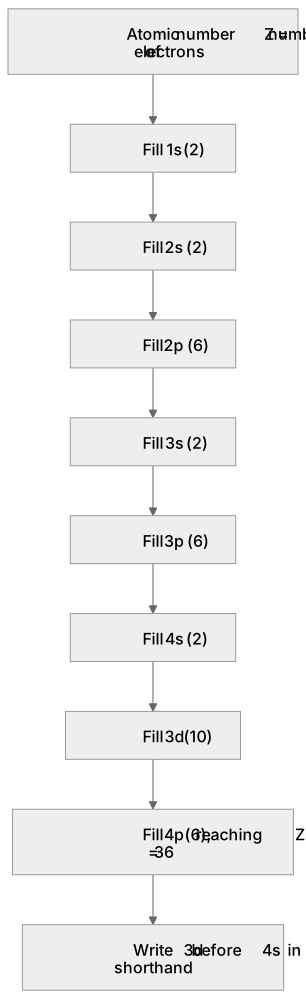
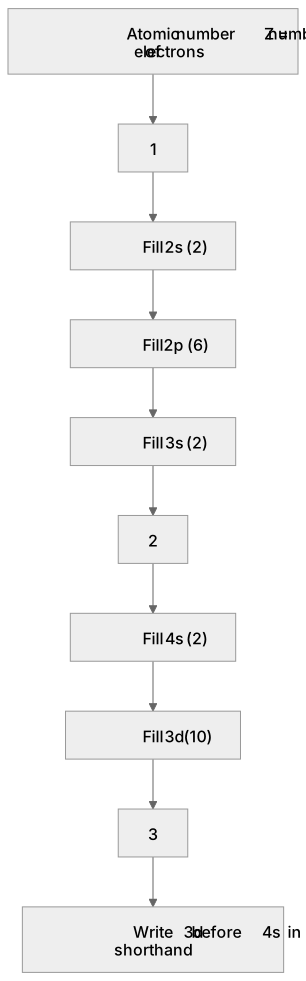
For a neutral atom, the atomic number Z equals the number of protons and therefore the number of electrons. You build the electron configuration by filling sub-shells in order of increasing energy: 1s, then 2s, 2p, 3s, 3p, 4s, then 3d and 4p, which reaches Z = 36 at krypton. Each s sub-shell holds 2 electrons, each p sub-shell holds 6 and each d sub-shell holds 10. For example, Z = 26 (iron) gives 1s² 2s² 2p⁶ 3s² 3p⁶ 3d⁶ 4s², often written as [Ar] 3d⁶ 4s². Remember that 4s fills before 3d but is written after it in the shorthand. The question supplies Z up to 36, so you never need sub-shells beyond 4p.
What earns the marks
- Counts electrons equal to the atomic number for a neutral atom.
- Fills sub-shells in the order 1s, 2s, 2p, 3s, 3p, 4s, 3d, 4p.
- Assigns 2 electrons to each s sub-shell, 6 to each p sub-shell and 10 to each d sub-shell.
- Writes the configuration with correct superscripts, for example 1s² 2s² 2p⁶.
- Places 4s before 3d in filling order while writing 3d before 4s in the shorthand.
Common mistakes and how to put them right
Fills 3d before 4s.
Put it right: Place 4s ahead of 3d in the filling sequence.
Gives a p sub-shell more than 6 electrons.
Put it right: Cap each p sub-shell at 6.
Omits the 4s electrons when writing the shorthand for a transition element.
Put it right: Include [Ar] 3dⁿ 4s².
Exam tips
- Write the filling order down the margin before starting so you do not skip a sub-shell.
- Check the total of your superscripts equals Z before selecting the option.
- For Z above 18, confirm whether the answer writes 3d before 4s in the shorthand.
Try the lesson
The start of the Electron structure: (i) atoms, given the atomic number, up to Z = 36 lesson, made from teaching notes for this specification point.
Listen
For a neutral atom, the atomic number Z equals the number of protons and therefore the number of electrons. You build the electron configuration by filling sub-shells in order of increasing energy: 1s, then 2s, 2p, 3s, 3p, 4s, then 3d and 4p, which reaches Z = 36 at krypton. Each s sub-shell holds 2 electrons, each p sub-shell holds 6 and each d sub-shell holds 10. For example, Z = 26 (iron) gives 1s² 2s² 2p⁶ 3s² 3p⁶ 3d⁶ 4s², often written as [Ar] 3d⁶ 4s². Remember that 4s fills before 3d but is written after it in the shorthand. The question supplies Z up to 36, so you never need sub-shells beyond 4p. A strong answer earns marks for these points. Counts electrons equal to the atomic number for a neutral atom. Fills sub-shells in the order 1s, 2s, 2p, 3s, 3p, 4s, 3d, 4p. Assigns 2 electrons to each s sub-shell, 6 to each p sub-shell and 10 to each d sub-shell. Writes the configuration with correct superscripts, for example 1s² 2s² 2p⁶. Exam tip: Write the filling order down the margin before starting so you do not skip a sub-shell.
See it
Key words
Say what each word means before you turn the card.
Atomic number equals electron count in neutral atoms
Try answering aloud or in your head before turning the card.
Aufbau filling order of sub-shells
Try answering aloud or in your head before turning the card.
Sub-shell capacities: s = 2, p = 6, d = 10
Try answering aloud or in your head before turning the card.
See every definition
- Atomic number equals electron count in neutral atoms
- For a neutral atom, the atomic number Z equals the number of protons and therefore the number of electrons.
- Aufbau filling order of sub-shells
- Sub-shells are filled in order of increasing energy: 1s, then 2s, 2p, 3s, 3p, 4s, then 3d and 4p.
- Sub-shell capacities: s = 2, p = 6, d = 10
- Each s sub-shell holds 2 electrons, each p sub-shell holds 6 and each d sub-shell holds 10.
Label the diagram
Some boxes have lost their names. Pick the right name for each number.
1Box 1
2Box 2
3Box 3
There is more to this lesson
The full lesson goes on to check your understanding and help you earn the marks. Create a free account to carry on, with your progress saved.
A week of Premium from your first lesson · Then the free plan continues · No card, no charge
Test your understanding of Electron structure: (i) atoms, given the atomic number, up to Z = 36
Active recall beats re-reading. Take an instant quiz now to test what you’ve learned and lock it into long-term memory.
A week of Premium from your first lesson · Then the free plan continues · No card, no charge