OCR · A-Level · Chemistry
Course version: H432 · Version from Sept 2017
(f) the limitations of predictions made by ∆G about feasibility, in terms…
Full specification wording
Enthalpy and entropy: (f) the limitations of predictions made by ∆G about feasibility, in terms of kinetics.
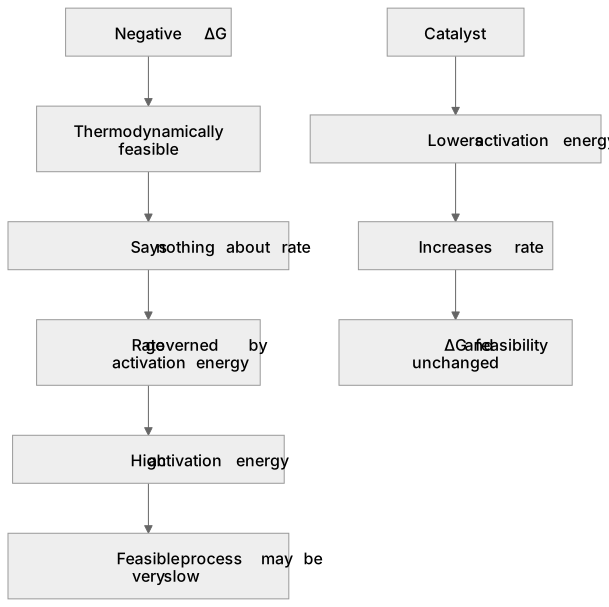
A negative ∆G tells you a process is thermodynamically feasible, but it says nothing about how fast the process happens.
- Point 7 of 7
- 4 key terms
Study notes
From the teaching notes for this specification point.
The idea
A negative ∆G tells you a process is thermodynamically feasible, but it says nothing about how fast the process happens. Feasibility is a thermodynamic judgement about the relative free energy of reactants and products; the rate is a kinetic matter governed by activation energy and the reaction pathway. A reaction with a large negative ∆G can still be immeasurably slow at room temperature if its activation energy is high, because few particles have enough energy to overcome the barrier. For example, the combustion of methane is strongly feasible yet methane is stable in air until ignited. Conversely, a process with a positive ∆G is not feasible overall, though local or coupled steps may occur. So ∆G predicts whether a process can happen, not whether it will happen at an observable rate; catalysts change rate by lowering activation energy without altering ∆G.
What earns the marks
- States that ∆G indicates thermodynamic feasibility but not the rate of a process.
- Explains that a feasible process may be very slow because of a high activation energy.
- Distinguishes thermodynamic feasibility from kinetic control of rate.
- Notes that a catalyst can increase rate without changing ∆G or feasibility.
- Gives a concrete example of a feasible but slow process at ordinary conditions.
Common mistakes and how to put them right
Assumes a negative ∆G means the reaction will occur quickly.
Put it right: Feasibility does not set rate.
Claims a catalyst makes a non-feasible reaction feasible.
Put it right: A catalyst lowers activation energy and leaves ∆G unchanged.
Confuses activation energy with free energy change.
Put it right: They describe different things.
Concludes a positive ∆G means no reaction can ever occur under any conditions.
Put it right: Feasibility depends on conditions such as temperature.
Exam tips
- Separate the two ideas clearly: ∆G answers 'can it?', kinetics answers 'how fast?'.
- Refer to activation energy when explaining why a feasible reaction may be slow.
- Use a familiar example such as methane in air to illustrate kinetic stability.
- State that a catalyst affects rate, not the sign or value of ∆G.
Try the lesson
The start of the Enthalpy and entropy: (f) the limitations of predictions made by ∆G about feasibility, in terms of kinetics. lesson, made from teaching notes for this specification point.
Listen
A negative ∆G tells you a process is thermodynamically feasible, but it says nothing about how fast the process happens. Feasibility is a thermodynamic judgement about the relative free energy of reactants and products; the rate is a kinetic matter governed by activation energy and the reaction pathway. A reaction with a large negative ∆G can still be immeasurably slow at room temperature if its activation energy is high, because few particles have enough energy to overcome the barrier. For example, the combustion of methane is strongly feasible yet methane is stable in air until ignited. Conversely, a process with a positive ∆G is not feasible overall, though local or coupled steps may occur. So ∆G predicts whether a process can happen, not whether it will happen at an observable rate; catalysts change rate by lowering activation energy without altering ∆G. A strong answer earns marks for these points. States that ∆G indicates thermodynamic feasibility but not the rate of a process. Explains that a feasible process may be very slow because of a high activation energy. Distinguishes thermodynamic feasibility from kinetic control of rate. Notes that a catalyst can increase rate without changing ∆G or feasibility. Exam tip: Separate the two ideas clearly: ∆G answers 'can it?', kinetics answers 'how fast?
See it
Key words
Say what each word means before you turn the card.
Thermodynamic feasibility versus kinetic rate
Try answering aloud or in your head before turning the card.
Activation energy and reaction rate
Try answering aloud or in your head before turning the card.
Role of catalysts
Try answering aloud or in your head before turning the card.
Limitations of ∆G predictions
Try answering aloud or in your head before turning the card.
See every definition
- Thermodynamic feasibility versus kinetic rate
- A negative ∆G shows a process is thermodynamically feasible, but it says nothing about how fast the process happens, which is a kinetic matter.
- Activation energy and reaction rate
- A reaction with a large negative ∆G can still be immeasurably slow at room temperature if its activation energy is high, because few particles have enough energy to overcome the barrier.
- Role of catalysts
- Catalysts change rate by lowering activation energy without altering ∆G.
- Limitations of ∆G predictions
- ∆G predicts whether a process can happen, not whether it will happen at an observable rate.
Label the diagram
Some boxes have lost their names. Pick the right name for each number.
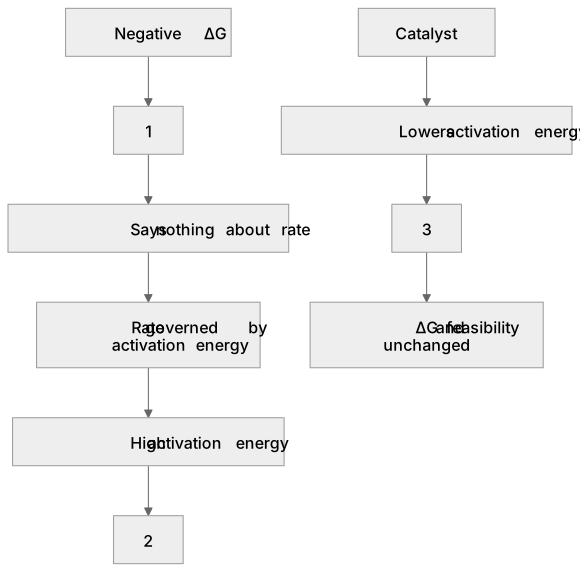
1Box 1
2Box 2
3Box 3
There is more to this lesson
The full lesson goes on to check your understanding and help you earn the marks. Create a free account to carry on, with your progress saved.
A week of Premium from your first lesson · Then the free plan continues · No card, no charge
Test your understanding of Enthalpy and entropy: (f) the limitations of predictions made by ∆G about feasibility, in terms of kinetics.
Active recall beats re-reading. Take an instant quiz now to test what you’ve learned and lock it into long-term memory.
A week of Premium from your first lesson · Then the free plan continues · No card, no charge