OCR · A-Level · Chemistry
Course version: H432 · Version from Sept 2017
(e) explanation, and related calculations, of the free energy change, ∆G,…
Full specification wording
Enthalpy and entropy: (e) explanation, and related calculations, of the free energy change, ∆G, as: ∆G = ∆H – T∆S (the Gibbs’ equation) and that a process is feasible when ∆G has a negative value
The Gibbs equation combines enthalpy and entropy into one feasibility test: ∆G = ∆H – T∆S. Here ∆H is the enthalpy change of the process, ∆S its entropy change and T the temperature in kelvin (K =…
- Point 6 of 7
- 3 key terms
Study notes
From the teaching notes for this specification point.
The idea
The Gibbs equation combines enthalpy and entropy into one feasibility test: ∆G = ∆H – T∆S. Here ∆H is the enthalpy change of the process, ∆S its entropy change and T the temperature in kelvin (K = °C + 273). Both ∆H and ∆S must be expressed in consistent energy units, so convert ∆S from J K⁻¹ mol⁻¹ to kJ K⁻¹ mol⁻¹ by dividing by 1000 before subtracting. A process is feasible when ∆G is negative. Worked example: ∆H = +50 kJ mol⁻¹, ∆S = +100 J K⁻¹ mol⁻¹ at 298 K gives T∆S = 298 × 0.100 = 29.8 kJ mol⁻¹, so ∆G = 50 − 29.8 = +20.2 kJ mol⁻¹, not feasible. At 600 K, T∆S = 60 kJ mol⁻¹ and ∆G = −10 kJ mol⁻¹, feasible. The sign of ∆G also shows how temperature shifts feasibility: when ∆H and ∆S have the same sign, one temperature range is feasible and the other is not.
What earns the marks
- Applies the equation ∆G = ∆H – T∆S with the temperature converted to kelvin.
- Converts the entropy term to the same energy unit as the enthalpy term before subtracting.
- Calculates T∆S as the product of temperature and entropy change.
- States that a process is feasible when ∆G has a negative value.
- Interprets a positive ∆G as indicating the process is not feasible under those conditions.
- Explains how changing temperature alters the sign of ∆G when ∆H and ∆S have the same sign.
Common mistakes and how to put them right
Uses temperature in degrees Celsius rather than kelvin.
Put it right: Add 273 to convert.
Subtracts an entropy term in J K⁻¹ mol⁻¹ directly from an enthalpy term in kJ mol⁻¹.
Put it right: Divide the entropy term by 1000 first.
Reverses the equation and adds the terms.
Put it right: Keep the subtraction ∆H – T∆S.
Treats a positive ∆G as feasible.
Put it right: A negative ∆G marks feasibility.
Exam tips
- Write the equation, then substitute values with units shown, so the arithmetic is easy to follow.
- Convert ∆S to kJ K⁻¹ mol⁻¹ before multiplying by T, and state the conversion you made.
- Check the sign of your final ∆G and state explicitly whether the process is feasible.
- When asked about temperature effects, reason from the signs of ∆H and ∆S rather than reciting a rule.
Try the lesson
The start of the Enthalpy and entropy: (e) explanation, and related calculations, of the free energy change, ∆G, as: ∆G = ∆H – T∆S (the Gibbs’ equation) and that a process is feasible when ∆G has a negative value lesson, made from teaching notes for this specification point.
Listen
The Gibbs equation combines enthalpy and entropy into one feasibility test: ∆G = ∆H – T∆S. Here ∆H is the enthalpy change of the process, ∆S its entropy change and T the temperature in kelvin (K = °C + 273). Both ∆H and ∆S must be expressed in consistent energy units, so convert ∆S from J K⁻¹ mol⁻¹ to kJ K⁻¹ mol⁻¹ by dividing by 1000 before subtracting. A process is feasible when ∆G is negative. Worked example: ∆H = +50 kJ mol⁻¹, ∆S = +100 J K⁻¹ mol⁻¹ at 298 K gives T∆S = 298 × 0.100 = 29.8 kJ mol⁻¹, so ∆G = 50 − 29.8 = +20.2 kJ mol⁻¹, not feasible. At 600 K, T∆S = 60 kJ mol⁻¹ and ∆G = −10 kJ mol⁻¹, feasible. The sign of ∆G also shows how temperature shifts feasibility: when ∆H and ∆S have the same sign, one temperature range is feasible and the other is not. A strong answer earns marks for these points. Applies the equation ∆G = ∆H – T∆S with the temperature converted to kelvin. Converts the entropy term to the same energy unit as the enthalpy term before subtracting. Calculates T∆S as the product of temperature and entropy change. States that a process is feasible when ∆G has a negative value. Exam tip: Write the equation, then substitute values with units shown, so the arithmetic is easy to follow.
See it
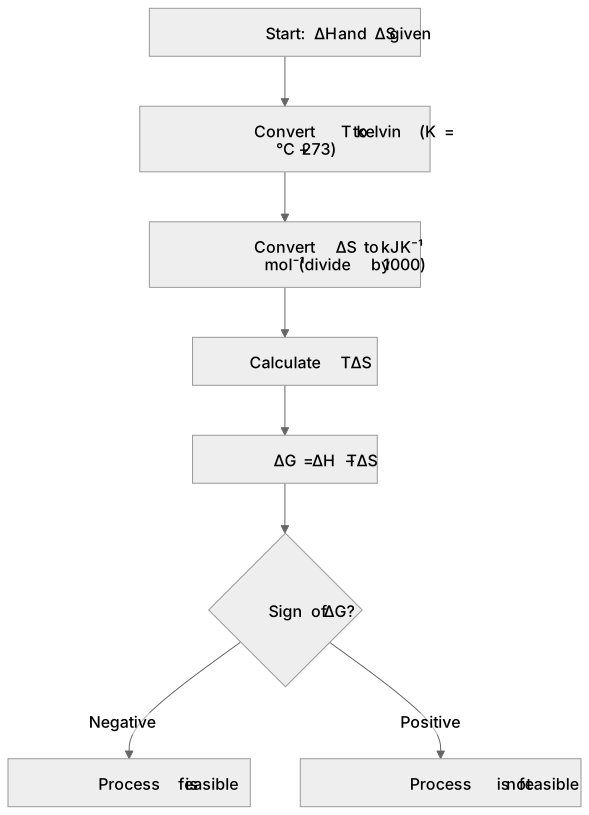
Key words
Say what each word means before you turn the card.
Gibbs equation and free energy change
Try answering aloud or in your head before turning the card.
Feasibility and the sign of ∆G
Try answering aloud or in your head before turning the card.
Temperature dependence of feasibility
Try answering aloud or in your head before turning the card.
See every definition
- Gibbs equation and free energy change
- The free energy change, ∆G, is calculated as ∆G = ∆H – T∆S, where ∆H is the enthalpy change, ∆S the entropy change and T the temperature in kelvin.
- Feasibility and the sign of ∆G
- A process is feasible when ∆G has a negative value, and a positive ∆G indicates the process is not feasible under those conditions.
- Temperature dependence of feasibility
- When ∆H and ∆S have the same sign, one temperature range is feasible and the other is not, so changing temperature alters the sign of ∆G.
Label the diagram
Some boxes have lost their names. Pick the right name for each number.
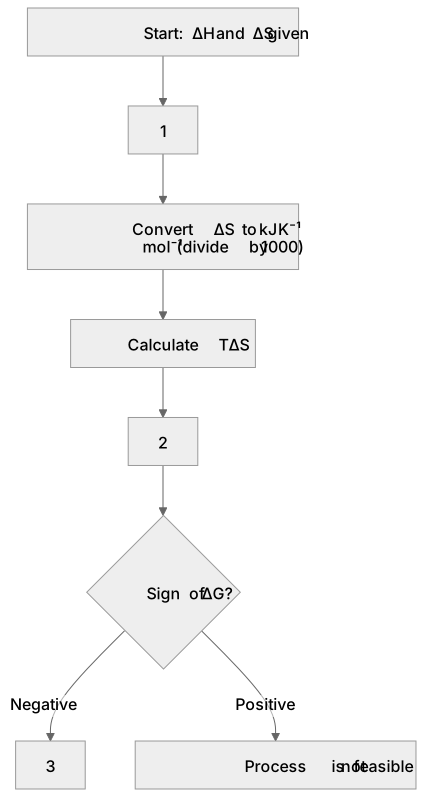
1Box 1
2Box 2
3Box 3
There is more to this lesson
The full lesson goes on to check your understanding and help you earn the marks. Create a free account to carry on, with your progress saved.
A week of Premium from your first lesson · Then the free plan continues · No card, no charge
Test your understanding of Enthalpy and entropy: (e) explanation, and related calculations, of the free energy change, ∆G, as: ∆G = ∆H – T∆S (the Gibbs’ equation) and that a process is feasible when ∆G has a negative value
Active recall beats re-reading. Take an instant quiz now to test what you’ve learned and lock it into long-term memory.
A week of Premium from your first lesson · Then the free plan continues · No card, no charge