OCR · A-Level · Chemistry
Course version: H432 · Version from Sept 2017
Enthalpy and entropy: (i) of solids, liquids and gases
This item tests whether you can rank the entropy of the three physical states of the same substance and justify the ranking.
- Point 2 of 7
- 4 key terms
Study notes
From the teaching notes for this specification point.
The idea
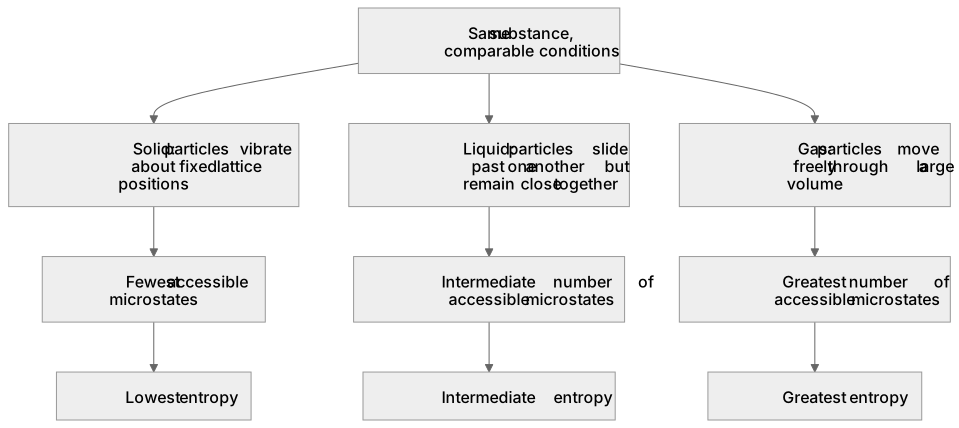
This item tests whether you can rank the entropy of the three physical states of the same substance and justify the ranking. For a given substance at comparable conditions, the gas has the greatest entropy, the liquid has an intermediate value and the solid has the lowest. The reason is the number of accessible microstates: particles in a gas move freely through a large volume and can occupy many positions and momenta, particles in a liquid can slide past one another but remain close together, and particles in a solid vibrate about fixed lattice positions. When you answer a multiple-choice question, read whether it asks for the order from lowest to highest or the reverse, and check whether the substance and conditions are the same for each state. Eliminate options that place a solid above a gas or that treat entropy as increasing as particles become more ordered.
What earns the marks
- Selects the order in which the gas has the greatest entropy and the solid the least for the same substance.
- Justifies the ranking by the greater number of accessible microstates in the gas than in the liquid or solid.
- Recognises that particles in a solid vibrate about fixed positions and so have fewer arrangements than in a liquid.
- Rejects an option that places the entropy of a solid above that of a gas for the same substance.
- Reads the direction of the requested order, lowest to highest or highest to lowest, before choosing an option.
Common mistakes and how to put them right
Chooses an order that ranks the solid above the liquid.
Put it right: Place the solid lowest because its particles are fixed in a lattice.
Assumes entropy depends only on the mass of the particles.
Put it right: Base the ranking on the freedom of motion and number of arrangements.
Ignores the direction of the requested order and picks the reverse sequence.
Put it right: Check whether the question asks for lowest to highest or highest to lowest.
Treats entropy as increasing with order.
Put it right: Recognise that greater order corresponds to fewer microstates and lower entropy.
Exam tips
- Write the expected order gas greater than liquid greater than solid in the margin before reading the options.
- Check that every option refers to the same substance and comparable conditions before ranking.
- Eliminate any option that contradicts the freedom of motion of particles in each state.
- Confirm the direction of the requested order in the final seconds before recording your answer.
Try the lesson
The start of the Enthalpy and entropy: (i) of solids, liquids and gases lesson, made from teaching notes for this specification point.
Listen
This item tests whether you can rank the entropy of the three physical states of the same substance and justify the ranking. For a given substance at comparable conditions, the gas has the greatest entropy, the liquid has an intermediate value and the solid has the lowest. The reason is the number of accessible microstates: particles in a gas move freely through a large volume and can occupy many positions and momenta, particles in a liquid can slide past one another but remain close together, and particles in a solid vibrate about fixed lattice positions. When you answer a multiple-choice question, read whether it asks for the order from lowest to highest or the reverse, and check whether the substance and conditions are the same for each state. Eliminate options that place a solid above a gas or that treat entropy as increasing as particles become more ordered. A strong answer earns marks for these points. Selects the order in which the gas has the greatest entropy and the solid the least for the same substance. Justifies the ranking by the greater number of accessible microstates in the gas than in the liquid or solid. Recognises that particles in a solid vibrate about fixed positions and so have fewer arrangements than in a liquid. Rejects an option that places the entropy of a solid above that of a gas for the same substance. Exam tip: Write the expected order gas greater than liquid greater than solid in the margin before reading the options.
See it
Key words
Say what each word means before you turn the card.
Ranking entropy of solids, liquids and gases
Try answering aloud or in your head before turning the card.
Number of accessible microstates in each state
Try answering aloud or in your head before turning the card.
Freedom of motion of particles in each state
Try answering aloud or in your head before turning the card.
Reading the direction of an ordering question
Try answering aloud or in your head before turning the card.
See every definition
- Ranking entropy of solids, liquids and gases
- For a given substance at comparable conditions, the gas has the greatest entropy, the liquid has an intermediate value and the solid has the lowest.
- Number of accessible microstates in each state
- The gas has a greater number of accessible microstates than the liquid or solid, because particles in a gas move freely through a large volume and can occupy many positions and momenta.
- Freedom of motion of particles in each state
- Particles in a gas move freely through a large volume, particles in a liquid can slide past one another but remain close together, and particles in a solid vibrate about fixed lattice positions.
- Reading the direction of an ordering question
- Read whether the question asks for the order from lowest to highest or the reverse, and check whether the substance and conditions are the same for each state.
Label the diagram
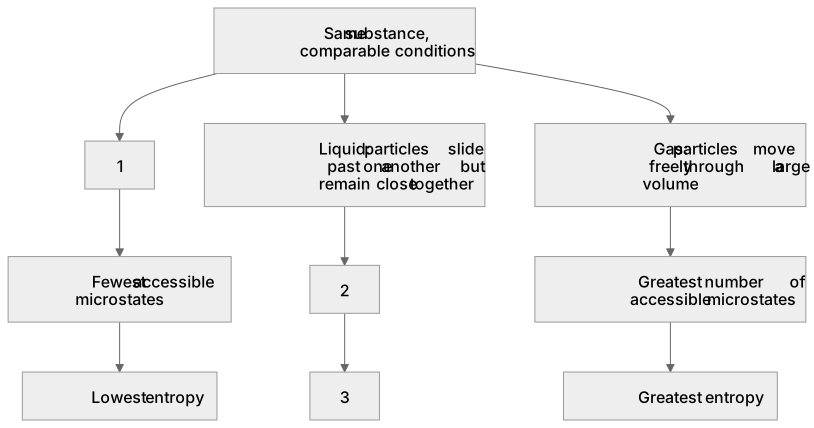
Some boxes have lost their names. Pick the right name for each number.
1Box 1
2Box 2
3Box 3
There is more to this lesson
The full lesson goes on to check your understanding and help you earn the marks. Create a free account to carry on, with your progress saved.
A week of Premium from your first lesson · Then the free plan continues · No card, no charge
Test your understanding of Enthalpy and entropy: (i) of solids, liquids and gases
Active recall beats re-reading. Take an instant quiz now to test what you’ve learned and lock it into long-term memory.
A week of Premium from your first lesson · Then the free plan continues · No card, no charge