OCR · A-Level · Chemistry
Course version: H432 · Version from Sept 2017
(ii) for a reaction in which there is a change in the number of gaseous…
Full specification wording
Enthalpy and entropy: (ii) for a reaction in which there is a change in the number of gaseous molecules
This point asks you to reason qualitatively about how the entropy of the system changes when the number of gaseous molecules changes during a reaction.
- Point 3 of 7
- 4 key terms
Study notes
From the teaching notes for this specification point.
The idea
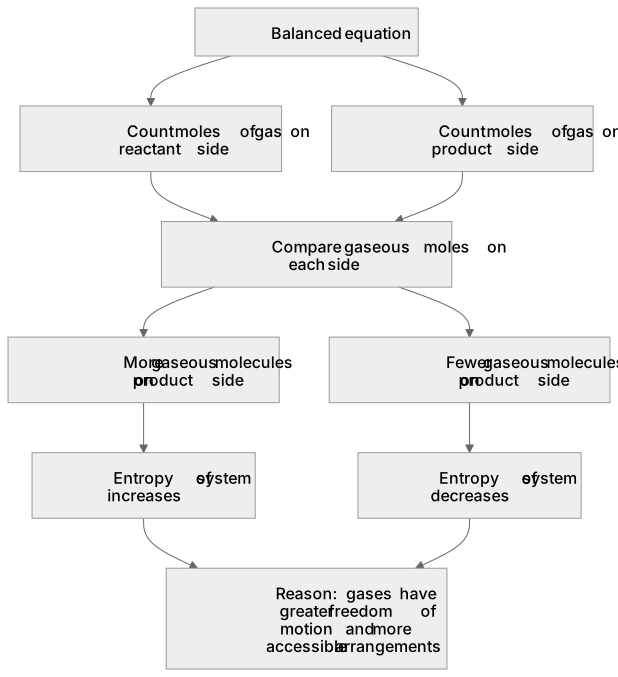
This point asks you to reason qualitatively about how the entropy of the system changes when the number of gaseous molecules changes during a reaction. Gases have far more freedom of motion and far more accessible microstates than liquids or solids, so a reaction that increases the number of gas molecules usually increases the entropy of the system, and one that decreases the number of gas molecules usually decreases it. Compare the total moles of gas on each side of the equation. For example, N₂O₄(g) → 2NO₂(g) converts one gas molecule into two, so the system entropy rises; the reverse change lowers it. Judge only the sign and direction of the change, and keep the reasoning tied to the gaseous species counted in the balanced equation.
What earns the marks
- Counts the total moles of gaseous molecules on the reactant side and on the product side of the balanced equation.
- States that an increase in the number of gaseous molecules corresponds to an increase in the entropy of the system.
- States that a decrease in the number of gaseous molecules corresponds to a decrease in the entropy of the system.
- Explains the link by referring to the greater freedom of motion and greater number of accessible arrangements available to gas molecules.
- Applies the reasoning to a specific equation by comparing gaseous moles on each side rather than counting aqueous or solid species.
Common mistakes and how to put them right
Counts all species in the equation instead of only gaseous molecules.
Put it right: Count the moles of gas on each side.
Assumes entropy always rises in any reaction.
Put it right: Compare the gaseous moles on each side to decide the direction.
Treats a change in the number of gas molecules as having no effect on system entropy.
Put it right: Link the change to the greater freedom of motion of gases.
Exam tips
- Write the balanced equation and annotate the moles of gas above each formula before deciding the direction of entropy change.
- Answer the question asked about the sign of the change in system entropy, and justify it by the gas-mole comparison.
- Check that coefficients are balanced before counting, because an unbalanced equation gives a false comparison.
Try the lesson
The start of the Enthalpy and entropy: (ii) for a reaction in which there is a change in the number of gaseous molecules lesson, made from teaching notes for this specification point.
Listen
This point asks you to reason qualitatively about how the entropy of the system changes when the number of gaseous molecules changes during a reaction. Gases have far more freedom of motion and far more accessible microstates than liquids or solids, so a reaction that increases the number of gas molecules usually increases the entropy of the system, and one that decreases the number of gas molecules usually decreases it. Compare the total moles of gas on each side of the equation. For example, N₂O₄(g) → 2NO₂(g) converts one gas molecule into two, so the system entropy rises; the reverse change lowers it. Judge only the sign and direction of the change, and keep the reasoning tied to the gaseous species counted in the balanced equation. A strong answer earns marks for these points. Counts the total moles of gaseous molecules on the reactant side and on the product side of the balanced equation. States that an increase in the number of gaseous molecules corresponds to an increase in the entropy of the system. States that a decrease in the number of gaseous molecules corresponds to a decrease in the entropy of the system. Explains the link by referring to the greater freedom of motion and greater number of accessible arrangements available to gas molecules. Exam tip: Write the balanced equation and annotate the moles of gas above each formula before deciding the direction of entropy change.
See it
Key words
Say what each word means before you turn the card.
Entropy of the system
Try answering aloud or in your head before turning the card.
Gaseous molecules
Try answering aloud or in your head before turning the card.
Increase in entropy
Try answering aloud or in your head before turning the card.
Decrease in entropy
Try answering aloud or in your head before turning the card.
See every definition
- Entropy of the system
- Changes in the entropy of the system can be predicted qualitatively by comparing the number of gaseous molecules on each side of a balanced equation.
- Gaseous molecules
- Gases have far more freedom of motion and far more accessible microstates than liquids or solids.
- Increase in entropy
- A reaction that increases the number of gas molecules usually increases the entropy of the system.
- Decrease in entropy
- A reaction that decreases the number of gas molecules usually decreases the entropy of the system.
Label the diagram
Some boxes have lost their names. Pick the right name for each number.
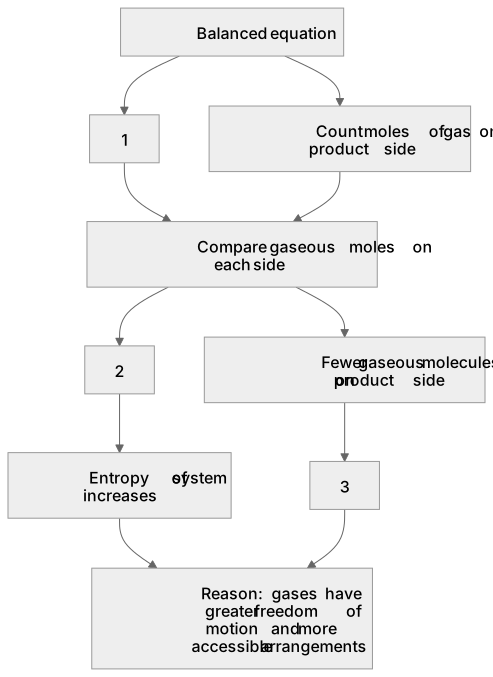
1Box 1
2Box 2
3Box 3
There is more to this lesson
The full lesson goes on to check your understanding and help you earn the marks. Create a free account to carry on, with your progress saved.
A week of Premium from your first lesson · Then the free plan continues · No card, no charge
Test your understanding of Enthalpy and entropy: (ii) for a reaction in which there is a change in the number of gaseous molecules
Active recall beats re-reading. Take an instant quiz now to test what you’ve learned and lock it into long-term memory.
A week of Premium from your first lesson · Then the free plan continues · No card, no charge