OCR · A-Level · Chemistry
Course version: H432 · Version from Sept 2017
(f) (i) explanation of the term average bond enthalpy (as the breaking of…
Full specification wording
Enthalpy changes: (f) (i) explanation of the term average bond enthalpy (as the breaking of 1 mol of bonds in gaseous molecules)
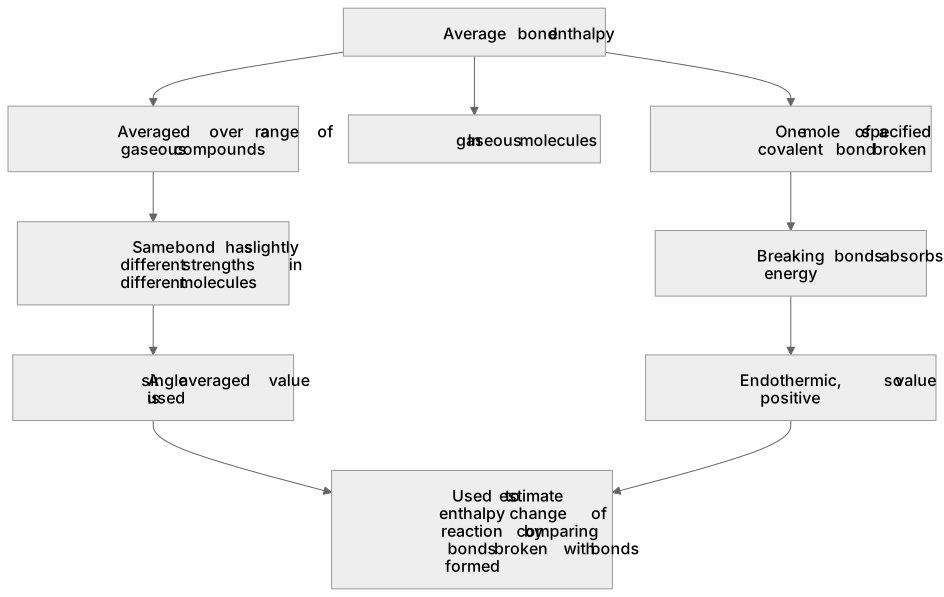
The average bond enthalpy is the enthalpy change when one mole of a specified covalent bond is broken in gaseous molecules, averaged over a range of gaseous compounds containing that bond.
- Point 12 of 20
- 4 key terms
Study notes
From the teaching notes for this specification point.
The idea
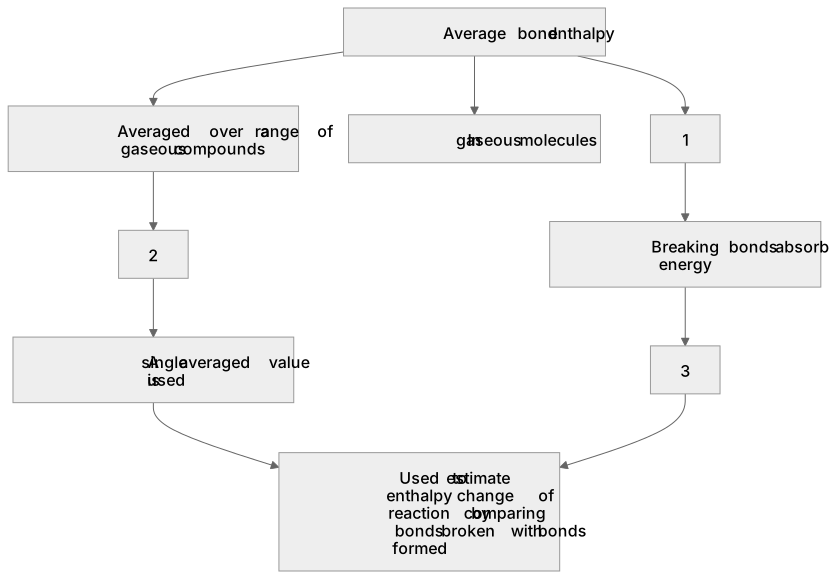
The average bond enthalpy is the enthalpy change when one mole of a specified covalent bond is broken in gaseous molecules, averaged over a range of gaseous compounds containing that bond. The same bond, such as an O–H bond, has slightly different strengths in different molecules, so a single averaged value is used for calculations. Breaking bonds absorbs energy, so the average bond enthalpy is positive and the process is endothermic. The gaseous condition matters: the value applies to gaseous molecules, not to liquids or solids. Average bond enthalpies allow an approximate enthalpy change of reaction to be estimated by comparing bonds broken with bonds formed.
What earns the marks
- Defines the average bond enthalpy as the enthalpy change when one mole of a specified covalent bond is broken in gaseous molecules.
- States that the value is averaged over a range of gaseous compounds containing that bond.
- Explains that the same bond has slightly different strengths in different molecules, so an average is used.
- States that breaking bonds is endothermic, so the average bond enthalpy is positive.
- Applies the gaseous condition, noting that the value refers to gaseous molecules.
Common mistakes and how to put them right
Describes the average bond enthalpy as energy released when bonds form.
Put it right: State that it is the energy absorbed when one mole of bonds is broken.
Omits the averaging; state that the value is averaged over a range of gaseous compounds.
Gives the value a negative sign.
Put it right: State that bond breaking is endothermic and the value is positive.
Ignores the gaseous condition.
Put it right: State that the molecules must be gaseous.
Exam tips
- Include all three parts of the definition: one mole of bonds, gaseous molecules, and an average over compounds.
- Link the positive sign to the endothermic nature of bond breaking.
- Use the word average explicitly, since a single molecule's bond strength may differ from the mean.
Try the lesson
The start of the Enthalpy changes: (f) (i) explanation of the term average bond enthalpy (as the breaking of 1 mol of bonds in gaseous molecules) lesson, made from teaching notes for this specification point.
Listen
The average bond enthalpy is the enthalpy change when one mole of a specified covalent bond is broken in gaseous molecules, averaged over a range of gaseous compounds containing that bond. The same bond, such as an O–H bond, has slightly different strengths in different molecules, so a single averaged value is used for calculations. Breaking bonds absorbs energy, so the average bond enthalpy is positive and the process is endothermic. The gaseous condition matters: the value applies to gaseous molecules, not to liquids or solids. Average bond enthalpies allow an approximate enthalpy change of reaction to be estimated by comparing bonds broken with bonds formed. A strong answer earns marks for these points. Defines the average bond enthalpy as the enthalpy change when one mole of a specified covalent bond is broken in gaseous molecules. States that the value is averaged over a range of gaseous compounds containing that bond. Explains that the same bond has slightly different strengths in different molecules, so an average is used. States that breaking bonds is endothermic, so the average bond enthalpy is positive. Exam tip: Include all three parts of the definition: one mole of bonds, gaseous molecules, and an average over compounds.
See it
Key words
Say what each word means before you turn the card.
Average bond enthalpy
Try answering aloud or in your head before turning the card.
Averaging over gaseous compounds
Try answering aloud or in your head before turning the card.
Endothermic bond breaking
Try answering aloud or in your head before turning the card.
Gaseous-state condition
Try answering aloud or in your head before turning the card.
See every definition
- Average bond enthalpy
- The enthalpy change when one mole of a specified covalent bond is broken in gaseous molecules, averaged over a range of gaseous compounds containing that bond.
- Averaging over gaseous compounds
- The same bond has slightly different strengths in different molecules, so a single averaged value is used for calculations.
- Endothermic bond breaking
- Breaking bonds absorbs energy, so the average bond enthalpy is positive and the process is endothermic.
- Gaseous-state condition
- The value applies to gaseous molecules, not to liquids or solids.
Label the diagram
Some boxes have lost their names. Pick the right name for each number.
1Box 1
2Box 2
3Box 3
There is more to this lesson
The full lesson goes on to check your understanding and help you earn the marks. Create a free account to carry on, with your progress saved.
A week of Premium from your first lesson · Then the free plan continues · No card, no charge
Test your understanding of Enthalpy changes: (f) (i) explanation of the term average bond enthalpy (as the breaking of 1 mol of bonds in gaseous molecules)
Active recall beats re-reading. Take an instant quiz now to test what you’ve learned and lock it into long-term memory.
A week of Premium from your first lesson · Then the free plan continues · No card, no charge