OCR · A-Level · Chemistry
Course version: H432 · Version from Sept 2017
(ii) explanation of exothermic and endothermic reactions in terms of…
Full specification wording
Enthalpy changes: (ii) explanation of exothermic and endothermic reactions in terms of enthalpy changes associated with the breaking and making of chemical bonds
Bond breaking and bond making carry opposite enthalpy changes.
- Point 13 of 20
- 4 key terms
Study notes
From the teaching notes for this specification point.
The idea
Bond breaking and bond making carry opposite enthalpy changes. Breaking a covalent bond requires energy from the surroundings, so it is endothermic and has a positive enthalpy change. Making a bond releases energy to the surroundings, so it is exothermic and has a negative enthalpy change. For a reaction, compare total energy absorbed in breaking bonds in the reactants with total energy released in making bonds in the products. If breaking absorbs more than making releases, the overall reaction is endothermic (ΔH positive). If making releases more than breaking absorbs, the overall reaction is exothermic (ΔH negative).
For example: In the combustion of methane, breaking bonds in CH₄ and O₂ absorbs energy, but forming CO₂ and H₂O releases more, so the reaction is exothermic.
What earns the marks
- States that breaking a bond is endothermic because energy is absorbed from the surroundings.
- States that making a bond is exothermic because energy is released to the surroundings.
- Compares total energy absorbed in breaking reactant bonds with total energy released in making product bonds.
- Concludes that a reaction is exothermic when bond making releases more energy than bond breaking absorbs.
- Concludes that a reaction is endothermic when bond breaking absorbs more energy than bond making releases.
- Links the sign of ΔH to the net balance of bond breaking and bond making.
Common mistakes and how to put them right
Claims that bond breaking releases energy.
Put it right by stating that breaking bonds absorbs energy and is endothermic.
Claims that bond making absorbs energy.
Put it right by stating that making bonds releases energy and is exothermic.
Decides exothermic or endothermic from the number of bonds broken rather than the energy balance.
Put it right: Compare total energies instead.
Reverses the sign of ΔH for an exothermic reaction.
Put it right: Keep ΔH negative for exothermic and positive for endothermic.
Exam tips
- Read the question carefully to see whether it asks about a single bond change or the overall reaction.
- Use the phrase 'energy absorbed in breaking bonds' and 'energy released in making bonds' to keep the two processes distinct.
- Check the sign of ΔH against your conclusion: exothermic is negative, endothermic is positive.
- Eliminate options that confuse which process absorbs or releases energy before comparing totals.
Try the lesson
The start of the Enthalpy changes: (ii) explanation of exothermic and endothermic reactions in terms of enthalpy changes associated with the breaking and making of chemical bonds lesson, made from teaching notes for this specification point.
Listen
Bond breaking and bond making carry opposite enthalpy changes. Breaking a covalent bond requires energy from the surroundings, so it is endothermic and has a positive enthalpy change. Making a bond releases energy to the surroundings, so it is exothermic and has a negative enthalpy change. For a reaction, compare total energy absorbed in breaking bonds in the reactants with total energy released in making bonds in the products. If breaking absorbs more than making releases, the overall reaction is endothermic (ΔH positive). If making releases more than breaking absorbs, the overall reaction is exothermic (ΔH negative). For example, in the combustion of methane, breaking bonds in CH₄ and O₂ absorbs energy, but forming CO₂ and H₂O releases more, so the reaction is exothermic. A strong answer earns marks for these points. States that breaking a bond is endothermic because energy is absorbed from the surroundings. States that making a bond is exothermic because energy is released to the surroundings. Compares total energy absorbed in breaking reactant bonds with total energy released in making product bonds. Concludes that a reaction is exothermic when bond making releases more energy than bond breaking absorbs. A common slip: Claims that bond breaking releases energy. Instead, stating that breaking bonds absorbs energy and is endothermic. Exam tip: Read the question carefully to see whether it asks about a single bond change or the overall reaction.
See it
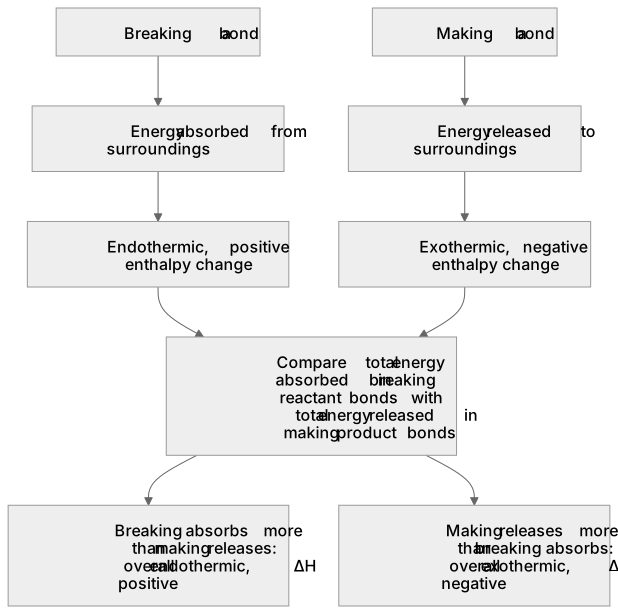
Key words
Say what each word means before you turn the card.
Enthalpy changes of bond breaking and bond making
Try answering aloud or in your head before turning the card.
Exothermic and endothermic reactions
Try answering aloud or in your head before turning the card.
Sign of ΔH
Try answering aloud or in your head before turning the card.
Energy balance in reactions
Try answering aloud or in your head before turning the card.
See every definition
- Enthalpy changes of bond breaking and bond making
- Breaking a covalent bond requires energy from the surroundings and is endothermic with a positive enthalpy change, while making a bond releases energy to the surroundings and is exothermic with a negative enthalpy change.
- Exothermic and endothermic reactions
- A reaction is exothermic when bond making releases more energy than bond breaking absorbs, and endothermic when bond breaking absorbs more energy than bond making releases.
- Sign of ΔH
- ΔH is positive for an endothermic reaction and negative for an exothermic reaction, linked to the net balance of bond breaking and bond making.
- Energy balance in reactions
- The total energy absorbed in breaking bonds in the reactants is compared with the total energy released in making bonds in the products to classify the overall reaction.
Label the diagram
Some boxes have lost their names. Pick the right name for each number.
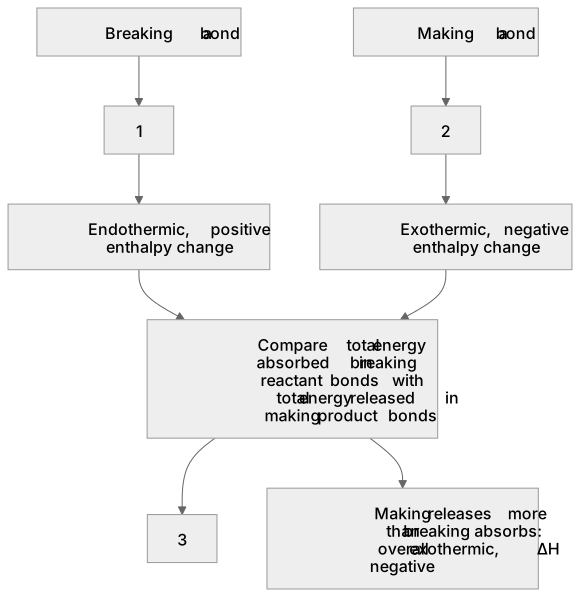
1Box 1
2Box 2
3Box 3
There is more to this lesson
The full lesson goes on to check your understanding and help you earn the marks. Create a free account to carry on, with your progress saved.
A week of Premium from your first lesson · Then the free plan continues · No card, no charge
Test your understanding of Enthalpy changes: (ii) explanation of exothermic and endothermic reactions in terms of enthalpy changes associated with the breaking and making of chemical bonds
Active recall beats re-reading. Take an instant quiz now to test what you’ve learned and lock it into long-term memory.
A week of Premium from your first lesson · Then the free plan continues · No card, no charge