OCR · A-Level · Chemistry
Course version: H432 · Version from Sept 2017
(iii) enthalpy change of formation (formation of 1 mol of a compound from…
Full specification wording
Enthalpy changes: (iii) enthalpy change of formation (formation of 1 mol of a compound from its elements, ∆fH)
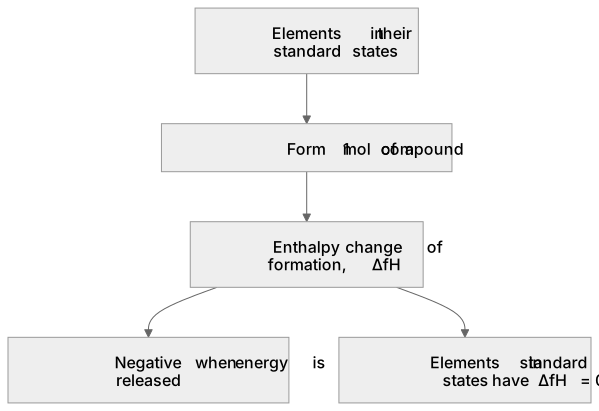
The standard enthalpy change of formation, ∆fH, is the enthalpy change when one mole of a compound forms from its elements in their standard states under standard conditions.
- Point 7 of 20
- 4 key terms
Study notes
From the teaching notes for this specification point.
The idea
The standard enthalpy change of formation, ∆fH, is the enthalpy change when one mole of a compound forms from its elements in their standard states under standard conditions. Two features define it: the product is exactly 1 mol of the compound, and the reactants are the elements themselves, not other compounds. For water, ∆fH refers to forming 1 mol of H₂O from H₂ and O₂ in their standard states, not to burning hydrogen in a way that yields 2 mol. Elements in their standard states have ∆fH = 0 by definition, so a formation equation always starts from elements. Values are usually negative for stable compounds because bond formation releases energy.
What earns the marks
- Identifies that exactly 1 mol of the compound is formed in a formation equation.
- States that the reactants are the elements in their standard states.
- Recognises that an element in its standard state has ∆fH = 0.
- Applies the correct sign, negative when energy is released as the compound forms.
- Selects the equation that shows only elements forming 1 mol of product.
Common mistakes and how to put them right
Counts a reaction between two compounds as formation.
Put it right by requiring elements as reactants.
Accepts an equation forming 2 mol of product as ∆fH.
Put it right by scaling to 1 mol.
Assigns a non-zero ∆fH to an element in its standard state.
Put it right: Correct it to zero by definition.
Exam tips
- Check the product coefficient is exactly 1 before choosing an answer.
- Confirm every reactant is an element in its standard state.
- Match the sign to whether the compound forms with release or absorption of energy.
Try the lesson
The start of the Enthalpy changes: (iii) enthalpy change of formation (formation of 1 mol of a compound from its elements, ∆fH) lesson, made from teaching notes for this specification point.
Listen
The standard enthalpy change of formation, ∆fH, is the enthalpy change when one mole of a compound forms from its elements in their standard states under standard conditions. Two features define it: the product is exactly 1 mol of the compound, and the reactants are the elements themselves, not other compounds. For water, ∆fH refers to forming 1 mol of H₂O from H₂ and O₂ in their standard states, not to burning hydrogen in a way that yields 2 mol. Elements in their standard states have ∆fH = 0 by definition, so a formation equation always starts from elements. Values are usually negative for stable compounds because bond formation releases energy. A strong answer earns marks for these points. Identifies that exactly 1 mol of the compound is formed in a formation equation. States that the reactants are the elements in their standard states. Recognises that an element in its standard state has ∆fH = 0. Applies the correct sign, negative when energy is released as the compound forms. A common slip: Counts a reaction between two compounds as formation. Instead, requiring elements as reactants. Exam tip: Check the product coefficient is exactly 1 before choosing an answer.
See it
Key words
Say what each word means before you turn the card.
Enthalpy change of formation
Try answering aloud or in your head before turning the card.
One mole of compound formed
Try answering aloud or in your head before turning the card.
Elements in standard states as reactants
Try answering aloud or in your head before turning the card.
Zero value for elements
Try answering aloud or in your head before turning the card.
See every definition
- Enthalpy change of formation
- The enthalpy change when one mole of a compound forms from its elements in their standard states under standard conditions.
- One mole of compound formed
- A feature of a formation equation is that exactly 1 mol of the compound is formed as the product.
- Elements in standard states as reactants
- A formation equation always starts from the elements themselves in their standard states, not other compounds.
- Zero value for elements
- An element in its standard state has ∆fH = 0 by definition.
Label the diagram
Some boxes have lost their names. Pick the right name for each number.
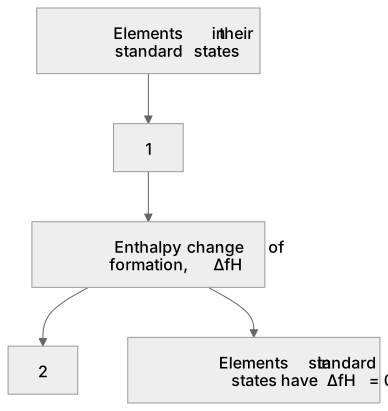
1Box 1
2Box 2
There is more to this lesson
The full lesson goes on to check your understanding and help you earn the marks. Create a free account to carry on, with your progress saved.
A week of Premium from your first lesson · Then the free plan continues · No card, no charge
Test your understanding of Enthalpy changes: (iii) enthalpy change of formation (formation of 1 mol of a compound from its elements, ∆fH)
Active recall beats re-reading. Take an instant quiz now to test what you’ve learned and lock it into long-term memory.
A week of Premium from your first lesson · Then the free plan continues · No card, no charge