OCR · A-Level · Chemistry
Course version: H432 · Version from Sept 2017
(ii) enthalpy change of reaction (enthalpy change associated with a stated…
Full specification wording
Enthalpy changes: (ii) enthalpy change of reaction (enthalpy change associated with a stated equation, ∆rH)
The enthalpy change of reaction, ∆rH, is the enthalpy change associated with a stated equation, with all species in their standard states and under standard conditions.
- Point 6 of 20
- 4 key terms
Study notes
From the teaching notes for this specification point.
The idea
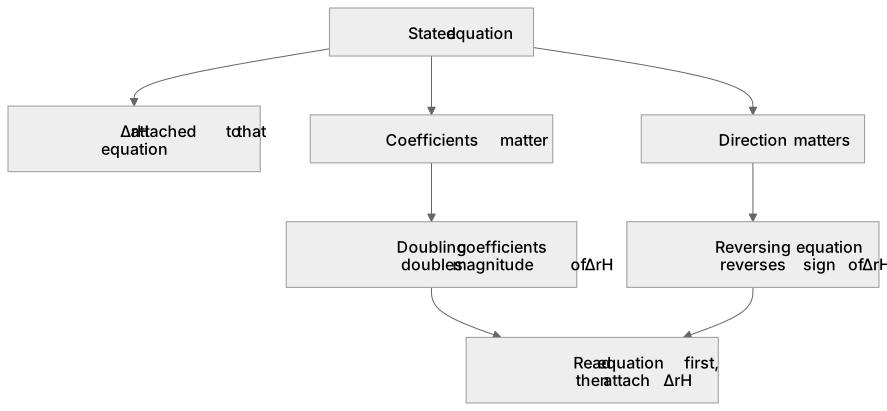
The enthalpy change of reaction, ∆rH, is the enthalpy change associated with a stated equation, with all species in their standard states and under standard conditions. Because the value depends on the equation as written, the same reaction can have different ∆rH values if the equation is scaled or reversed. For example, forming 2 mol of water from hydrogen and oxygen releases twice the energy of forming 1 mol, and reversing the equation reverses the sign. The symbol ∆rH is quoted per the equation as written, so the stoichiometric coefficients matter. When you compare or calculate ∆rH, always read the equation first: its coefficients and direction fix the magnitude and sign of the value.
What earns the marks
- Defines ∆rH as the enthalpy change associated with a stated equation.
- Explains that ∆rH depends on the equation as written, including its stoichiometric coefficients.
- States that reversing the equation reverses the sign of ∆rH.
- States that doubling the coefficients doubles the magnitude of ∆rH.
Common mistakes and how to put them right
Quotes ∆rH without reference to a specific equation.
Put it right by attaching the value to the stated equation.
Assumes ∆rH is fixed for a reaction regardless of how the equation is written.
Put it right by scaling or reversing the value with the equation.
Keeps the same sign when an equation is reversed.
Put it right by reversing the sign of ∆rH.
Exam tips
- Write the equation first, then attach the ∆rH value to it, so the coefficients are visible.
- Use the coefficients to scale a given ∆rH to a new equation before substituting into a calculation.
- Check the sign whenever you reverse an equation, since exothermic becomes endothermic and vice versa.
Try the lesson
The start of the Enthalpy changes: (ii) enthalpy change of reaction (enthalpy change associated with a stated equation, ∆rH) lesson, made from teaching notes for this specification point.
Listen
The enthalpy change of reaction, ∆rH, is the enthalpy change associated with a stated equation, with all species in their standard states and under standard conditions. Because the value depends on the equation as written, the same reaction can have different ∆rH values if the equation is scaled or reversed. For example, forming 2 mol of water from hydrogen and oxygen releases twice the energy of forming 1 mol, and reversing the equation reverses the sign. The symbol ∆rH is quoted per the equation as written, so the stoichiometric coefficients matter. When you compare or calculate ∆rH, always read the equation first: its coefficients and direction fix the magnitude and sign of the value. A strong answer earns marks for these points. Defines ∆rH as the enthalpy change associated with a stated equation. Explains that ∆rH depends on the equation as written, including its stoichiometric coefficients. States that reversing the equation reverses the sign of ∆rH. States that doubling the coefficients doubles the magnitude of ∆rH. A common slip: Quotes ∆rH without reference to a specific equation. Instead, attaching the value to the stated equation. Exam tip: Write the equation first, then attach the ∆rH value to it, so the coefficients are visible.
See it
Key words
Say what each word means before you turn the card.
Enthalpy change of reaction
Try answering aloud or in your head before turning the card.
Stated equation
Try answering aloud or in your head before turning the card.
Stoichiometric scaling
Try answering aloud or in your head before turning the card.
Sign conventions
Try answering aloud or in your head before turning the card.
See every definition
- Enthalpy change of reaction
- The enthalpy change associated with a stated equation, given the symbol ∆rH.
- Stated equation
- The equation as written, whose stoichiometric coefficients and direction fix the magnitude and sign of ∆rH.
- Stoichiometric scaling
- Doubling the coefficients doubles the magnitude of ∆rH, so the value depends on the equation as written.
- Sign conventions
- Reversing the equation reverses the sign of ∆rH, since exothermic becomes endothermic and vice versa.
Label the diagram
Some boxes have lost their names. Pick the right name for each number.
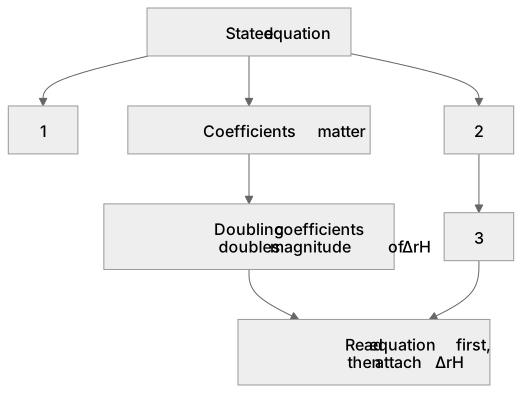
1Box 1
2Box 2
3Box 3
There is more to this lesson
The full lesson goes on to check your understanding and help you earn the marks. Create a free account to carry on, with your progress saved.
A week of Premium from your first lesson · Then the free plan continues · No card, no charge
Test your understanding of Enthalpy changes: (ii) enthalpy change of reaction (enthalpy change associated with a stated equation, ∆rH)
Active recall beats re-reading. Take an instant quiz now to test what you’ve learned and lock it into long-term memory.
A week of Premium from your first lesson · Then the free plan continues · No card, no charge