OCR · A-Level · Chemistry
Course version: H432 · Version from Sept 2017
Evaluation: (c) the limitations in experimental procedures
A limitation is a feature of a procedure that restricts how far the results can be trusted or how widely they apply, and evaluating it means naming the feature, explaining the effect on the data…
- Point 2 of 3
- 4 key terms
Study notes
From the teaching notes for this specification point.
The idea
A limitation is a feature of a procedure that restricts how far the results can be trusted or how widely they apply, and evaluating it means naming the feature, explaining the effect on the data and saying how the procedure could be improved. Typical limitations include heat loss to the surroundings in calorimetry, incomplete transfer of a solid or solution between vessels, side reactions, and a method that measures only one set of conditions. For example, a simple combustion calorimeter loses heat and does not condense water vapour, so the enthalpy change obtained is less exothermic than the true value. A good answer links each limitation to a direction of error and a realistic improvement rather than listing vague faults.
What earns the marks
- Identifies a specific feature of the stated procedure that restricts the reliability or validity of the results.
- Explains how that feature affects the measured quantity, including the direction of the effect where it is known.
- Distinguishes a limitation of the procedure from a random slip made by the operator.
- Suggests a realistic improvement that addresses the named limitation.
- Recognises that some limitations cannot be removed and only reduce the confidence in the conclusion.
Common mistakes and how to put them right
States a vague fault such as human error without naming the feature or its effect.
Put it right: Name the specific step and explain the consequence.
Treats an anomalous single reading as a limitation of the whole procedure.
Put it right: Separate an outlier from a systematic weakness in the method.
Claims an improvement without linking it to the limitation.
Put it right: Connect each change to the error it reduces.
Exam tips
- Read the stem carefully to see which procedure is described, then choose the option that names a feature and its effect rather than a general comment.
- Reject options that describe a calculation error when the question asks about the procedure itself.
- Check that any suggested improvement actually removes or reduces the stated limitation.
Try the lesson
The start of the Evaluation: (c) the limitations in experimental procedures lesson, made from teaching notes for this specification point.
Listen
A limitation is a feature of a procedure that restricts how far the results can be trusted or how widely they apply, and evaluating it means naming the feature, explaining the effect on the data and saying how the procedure could be improved. Typical limitations include heat loss to the surroundings in calorimetry, incomplete transfer of a solid or solution between vessels, side reactions, and a method that measures only one set of conditions. For example, a simple combustion calorimeter loses heat and does not condense water vapour, so the enthalpy change obtained is less exothermic than the true value. A good answer links each limitation to a direction of error and a realistic improvement rather than listing vague faults. A strong answer earns marks for these points. Identifies a specific feature of the stated procedure that restricts the reliability or validity of the results. Explains how that feature affects the measured quantity, including the direction of the effect where it is known. Distinguishes a limitation of the procedure from a random slip made by the operator. Suggests a realistic improvement that addresses the named limitation. Exam tip: Read the stem carefully to see which procedure is described, then choose the option that names a feature and its effect rather than a general comment.
See it
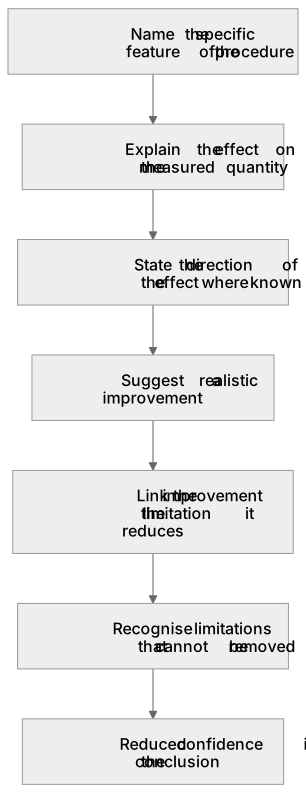
Put it in order
Put these steps in the order they happen.
- 1. Reduced confidence in the conclusion
- 2. Recognise limitations that cannot be removed
- 3. State the direction of the effect where known
- 4. Link the improvement to the limitation it reduces
- 5. Name the specific feature of the procedure
- 6. Explain the effect on the measured quantity
- 7. Suggest a realistic improvement
Key words
Say what each word means before you turn the card.
Limitation
Try answering aloud or in your head before turning the card.
Direction of error
Try answering aloud or in your head before turning the card.
Realistic improvement
Try answering aloud or in your head before turning the card.
Random slip
Try answering aloud or in your head before turning the card.
See every definition
- Limitation
- A feature of a procedure that restricts how far the results can be trusted or how widely they apply.
- Direction of error
- The way a named limitation affects the measured quantity, where it is known, such as an enthalpy change being less exothermic than the true value.
- Realistic improvement
- A change that addresses the named limitation and reduces the error it causes, rather than a vague fault.
- Random slip
- A slip made by the operator, which is distinguished from a limitation of the procedure.
Label the diagram
Some boxes have lost their names. Pick the right name for each number.
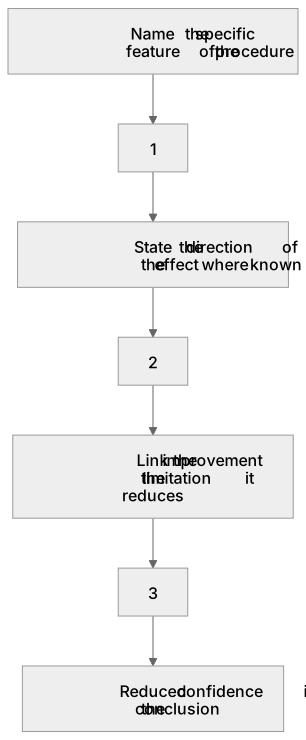
1Box 1
2Box 2
3Box 3
There is more to this lesson
The full lesson goes on to check your understanding and help you earn the marks. Create a free account to carry on, with your progress saved.
A week of Premium from your first lesson · Then the free plan continues · No card, no charge
Test your understanding of Evaluation: (c) the limitations in experimental procedures
Active recall beats re-reading. Take an instant quiz now to test what you’ve learned and lock it into long-term memory.
A week of Premium from your first lesson · Then the free plan continues · No card, no charge