OCR · A-Level · Chemistry
Course version: H432 · Version from Sept 2017
(a) the outer shell s² electron configuration and the loss of these…
Full specification wording
Group 2: (a) the outer shell s² electron configuration and the loss of these electrons in redox reactions to form 2+ ions
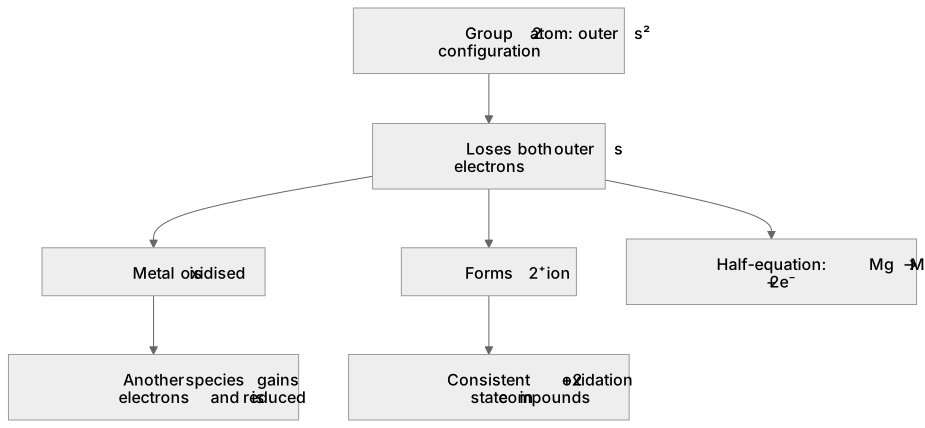
Group 2 elements (Mg, Ca, Sr, Ba) each have two electrons in their outer s subshell, written as an s² configuration such as [Ne] 3s² for magnesium or [Ar] 4s² for calcium.
- Point 2 of 11
- 4 key terms
Study notes
From the teaching notes for this specification point.
The idea
Group 2 elements (Mg, Ca, Sr, Ba) each have two electrons in their outer s subshell, written as an s² configuration such as [Ne] 3s² for magnesium or [Ar] 4s² for calcium. These two outer electrons are relatively easily removed because the resulting 2⁺ ion has a stable noble-gas configuration and the ionisation energies, though endothermic, are achievable in reactions. When a Group 2 atom reacts, it loses both outer s electrons and is itself oxidised, while another species gains electrons and is reduced. The product is a 2⁺ cation, for example Mg²⁺ or Ca²⁺, so the group consistently forms compounds in which the metal has oxidation state +2. Recognising this pattern lets you write formulae such as MgCl₂ and CaO and balance redox half-equations showing the metal losing two electrons.
What earns the marks
- States that Group 2 atoms have two electrons in the outer s subshell, giving an s² configuration.
- Explains that the metal loses both outer s electrons and is oxidised to a 2⁺ ion.
- Identifies the accompanying reduction of another species as the partner half of the redox reaction.
- Links the loss of two electrons to the consistent +2 oxidation state in Group 2 compounds.
- Writes a correct half-equation such as Mg → Mg²⁺ + 2e⁻ for the oxidation step.
Common mistakes and how to put them right
Claims the outer electrons are in a p subshell.
Put it right by stating the two outer electrons occupy an s subshell, giving s².
Says the metal gains electrons to form a 2⁺ ion.
Put it right by stating the metal loses two electrons and is oxidised.
Writes the ion charge as a postfix numeral.
Put it right by using the superscript form such as Mg²⁺ and Ca²⁺.
Exam tips
- Read the question carefully to see whether it asks about configuration, the redox change, or the ion formed, and answer that specific point.
- When writing half-equations, check that charge and atoms balance and that electrons appear on the product side for oxidation.
- Use the noble-gas shorthand to show the outer s² electrons clearly, for example [Ne] 3s² for magnesium.
Try the lesson
The start of the Group 2: (a) the outer shell s² electron configuration and the loss of these electrons in redox reactions to form 2+ ions lesson, made from teaching notes for this specification point.
Listen
Group 2 elements (Mg, Ca, Sr, Ba) each have two electrons in their outer s subshell, written as an s² configuration such as [Ne] 3s² for magnesium or [Ar] 4s² for calcium. These two outer electrons are relatively easily removed because the resulting 2⁺ ion has a stable noble-gas configuration and the ionisation energies, though endothermic, are achievable in reactions. When a Group 2 atom reacts, it loses both outer s electrons and is itself oxidised, while another species gains electrons and is reduced. The product is a 2⁺ cation, for example Mg²⁺ or Ca²⁺, so the group consistently forms compounds in which the metal has oxidation state +2. Recognising this pattern lets you write formulae such as MgCl₂ and CaO and balance redox half-equations showing the metal losing two electrons. A strong answer earns marks for these points. States that Group 2 atoms have two electrons in the outer s subshell, giving an s² configuration. Explains that the metal loses both outer s electrons and is oxidised to a 2⁺ ion. Identifies the accompanying reduction of another species as the partner half of the redox reaction. Links the loss of two electrons to the consistent +2 oxidation state in Group 2 compounds. A common slip: Claims the outer electrons are in a p subshell. Instead, stating the two outer electrons occupy an s subshell, giving s². Exam tip: Read the question carefully to see whether it asks about configuration, the redox change, or the ion formed, and answer that specific point.
See it
Key words
Say what each word means before you turn the card.
Outer shell s² configuration of Group 2 elements
Try answering aloud or in your head before turning the card.
Loss of outer s electrons as oxidation
Try answering aloud or in your head before turning the card.
Formation of 2⁺ ions
Try answering aloud or in your head before turning the card.
Redox pairing of oxidation and reduction
Try answering aloud or in your head before turning the card.
See every definition
- Outer shell s² configuration of Group 2 elements
- Each Group 2 atom has two electrons in its outer s subshell, giving an s² configuration such as [Ne] 3s² for magnesium.
- Loss of outer s electrons as oxidation
- When a Group 2 atom reacts, it loses both outer s electrons and is itself oxidised.
- Formation of 2⁺ ions
- The product of the loss of both outer s electrons is a 2⁺ cation, for example Mg²⁺ or Ca²⁺.
- Redox pairing of oxidation and reduction
- While the Group 2 metal is oxidised, another species gains electrons and is reduced, as the partner half of the redox reaction.
Label the diagram
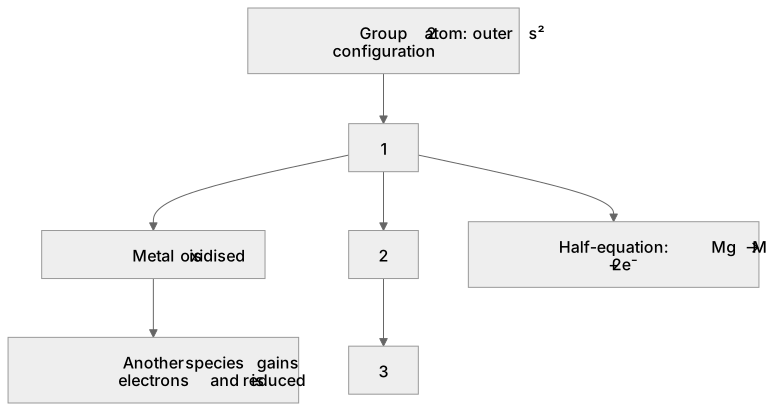
Some boxes have lost their names. Pick the right name for each number.
1Box 1
2Box 2
3Box 3
There is more to this lesson
The full lesson goes on to check your understanding and help you earn the marks. Create a free account to carry on, with your progress saved.
A week of Premium from your first lesson · Then the free plan continues · No card, no charge
Test your understanding of Group 2: (a) the outer shell s² electron configuration and the loss of these electrons in redox reactions to form 2+ ions
Active recall beats re-reading. Take an instant quiz now to test what you’ve learned and lock it into long-term memory.
A week of Premium from your first lesson · Then the free plan continues · No card, no charge