OCR · A-Level · Chemistry
Course version: H432 · Version from Sept 2017
Group 2: Redox reactions and reactivity of Group 2 metals
Group 2 metals (Mg, Ca, Sr, Ba) react by losing two outer electrons to form 2⁺ ions, so they act as reducing agents and are oxidised from oxidation state 0 to 2⁺.
- Point 1 of 11
- 4 key terms
Study notes
From the teaching notes for this specification point.
The idea
Group 2 metals (Mg, Ca, Sr, Ba) react by losing two outer electrons to form 2⁺ ions, so they act as reducing agents and are oxidised from oxidation state 0 to 2⁺. Reactivity increases down the group because the first and second ionisation energies decrease as atomic radius increases and shielding grows, so the outer electrons are lost more readily. They react with oxygen to form oxides, with water to form hydroxides and hydrogen, and with dilute acids to form salts and hydrogen. In each case the metal is oxidised and another species is reduced, for example hydrogen in water or acid is reduced from 1⁺ to 0. Solubility of hydroxides increases down the group while solubility of sulfates decreases.
What earns the marks
- Identifies Group 2 metals as reducing agents that are oxidised from oxidation state 0 to 2⁺ by losing two electrons.
- Explains that reactivity increases down the group because ionisation energies decrease as atomic radius and shielding increase.
- Describes the reaction with water as producing a metal hydroxide and hydrogen, with the metal oxidised and hydrogen reduced.
- States that the metal reacts with oxygen to form the oxide and with dilute acid to form a salt and hydrogen.
- Recognises that hydroxide solubility increases and sulfate solubility decreases down Group 2.
Common mistakes and how to put them right
Describes Group 2 metals as oxidising agents.
Put it right by identifying them as reducing agents that are themselves oxidised.
Claims reactivity decreases down the group.
Put it right by linking increasing reactivity to decreasing ionisation energy.
States that hydrogen is oxidised when a Group 2 metal reacts with water.
Put it right by showing hydrogen is reduced from 1⁺ to 0.
Assumes all Group 2 hydroxides are insoluble.
Put it right by noting solubility increases down the group.
Exam tips
- Write the ionic equation and assign oxidation states to confirm which species is oxidised and which is reduced.
- Link reactivity trends explicitly to ionisation energy, atomic radius and shielding rather than to mass alone.
- Check the formula of the hydroxide or sulfate against the 2⁺ charge on the Group 2 ion before selecting an answer.
Try the lesson
The start of the Group 2: Redox reactions and reactivity of Group 2 metals lesson, made from teaching notes for this specification point.
Listen
Group 2 metals (Mg, Ca, Sr, Ba) react by losing two outer electrons to form 2⁺ ions, so they act as reducing agents and are oxidised from oxidation state 0 to 2⁺. Reactivity increases down the group because the first and second ionisation energies decrease as atomic radius increases and shielding grows, so the outer electrons are lost more readily. They react with oxygen to form oxides, with water to form hydroxides and hydrogen, and with dilute acids to form salts and hydrogen. In each case the metal is oxidised and another species is reduced, for example hydrogen in water or acid is reduced from 1⁺ to 0. Solubility of hydroxides increases down the group while solubility of sulfates decreases. A strong answer earns marks for these points. Identifies Group 2 metals as reducing agents that are oxidised from oxidation state 0 to 2⁺ by losing two electrons. Explains that reactivity increases down the group because ionisation energies decrease as atomic radius and shielding increase. Describes the reaction with water as producing a metal hydroxide and hydrogen, with the metal oxidised and hydrogen reduced. States that the metal reacts with oxygen to form the oxide and with dilute acid to form a salt and hydrogen. A common slip: Describes Group 2 metals as oxidising agents. Instead, identifying them as reducing agents that are themselves oxidised. Exam tip: Write the ionic equation and assign oxidation states to confirm which species is oxidised and which is reduced.
See it
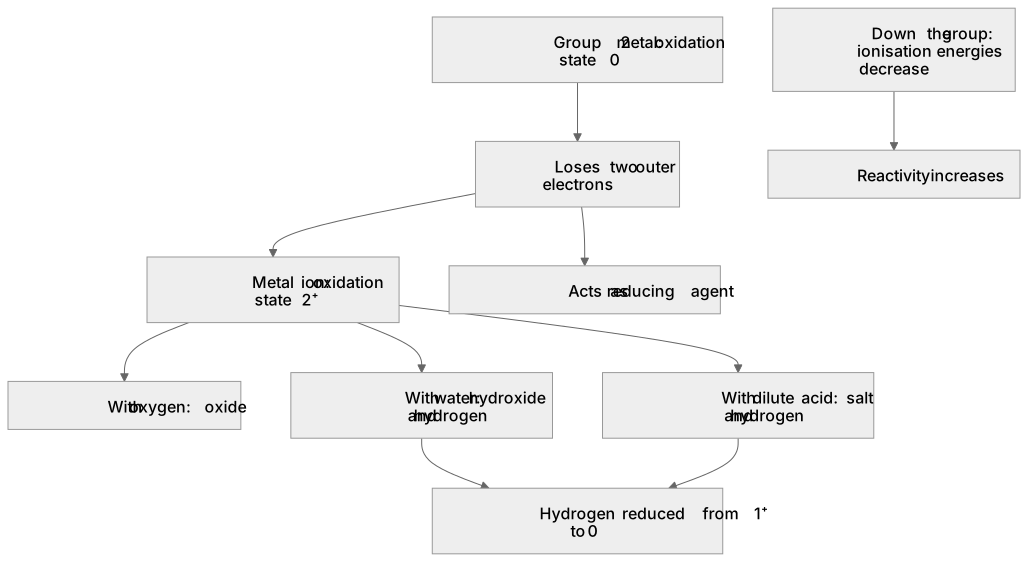
Key words
Say what each word means before you turn the card.
Redox and oxidation states
Try answering aloud or in your head before turning the card.
Group 2 reactivity trends
Try answering aloud or in your head before turning the card.
Reactions with water, oxygen and acids
Try answering aloud or in your head before turning the card.
Solubility trends of hydroxides and sulfates
Try answering aloud or in your head before turning the card.
See every definition
- Redox and oxidation states
- Group 2 metals act as reducing agents and are oxidised from oxidation state 0 to 2⁺ by losing two electrons, while another species is reduced.
- Group 2 reactivity trends
- Reactivity increases down the group because the first and second ionisation energies decrease as atomic radius increases and shielding grows, so the outer electrons are lost more readily.
- Reactions with water, oxygen and acids
- The metals react with oxygen to form oxides, with water to form hydroxides and hydrogen, and with dilute acids to form salts and hydrogen.
- Solubility trends of hydroxides and sulfates
- Solubility of hydroxides increases down the group while solubility of sulfates decreases.
Label the diagram
Some boxes have lost their names. Pick the right name for each number.
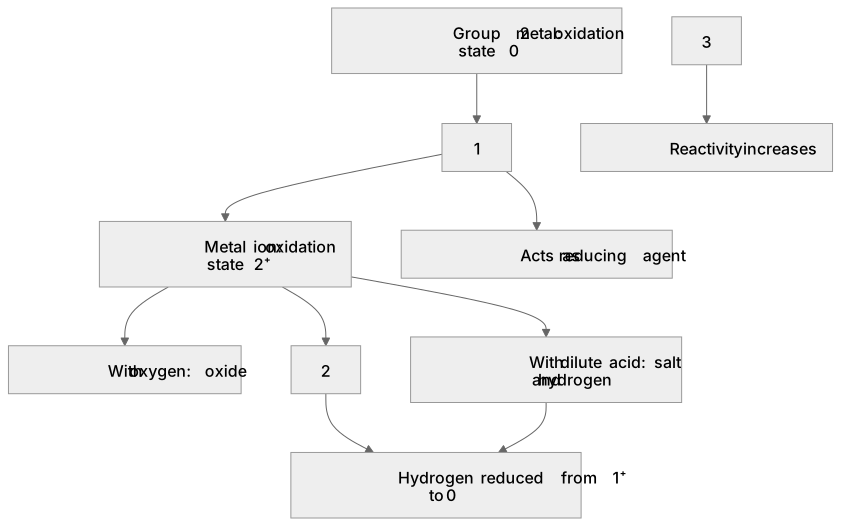
1Box 1
2Box 2
3Box 3
There is more to this lesson
The full lesson goes on to check your understanding and help you earn the marks. Create a free account to carry on, with your progress saved.
A week of Premium from your first lesson · Then the free plan continues · No card, no charge
Test your understanding of Group 2: Redox reactions and reactivity of Group 2 metals
Active recall beats re-reading. Take an instant quiz now to test what you’ve learned and lock it into long-term memory.
A week of Premium from your first lesson · Then the free plan continues · No card, no charge