OCR · A-Level · Chemistry
Course version: H432 · Version from Sept 2017
(c) the trend in reactivity in terms of the first and second ionisation…
Full specification wording
Group 2: (c) the trend in reactivity in terms of the first and second ionisation energies of Group 2 elements down the group (see also 3.1.1 c)
This clause asks learners to explain why Group 2 metals become more reactive down the group using first and second ionisation energies.
- Point 7 of 11
- 4 key terms
Study notes
From the teaching notes for this specification point.
The idea
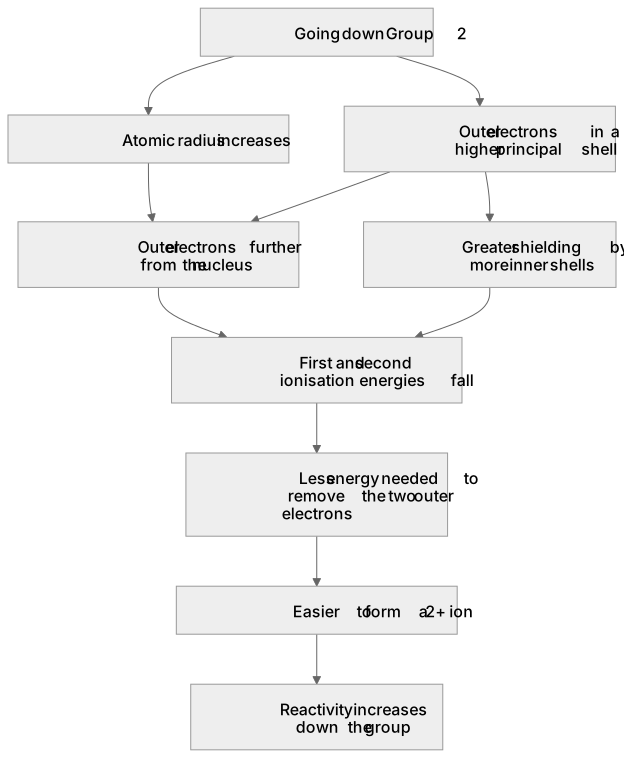
This clause asks learners to explain why Group 2 metals become more reactive down the group using first and second ionisation energies. Going down the group, atomic radius increases and the outer electrons sit in a higher principal shell, so they are further from the nucleus and more shielded. Both the first and second ionisation energies therefore fall, meaning less energy is needed to remove the two outer electrons to form a 2⁺ ion. For example, magnesium has higher first and second ionisation energies than calcium, so calcium loses its two electrons more readily and reacts more vigorously. Learners should link the falling ionisation energies to the greater ease of forming the 2⁺ ion and hence the increased reactivity.
What earns the marks
- States that first and second ionisation energies both decrease down Group 2.
- Explains the decrease by the increasing atomic radius and greater distance of outer electrons from the nucleus.
- Explains the decrease by increased shielding of the outer electrons by more inner shells.
- Links lower ionisation energies to easier removal of two electrons to form a 2⁺ ion.
- Concludes that greater ease of forming the 2⁺ ion makes the metal more reactive down the group.
- Compares two named elements, for example that calcium has lower first and second ionisation energies than magnesium.
Common mistakes and how to put them right
Claims ionisation energy increases down the group.
Put it right: State that both first and second ionisation energies decrease.
Explains the trend only by increasing nuclear charge.
Put it right: Note that increased distance and shielding outweigh the extra protons.
Says reactivity decreases down the group.
Put it right: Conclude that reactivity increases as ionisation energies fall.
Exam tips
- Name both first and second ionisation energies explicitly in your answer.
- Use the words distance, shielding and nuclear attraction to structure the explanation.
- Finish by linking the ionisation energy change to ease of forming the 2⁺ ion and to reactivity.
Try the lesson
The start of the Group 2: (c) the trend in reactivity in terms of the first and second ionisation energies of Group 2 elements down the group (see also 3.1.1 c) lesson, made from teaching notes for this specification point.
Listen
This clause asks learners to explain why Group 2 metals become more reactive down the group using first and second ionisation energies. Going down the group, atomic radius increases and the outer electrons sit in a higher principal shell, so they are further from the nucleus and more shielded. Both the first and second ionisation energies therefore fall, meaning less energy is needed to remove the two outer electrons to form a 2⁺ ion. For example, magnesium has higher first and second ionisation energies than calcium, so calcium loses its two electrons more readily and reacts more vigorously. Learners should link the falling ionisation energies to the greater ease of forming the 2⁺ ion and hence the increased reactivity. A strong answer earns marks for these points. States that first and second ionisation energies both decrease down Group 2. Explains the decrease by the increasing atomic radius and greater distance of outer electrons from the nucleus. Explains the decrease by increased shielding of the outer electrons by more inner shells. Links lower ionisation energies to easier removal of two electrons to form a 2⁺ ion. Exam tip: Name both first and second ionisation energies explicitly in your answer.
See it
Key words
Say what each word means before you turn the card.
First and second ionisation energies
Try answering aloud or in your head before turning the card.
Atomic radius and shielding down Group 2
Try answering aloud or in your head before turning the card.
Formation of 2⁺ ions
Try answering aloud or in your head before turning the card.
Reactivity trends down Group 2
Try answering aloud or in your head before turning the card.
See every definition
- First and second ionisation energies
- Both decrease down Group 2, meaning less energy is needed to remove the two outer electrons.
- Atomic radius and shielding down Group 2
- Going down the group, atomic radius increases and the outer electrons sit in a higher principal shell, so they are further from the nucleus and more shielded.
- Formation of 2⁺ ions
- Lower ionisation energies mean easier removal of two electrons to form a 2⁺ ion, making the metal more reactive down the group.
- Reactivity trends down Group 2
- Reactivity increases as ionisation energies fall, so the metal loses its two electrons more readily and reacts more vigorously.
Label the diagram
Some boxes have lost their names. Pick the right name for each number.
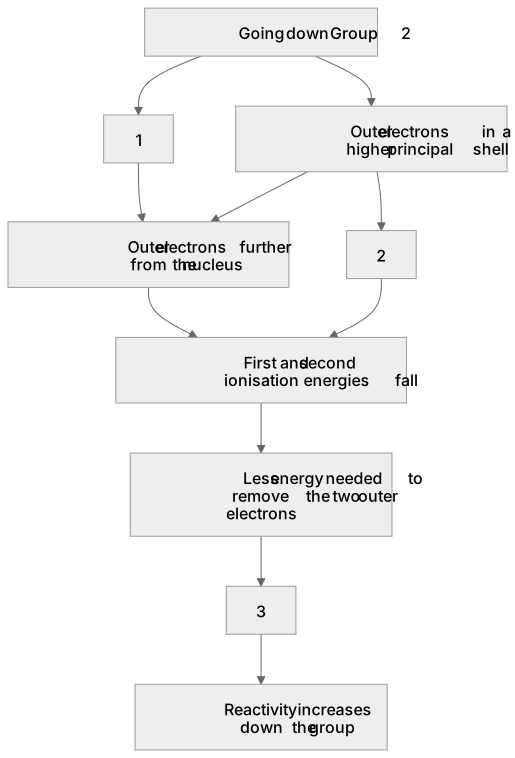
1Box 1
2Box 2
3Box 3
There is more to this lesson
The full lesson goes on to check your understanding and help you earn the marks. Create a free account to carry on, with your progress saved.
A week of Premium from your first lesson · Then the free plan continues · No card, no charge
Test your understanding of Group 2: (c) the trend in reactivity in terms of the first and second ionisation energies of Group 2 elements down the group (see also 3.1.1 c)
Active recall beats re-reading. Take an instant quiz now to test what you’ve learned and lock it into long-term memory.
A week of Premium from your first lesson · Then the free plan continues · No card, no charge