OCR · A-Level · Chemistry
Course version: H432 · Version from Sept 2017
Group 2: (iii) dilute acids
This clause sits inside the Group 2 reactions list, so the assessed skill is predicting and describing how Group 2 metals react with dilute acids.
- Point 6 of 11
- 4 key terms
Study notes
From the teaching notes for this specification point.
The idea
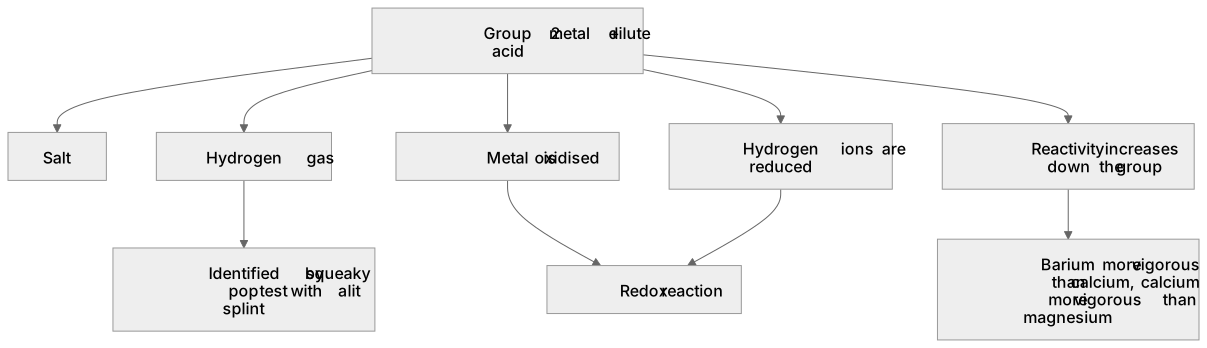
This clause sits inside the Group 2 reactions list, so the assessed skill is predicting and describing how Group 2 metals react with dilute acids. A Group 2 metal such as magnesium reacts with a dilute acid such as hydrochloric acid to give a salt and hydrogen gas, for example Mg(s) + 2HCl(aq) → MgCl₂(aq) + H₂(g). The metal is oxidised and the hydrogen ions in the acid are reduced, so the reaction is a redox process as well as a displacement of hydrogen. Reactivity increases down the group, so barium reacts more vigorously than calcium and calcium more vigorously than magnesium, matching the trend in first and second ionisation energies. Learners should balance equations, name the salt formed from the acid used, and identify the gas by its test.
What earns the marks
- States that a Group 2 metal reacts with a dilute acid to form a salt and hydrogen gas.
- Writes a correctly balanced equation such as Mg + 2HCl → MgCl₂ + H₂.
- Names the salt produced from the specific acid given, for example magnesium sulfate from dilute sulfuric acid.
- Identifies hydrogen as the gas evolved, for example by the squeaky pop test with a lit splint.
- Explains that the metal is oxidised and hydrogen ions are reduced, so the reaction is redox.
- Links the vigour of the reaction to the increasing reactivity of Group 2 metals down the group.
Common mistakes and how to put them right
Writes hydrogen as the only product and omits the salt.
Put it right: Include both the salt and hydrogen in the equation.
Uses an unbalanced equation such as Mg + HCl → MgCl₂ + H₂.
Put it right: Balance the atoms so both sides match.
Claims a Group 2 metal reacts with acid to give carbon dioxide.
Put it right: State that hydrogen is evolved instead.
Assumes all Group 2 metals react at the same rate.
Put it right: Note that reactivity increases down the group.
Exam tips
- Read the acid named in the question and derive the salt from it rather than defaulting to a chloride.
- Balance the equation and check the state symbols before moving on.
- Link any question about rate or vigour back to the ionisation energy trend down Group 2.
Try the lesson
The start of the Group 2: (iii) dilute acids lesson, made from teaching notes for this specification point.
Listen
This clause sits inside the Group 2 reactions list, so the assessed skill is predicting and describing how Group 2 metals react with dilute acids. A Group 2 metal such as magnesium reacts with a dilute acid such as hydrochloric acid to give a salt and hydrogen gas, for example Mg(s) + 2HCl(aq) → MgCl₂(aq) + H₂(g). The metal is oxidised and the hydrogen ions in the acid are reduced, so the reaction is a redox process as well as a displacement of hydrogen. Reactivity increases down the group, so barium reacts more vigorously than calcium and calcium more vigorously than magnesium, matching the trend in first and second ionisation energies. Learners should balance equations, name the salt formed from the acid used, and identify the gas by its test. A strong answer earns marks for these points. States that a Group 2 metal reacts with a dilute acid to form a salt and hydrogen gas. Writes a correctly balanced equation such as Mg + 2HCl → MgCl₂ + H₂. Names the salt produced from the specific acid given, for example magnesium sulfate from dilute sulfuric acid. Identifies hydrogen as the gas evolved, for example by the squeaky pop test with a lit splint. Exam tip: Read the acid named in the question and derive the salt from it rather than defaulting to a chloride.
See it
Key words
Say what each word means before you turn the card.
Salt and hydrogen formation
Try answering aloud or in your head before turning the card.
Balancing equations and state symbols
Try answering aloud or in your head before turning the card.
Redox and reactivity trends
Try answering aloud or in your head before turning the card.
Group 2 reactions with dilute acids
Try answering aloud or in your head before turning the card.
See every definition
- Salt and hydrogen formation
- A Group 2 metal reacts with a dilute acid to give a salt and hydrogen gas.
- Balancing equations and state symbols
- Equations must be balanced so the atoms match on both sides, with correct state symbols checked before moving on.
- Redox and reactivity trends
- The metal is oxidised and the hydrogen ions in the acid are reduced, and reactivity increases down the group.
- Group 2 reactions with dilute acids
- The assessed skill is predicting and describing how Group 2 metals react with dilute acids, naming the salt formed from the acid used and identifying the gas by its test.
Label the diagram
Some boxes have lost their names. Pick the right name for each number.
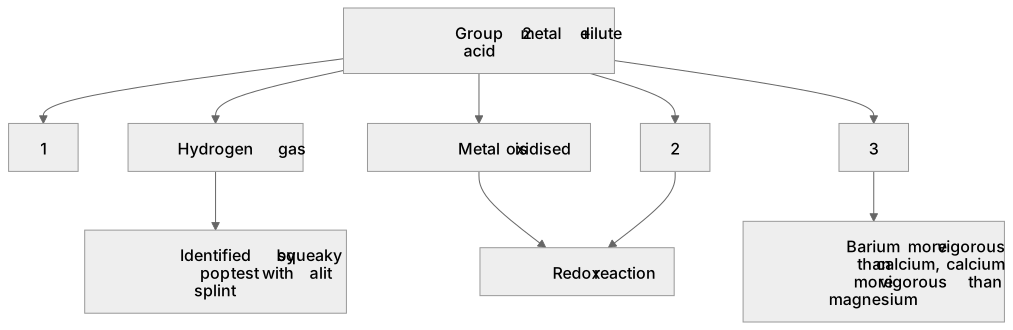
1Box 1
2Box 2
3Box 3
There is more to this lesson
The full lesson goes on to check your understanding and help you earn the marks. Create a free account to carry on, with your progress saved.
A week of Premium from your first lesson · Then the free plan continues · No card, no charge
Test your understanding of Group 2: (iii) dilute acids
Active recall beats re-reading. Take an instant quiz now to test what you’ve learned and lock it into long-term memory.
A week of Premium from your first lesson · Then the free plan continues · No card, no charge