OCR · A-Level · Chemistry
Course version: H432 · Version from Sept 2017
Haloalkanes: (a) hydrolysis of haloalkanes in a substitution reaction:
Hydrolysis of a haloalkane is nucleophilic substitution: the halogen is replaced by a nucleophile and the C–X bond breaks.
- Point 2 of 11
- 4 key terms
Study notes
From the teaching notes for this specification point.
The idea
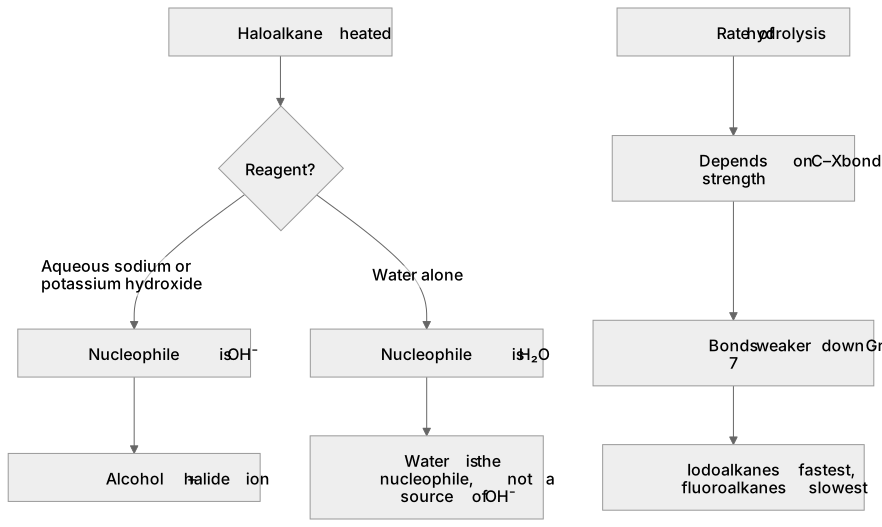
Hydrolysis of a haloalkane is nucleophilic substitution: the halogen is replaced by a nucleophile and the C–X bond breaks. The nucleophile depends on the reagent. With aqueous sodium or potassium hydroxide, warm, the nucleophile is the hydroxide ion, OH⁻, and the product is an alcohol plus the halide ion. With water alone, the nucleophile is a water molecule, H₂O, which attacks the carbon and later loses a proton, so water is the nucleophile and not a source of OH⁻. The rate depends on the C–X bond strength, which falls down Group 7 as bonds get weaker, so iodoalkanes hydrolyse fastest and fluoroalkanes slowest. Primary haloalkanes react mainly by SN2, tertiary mainly by SN1.
What earns the marks
- Identifies the reaction as nucleophilic substitution in which the halogen atom is replaced by a nucleophile.
- States that aqueous hydroxide, OH⁻, is the nucleophile when aqueous sodium or potassium hydroxide is used, giving an alcohol and a halide ion.
- States that water, H₂O, is the nucleophile when the haloalkane is heated with water alone, rather than hydroxide ions.
- Explains that the rate of hydrolysis increases down Group 7 because the carbon–halogen bond becomes weaker and easier to break.
Common mistakes and how to put them right
Claims that water supplies hydroxide ions as the nucleophile.
Put it right: State that water itself is the nucleophile and that OH⁻ comes from aqueous alkali.
Treats hydrolysis as an addition reaction.
Put it right: Describe it as substitution in which the halogen is replaced.
Assumes all haloalkanes hydrolyse at the same rate.
Put it right: Link the rate to carbon–halogen bond strength down the group.
Exam tips
- Name the nucleophile explicitly for the reagent given, distinguishing aqueous alkali from water alone.
- Write the equation with the haloalkane, the nucleophile and both products, balancing the halide ion.
- Justify any rate comparison by referring to carbon–halogen bond strength and bond enthalpy down Group 7.
Try the lesson
The start of the Haloalkanes: (a) hydrolysis of haloalkanes in a substitution reaction: lesson, made from teaching notes for this specification point.
Listen
Hydrolysis of a haloalkane is nucleophilic substitution: the halogen is replaced by a nucleophile and the C–X bond breaks. The nucleophile depends on the reagent. With aqueous sodium or potassium hydroxide, warm, the nucleophile is the hydroxide ion, OH⁻, and the product is an alcohol plus the halide ion. With water alone, the nucleophile is a water molecule, H₂O, which attacks the carbon and later loses a proton, so water is the nucleophile and not a source of OH⁻. The rate depends on the C–X bond strength, which falls down Group 7 as bonds get weaker, so iodoalkanes hydrolyse fastest and fluoroalkanes slowest. Primary haloalkanes react mainly by SN2, tertiary mainly by SN1. A strong answer earns marks for these points. Identifies the reaction as nucleophilic substitution in which the halogen atom is replaced by a nucleophile. States that aqueous hydroxide, OH⁻, is the nucleophile when aqueous sodium or potassium hydroxide is used, giving an alcohol and a halide ion. States that water, H₂O, is the nucleophile when the haloalkane is heated with water alone, rather than hydroxide ions. Explains that the rate of hydrolysis increases down Group 7 because the carbon–halogen bond becomes weaker and easier to break. Exam tip: Name the nucleophile explicitly for the reagent given, distinguishing aqueous alkali from water alone.
See it
Key words
Say what each word means before you turn the card.
Nucleophilic substitution
Try answering aloud or in your head before turning the card.
Hydrolysis of haloalkanes
Try answering aloud or in your head before turning the card.
Nucleophile identity and reagents
Try answering aloud or in your head before turning the card.
Bond strength and reactivity down Group 7
Try answering aloud or in your head before turning the card.
See every definition
- Nucleophilic substitution
- A reaction in which the halogen atom of a haloalkane is replaced by a nucleophile and the carbon–halogen bond breaks.
- Hydrolysis of haloalkanes
- A substitution reaction in which a haloalkane is heated with aqueous sodium or potassium hydroxide, or with water alone, giving an alcohol and a halide ion.
- Nucleophile identity and reagents
- The nucleophile depends on the reagent: with aqueous sodium or potassium hydroxide the nucleophile is the hydroxide ion, OH⁻, while with water alone it is a water molecule, H₂O.
- Bond strength and reactivity down Group 7
- The rate of hydrolysis increases down Group 7 because the carbon–halogen bond becomes weaker and easier to break, so iodoalkanes hydrolyse fastest and fluoroalkanes slowest.
There is more to this lesson
The full lesson goes on to check your understanding and help you earn the marks. Create a free account to carry on, with your progress saved.
A week of Premium from your first lesson · Then the free plan continues · No card, no charge
Test your understanding of Haloalkanes: (a) hydrolysis of haloalkanes in a substitution reaction:
Active recall beats re-reading. Take an instant quiz now to test what you’ve learned and lock it into long-term memory.
A week of Premium from your first lesson · Then the free plan continues · No card, no charge