OCR · A-Level · Chemistry
Course version: H432 · Version from Sept 2017
Haloalkanes: (i) by aqueous alkali
A haloalkane is hydrolysed by aqueous alkali in a nucleophilic substitution.
- Point 3 of 11
- 4 key terms
Study notes
From the teaching notes for this specification point.
The idea
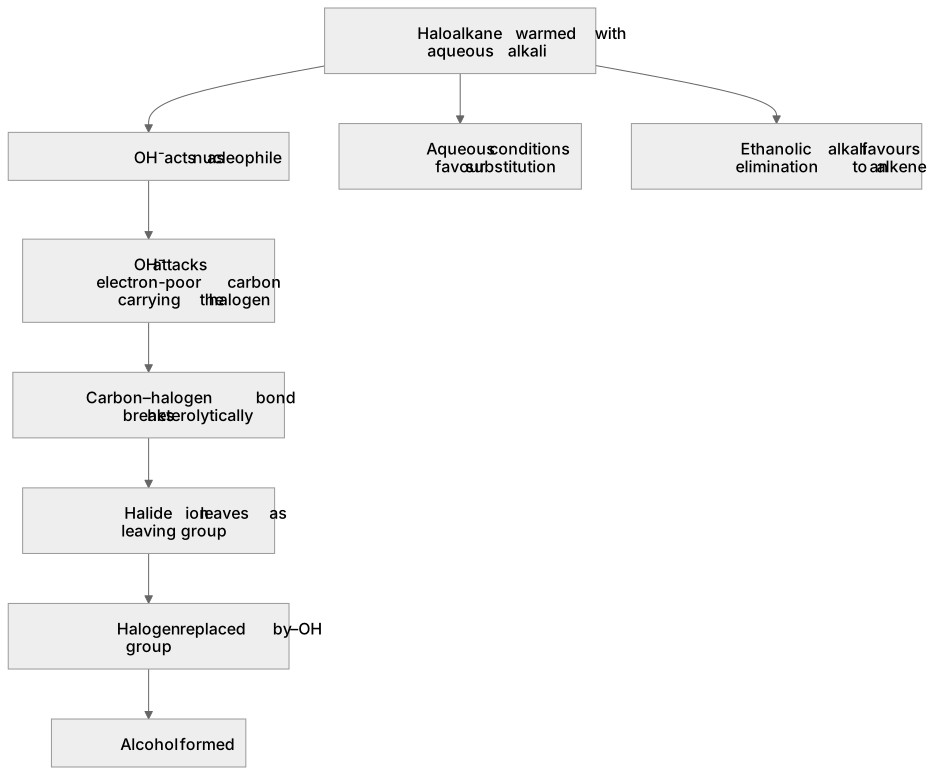
A haloalkane is hydrolysed by aqueous alkali in a nucleophilic substitution. Warm the haloalkane with aqueous sodium hydroxide or potassium hydroxide; the hydroxide ion, OH⁻, is the nucleophile and attacks the electron-poor carbon that carries the halogen. The carbon–halogen bond breaks heterolytically and the halide ion leaves. With a primary haloalkane the main organic product is a primary alcohol, for example bromoethane with aqueous NaOH gives ethanol and NaBr. The reaction is slow at room temperature, so heating under reflux is used. Aqueous conditions matter: if the alkali is dissolved in ethanol the dominant pathway becomes elimination, giving an alkene. Recognise that the halogen is replaced, not removed to leave a bare carbon, and that the hydroxide supplies the new O–H group of the alcohol.
What earns the marks
- Identifies hydroxide ions, OH⁻, from the aqueous alkali as the nucleophile that attacks the carbon bonded to the halogen.
- States that the halogen atom is replaced by an –OH group so the organic product is an alcohol.
- Describes the carbon–halogen bond breaking and the halide ion being released as the leaving group.
- Recognises that aqueous conditions favour substitution, whereas ethanolic alkali favours elimination to an alkene.
- Applies the reaction to a named example, such as bromoethane with aqueous NaOH forming ethanol and sodium bromide.
Common mistakes and how to put them right
Names the hydroxide ion as an electrophile.
Put it right by describing OH⁻ as a nucleophile that donates a lone pair to the electron-poor carbon.
Claims the halogen stays attached while an –OH is added elsewhere.
Put it right by stating the halogen is substituted and leaves as a halide ion.
Treats aqueous and ethanolic alkali as interchangeable.
Put it right by linking aqueous alkali to substitution and ethanolic alkali to elimination.
Exam tips
- Write the nucleophile explicitly as OH⁻ and say which atom it attacks.
- Give a balanced equation or displayed structure for one named haloalkane to show the substitution clearly.
- Contrast aqueous with ethanolic conditions in one sentence so the role of the solvent is visible.
Try the lesson
The start of the Haloalkanes: (i) by aqueous alkali lesson, made from teaching notes for this specification point.
Listen
A haloalkane is hydrolysed by aqueous alkali in a nucleophilic substitution. Warm the haloalkane with aqueous sodium hydroxide or potassium hydroxide; the hydroxide ion, OH⁻, is the nucleophile and attacks the electron-poor carbon that carries the halogen. The carbon–halogen bond breaks heterolytically and the halide ion leaves. With a primary haloalkane the main organic product is a primary alcohol, for example bromoethane with aqueous NaOH gives ethanol and NaBr. The reaction is slow at room temperature, so heating under reflux is used. Aqueous conditions matter: if the alkali is dissolved in ethanol the dominant pathway becomes elimination, giving an alkene. Recognise that the halogen is replaced, not removed to leave a bare carbon, and that the hydroxide supplies the new O–H group of the alcohol. A strong answer earns marks for these points. Identifies hydroxide ions, OH⁻, from the aqueous alkali as the nucleophile that attacks the carbon bonded to the halogen. States that the halogen atom is replaced by an –OH group so the organic product is an alcohol. Describes the carbon–halogen bond breaking and the halide ion being released as the leaving group. Recognises that aqueous conditions favour substitution, whereas ethanolic alkali favours elimination to an alkene. A common slip: Names the hydroxide ion as an electrophile. Instead, describing OH⁻ as a nucleophile that donates a lone pair to the electron-poor carbon. Exam tip: Write the nucleophile explicitly as OH⁻ and say which atom it attacks.
See it
Key words
Say what each word means before you turn the card.
Nucleophilic substitution of haloalkanes
Try answering aloud or in your head before turning the card.
Role of aqueous alkali as a source of OH⁻
Try answering aloud or in your head before turning the card.
Substitution versus elimination controlled by solvent
Try answering aloud or in your head before turning the card.
Formation of alcohols from haloalkanes
Try answering aloud or in your head before turning the card.
See every definition
- Nucleophilic substitution of haloalkanes
- A reaction in which the hydroxide ion, OH⁻, acts as the nucleophile and attacks the electron-poor carbon that carries the halogen, so the halogen is replaced.
- Role of aqueous alkali as a source of OH⁻
- Aqueous sodium hydroxide or potassium hydroxide supplies the hydroxide ion, OH⁻, which is the nucleophile that attacks the carbon bonded to the halogen.
- Substitution versus elimination controlled by solvent
- Aqueous conditions favour substitution, whereas if the alkali is dissolved in ethanol the dominant pathway becomes elimination, giving an alkene.
- Formation of alcohols from haloalkanes
- With a primary haloalkane the main organic product is a primary alcohol, as the hydroxide supplies the new O–H group, for example bromoethane with aqueous NaOH gives ethanol and NaBr.
Label the diagram
Some boxes have lost their names. Pick the right name for each number.
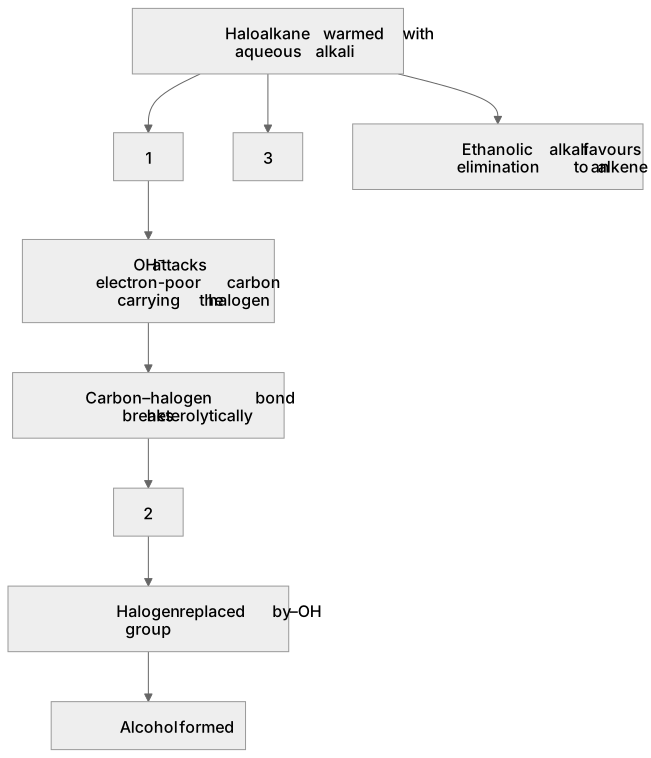
1Box 1
2Box 2
3Box 3
There is more to this lesson
The full lesson goes on to check your understanding and help you earn the marks. Create a free account to carry on, with your progress saved.
A week of Premium from your first lesson · Then the free plan continues · No card, no charge
Test your understanding of Haloalkanes: (i) by aqueous alkali
Active recall beats re-reading. Take an instant quiz now to test what you’ve learned and lock it into long-term memory.
A week of Premium from your first lesson · Then the free plan continues · No card, no charge