OCR · A-Level · Chemistry
Course version: H432 · Version from Sept 2017
Haloalkanes: (i) the production of halogen radicals
Halogen radicals form when a halogen-containing molecule absorbs enough energy to break a carbon–halogen bond.
- Point 10 of 11
- 4 key terms
Study notes
From the teaching notes for this specification point.
The idea
Halogen radicals form when a halogen-containing molecule absorbs enough energy to break a carbon–halogen bond. In the upper atmosphere, ultraviolet radiation provides this energy, and the bond breaks by homolytic fission so that each atom takes one electron from the shared pair. For a CFC such as CF₂Cl₂, the equation is CF₂Cl₂ → CF₂Cl• + Cl•. The key features are the energy source (UV), the type of fission (homolytic) and the products (two radicals, each shown with a dot). A correct answer recognises that radicals are species with an unpaired electron and that the C–Cl bond is the one broken in CFCs.
What earns the marks
- States that ultraviolet radiation supplies the energy needed to break the carbon–halogen bond.
- Identifies homolytic fission as the process that produces the halogen radicals.
- Writes an equation showing a CFC splitting into two radicals, for example CF₂Cl₂ → CF₂Cl• + Cl•.
- Defines a radical as a species with an unpaired electron and shows it with dot notation.
Common mistakes and how to put them right
Describes the bond breaking as heterolytic.
Put it right: Correct the answer by stating homolytic fission gives one electron to each atom.
Shows only one radical product from the CFC.
Put it right: Correct the answer by showing both CF₂Cl• and Cl•.
Names heat rather than UV as the energy source in the upper atmosphere.
Put it right: Correct the answer by identifying ultraviolet radiation.
Exam tips
- Use the phrase homolytic fission and pair it with the word radicals.
- Write the dot on every radical species to make the unpaired electron explicit.
- Check the equation balances both atoms and charge before selecting your answer.
Try the lesson
The start of the Haloalkanes: (i) the production of halogen radicals lesson, made from teaching notes for this specification point.
Listen
Halogen radicals form when a halogen-containing molecule absorbs enough energy to break a carbon–halogen bond. In the upper atmosphere, ultraviolet radiation provides this energy, and the bond breaks by homolytic fission so that each atom takes one electron from the shared pair. For a CFC such as CF₂Cl₂, the equation is CF₂Cl₂ → CF₂Cl• + Cl•. The key features are the energy source (UV), the type of fission (homolytic) and the products (two radicals, each shown with a dot). A correct answer recognises that radicals are species with an unpaired electron and that the C–Cl bond is the one broken in CFCs. A strong answer earns marks for these points. States that ultraviolet radiation supplies the energy needed to break the carbon–halogen bond. Identifies homolytic fission as the process that produces the halogen radicals. Writes an equation showing a CFC splitting into two radicals, for example CF₂Cl₂ → CF₂Cl• + Cl•. Defines a radical as a species with an unpaired electron and shows it with dot notation. Exam tip: Use the phrase homolytic fission and pair it with the word radicals.
See it
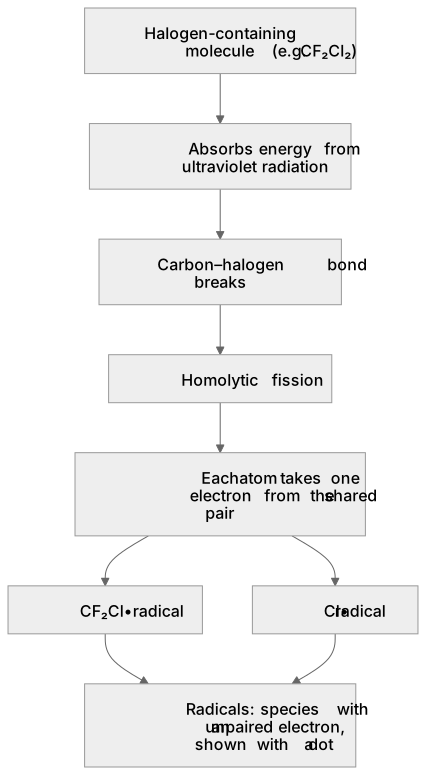
Key words
Say what each word means before you turn the card.
Radicals and unpaired electrons
Try answering aloud or in your head before turning the card.
Homolytic fission
Try answering aloud or in your head before turning the card.
Ultraviolet radiation
Try answering aloud or in your head before turning the card.
CFC chemistry
Try answering aloud or in your head before turning the card.
See every definition
- Radicals and unpaired electrons
- Species with an unpaired electron, shown with a dot, produced when a carbon–halogen bond breaks.
- Homolytic fission
- The process in which the bond breaks so that each atom takes one electron from the shared pair, producing the halogen radicals.
- Ultraviolet radiation
- The energy source in the upper atmosphere that supplies the energy needed to break the carbon–halogen bond.
- CFC chemistry
- For a CFC such as CF₂Cl₂, the C–Cl bond is the one broken, giving two radicals shown with dot notation.
Label the diagram
Some boxes have lost their names. Pick the right name for each number.
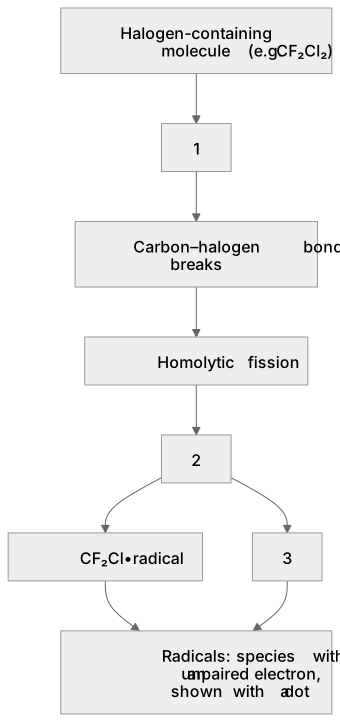
1Box 1
2Box 2
3Box 3
There is more to this lesson
The full lesson goes on to check your understanding and help you earn the marks. Create a free account to carry on, with your progress saved.
A week of Premium from your first lesson · Then the free plan continues · No card, no charge
Test your understanding of Haloalkanes: (i) the production of halogen radicals
Active recall beats re-reading. Take an instant quiz now to test what you’ve learned and lock it into long-term memory.
A week of Premium from your first lesson · Then the free plan continues · No card, no charge