OCR · A-Level · Chemistry
Course version: H432 · Version from Sept 2017
(ii) the catalysed breakdown of ozone by Cl• and other radicals e.g. •NO.
Full specification wording
Haloalkanes: (ii) the catalysed breakdown of ozone by Cl• and other radicals e.g. •NO.
Chlorine radicals, Cl•, formed when UV light breaks C–Cl bonds in chloroalkanes such as CFCs, catalyse ozone breakdown in the stratosphere.
- Point 11 of 11
- 4 key terms
Study notes
From the teaching notes for this specification point.
The idea
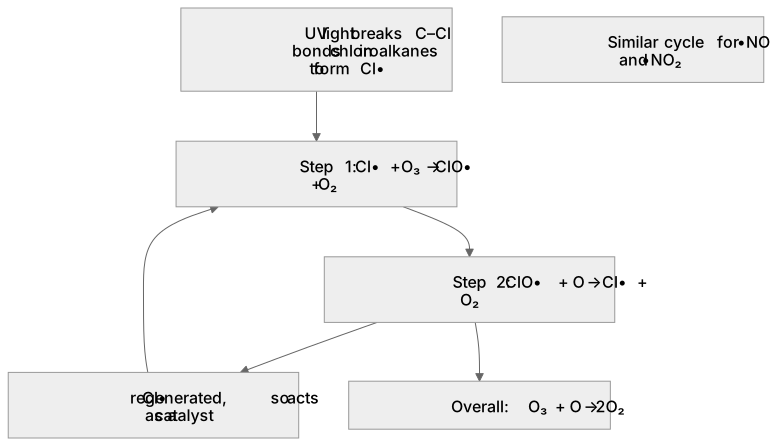
Chlorine radicals, Cl•, formed when UV light breaks C–Cl bonds in chloroalkanes such as CFCs, catalyse ozone breakdown in the stratosphere. In the first step a chlorine radical reacts with ozone to form chlorine monoxide and oxygen: Cl• + O₃ → ClO• + O₂. In the second step the chlorine monoxide radical reacts with an oxygen atom to regenerate the chlorine radical: ClO• + O → Cl• + O₂. Adding these two steps gives the overall equation O₃ + O → 2O₂, and the chlorine radical is regenerated, so it acts as a catalyst. Nitrogen oxide radicals, •NO, work in a similar catalytic cycle, for example •NO + O₃ → •NO₂ + O₂ followed by •NO₂ + O → •NO + O₂.
What earns the marks
- States that UV light breaks carbon–chlorine bonds in chloroalkanes to form chlorine radicals, Cl•.
- Writes the propagation step Cl• + O₃ → ClO• + O₂ in which a chlorine radical reacts with ozone.
- Writes the step ClO• + O → Cl• + O₂ in which chlorine monoxide reacts with an oxygen atom and regenerates the chlorine radical.
- Combines the two steps to give the overall equation O₃ + O → 2O₂ and explains that the radical is regenerated so acts as a catalyst.
- Describes a similar catalytic cycle for nitrogen oxide radicals such as •NO and •NO₂ breaking down ozone.
Common mistakes and how to put them right
States the overall equation as 2O₃ → 3O₂ for the chlorine cycle.
Put it right: Combine the two steps to give O₃ + O → 2O₂.
Omits the regeneration of the chlorine radical.
Put it right: Show that Cl• is reformed so the species is a catalyst.
Writes radicals without the dot symbol.
Put it right: Include the radical dot, for example Cl• and ClO•.
Exam tips
- Write each propagation step separately before combining them into the overall equation.
- Check that the catalyst appears as a reactant in one step and as a product in the other.
- Use the radical dot consistently and balance atoms and charge in each step.
Try the lesson
The start of the Haloalkanes: (ii) the catalysed breakdown of ozone by Cl• and other radicals e.g. •NO. lesson, made from teaching notes for this specification point.
Listen
Chlorine radicals, Cl•, formed when UV light breaks C–Cl bonds in chloroalkanes such as CFCs, catalyse ozone breakdown in the stratosphere. In the first step a chlorine radical reacts with ozone to form chlorine monoxide and oxygen: Cl• + O₃ → ClO• + O₂. In the second step the chlorine monoxide radical reacts with an oxygen atom to regenerate the chlorine radical: ClO• + O → Cl• + O₂. Adding these two steps gives the overall equation O₃ + O → 2O₂, and the chlorine radical is regenerated, so it acts as a catalyst. Nitrogen oxide radicals, •NO, work in a similar catalytic cycle, for example •NO + O₃ → •NO₂ + O₂ followed by •NO₂ + O → •NO + O₂. A strong answer earns marks for these points. States that UV light breaks carbon–chlorine bonds in chloroalkanes to form chlorine radicals, Cl•. Writes the propagation step Cl• + O₃ → ClO• + O₂ in which a chlorine radical reacts with ozone. Writes the step ClO• + O → Cl• + O₂ in which chlorine monoxide reacts with an oxygen atom and regenerates the chlorine radical. Combines the two steps to give the overall equation O₃ + O → 2O₂ and explains that the radical is regenerated so acts as a catalyst. Exam tip: Write each propagation step separately before combining them into the overall equation.
See it
Key words
Say what each word means before you turn the card.
Radical reactions
Try answering aloud or in your head before turning the card.
Catalytic breakdown of ozone
Try answering aloud or in your head before turning the card.
Chlorine radicals from CFCs
Try answering aloud or in your head before turning the card.
Nitrogen oxide radicals
Try answering aloud or in your head before turning the card.
See every definition
- Radical reactions
- Reactions in which radicals such as Cl• and •NO take part, shown with the radical dot included.
- Catalytic breakdown of ozone
- The breakdown of ozone by Cl• and other radicals, in which the radical is regenerated so it acts as a catalyst.
- Chlorine radicals from CFCs
- Cl• formed when UV light breaks carbon–chlorine bonds in chloroalkanes such as CFCs.
- Nitrogen oxide radicals
- •NO radicals that work in a similar catalytic cycle to chlorine radicals, breaking down ozone.
Label the diagram
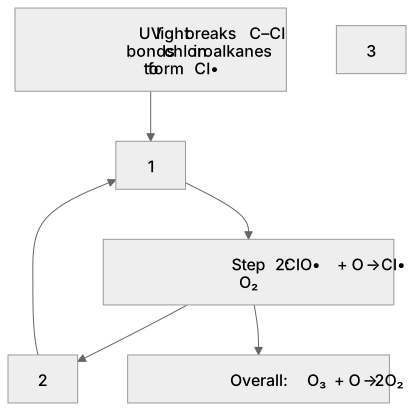
Some boxes have lost their names. Pick the right name for each number.
1Box 1
2Box 2
3Box 3
There is more to this lesson
The full lesson goes on to check your understanding and help you earn the marks. Create a free account to carry on, with your progress saved.
A week of Premium from your first lesson · Then the free plan continues · No card, no charge
Test your understanding of Haloalkanes: (ii) the catalysed breakdown of ozone by Cl• and other radicals e.g. •NO.
Active recall beats re-reading. Take an instant quiz now to test what you’ve learned and lock it into long-term memory.
A week of Premium from your first lesson · Then the free plan continues · No card, no charge