OCR · A-Level · Chemistry
Course version: H432 · Version from Sept 2017
(ii) by water in the presence of AgNO₃ and ethanol to compare…
Full specification wording
Haloalkanes: (ii) by water in the presence of AgNO₃ and ethanol to compare experimentally the rates of hydrolysis of different carbon–halogen bonds
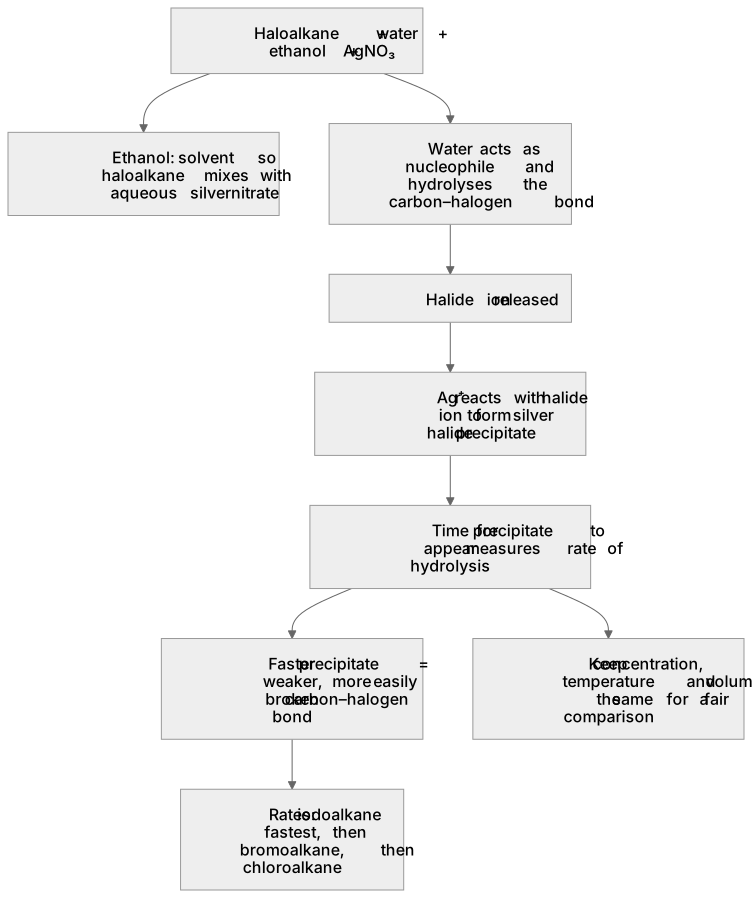
This test hydrolyses a haloalkane with water, using ethanol as a solvent to mix the organic halide with the aqueous silver nitrate, and silver nitrate to detect the halide ion released.
- Point 4 of 11
- 4 key terms
Study notes
From the teaching notes for this specification point.
The idea
This test hydrolyses a haloalkane with water, using ethanol as a solvent to mix the organic halide with the aqueous silver nitrate, and silver nitrate to detect the halide ion released. Water supplies the nucleophile and the carbon–halogen bond breaks, releasing a halide ion. The Ag⁺ ions then precipitate that halide as a silver halide, whose appearance and colour identify which halogen was present. The time taken for the precipitate to appear measures the rate of hydrolysis. A faster precipitate means a weaker, more easily broken carbon–halogen bond. Rates increase down the halogen group: iodoalkanes react fastest, then bromoalkanes, then chloroalkanes, because the C–I bond is weakest and most polarisable. Compare haloalkanes fairly by keeping concentration, temperature and volume the same.
What earns the marks
- Explains that water acts as the nucleophile and hydrolyses the carbon–halogen bond, releasing a halide ion.
- States that ethanol is present as a solvent so the haloalkane mixes with the aqueous silver nitrate.
- Describes silver ions, Ag⁺, reacting with the released halide ion to form a silver halide precipitate.
- Uses the time for the precipitate to appear as a measure of the rate of hydrolysis.
- Orders the rates as iodoalkane fastest, then bromoalkane, then chloroalkane, linking this to carbon–halogen bond strength.
- Keeps concentration, temperature and volumes constant so the comparison of rates is fair.
Common mistakes and how to put them right
Says the silver nitrate hydrolyses the haloalkane.
Put it right by stating water is the nucleophile and Ag⁺ only detects the halide ion.
Omits ethanol and treats the mixture as purely aqueous.
Put it right by explaining ethanol dissolves the haloalkane so it mixes with the aqueous silver nitrate.
Compares rates without controlling temperature or concentration.
Put it right by keeping these variables constant across the haloalkanes tested.
Exam tips
- State the observation for each halogen, such as the colour of the silver halide precipitate, alongside the timing.
- Link the order of rates to the strength and polarisability of the carbon–halogen bond.
- Name the controlled variables explicitly when describing how the comparison is made fair.
Try the lesson
The start of the Haloalkanes: (ii) by water in the presence of AgNO₃ and ethanol to compare experimentally the rates of hydrolysis of different carbon–halogen bonds lesson, made from teaching notes for this specification point.
Listen
This test hydrolyses a haloalkane with water, using ethanol as a solvent to mix the organic halide with the aqueous silver nitrate, and silver nitrate to detect the halide ion released. Water supplies the nucleophile and the carbon–halogen bond breaks, releasing a halide ion. The Ag⁺ ions then precipitate that halide as a silver halide, whose appearance and colour identify which halogen was present. The time taken for the precipitate to appear measures the rate of hydrolysis. A faster precipitate means a weaker, more easily broken carbon–halogen bond. Rates increase down the halogen group: iodoalkanes react fastest, then bromoalkanes, then chloroalkanes, because the C–I bond is weakest and most polarisable. Compare haloalkanes fairly by keeping concentration, temperature and volume the same. A strong answer earns marks for these points. Explains that water acts as the nucleophile and hydrolyses the carbon–halogen bond, releasing a halide ion. States that ethanol is present as a solvent so the haloalkane mixes with the aqueous silver nitrate. Describes silver ions, Ag⁺, reacting with the released halide ion to form a silver halide precipitate. Uses the time for the precipitate to appear as a measure of the rate of hydrolysis. A common slip: Says the silver nitrate hydrolyses the haloalkane. Instead, stating water is the nucleophile and Ag⁺ only detects the halide ion. Exam tip: State the observation for each halogen, such as the colour of the silver halide precipitate, alongside the timing.
See it
Key words
Say what each word means before you turn the card.
Hydrolysis of haloalkanes by water
Try answering aloud or in your head before turning the card.
Silver nitrate as a halide test
Try answering aloud or in your head before turning the card.
Ethanol as a solvent for mixing
Try answering aloud or in your head before turning the card.
Rates linked to carbon–halogen bond strength
Try answering aloud or in your head before turning the card.
See every definition
- Hydrolysis of haloalkanes by water
- Water acts as the nucleophile and hydrolyses the carbon–halogen bond, releasing a halide ion.
- Silver nitrate as a halide test
- Silver ions, Ag⁺, react with the released halide ion to form a silver halide precipitate, whose appearance and colour identify which halogen was present.
- Ethanol as a solvent for mixing
- Ethanol is present as a solvent so the haloalkane mixes with the aqueous silver nitrate.
- Rates linked to carbon–halogen bond strength
- The time for the precipitate to appear measures the rate of hydrolysis, and a faster precipitate means a weaker, more easily broken carbon–halogen bond.
Label the diagram
Some boxes have lost their names. Pick the right name for each number.
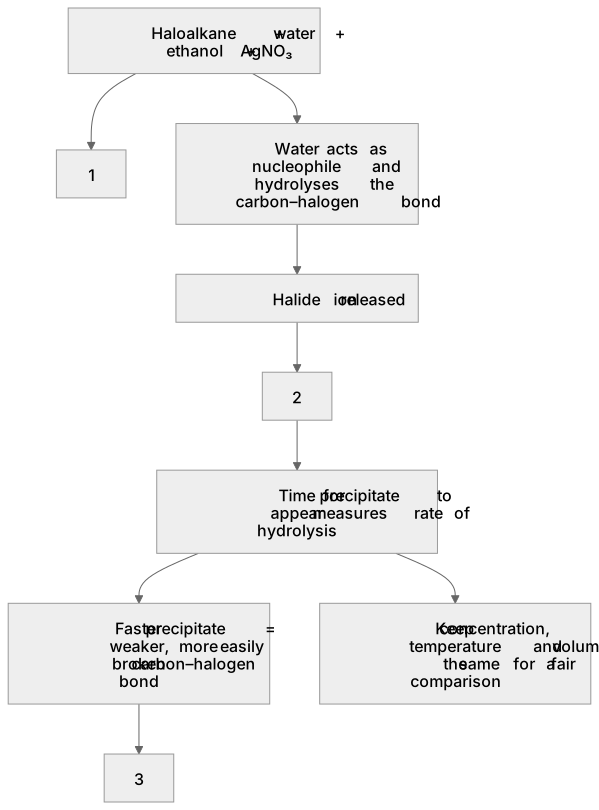
1Box 1
2Box 2
3Box 3
There is more to this lesson
The full lesson goes on to check your understanding and help you earn the marks. Create a free account to carry on, with your progress saved.
A week of Premium from your first lesson · Then the free plan continues · No card, no charge
Test your understanding of Haloalkanes: (ii) by water in the presence of AgNO₃ and ethanol to compare experimentally the rates of hydrolysis of different carbon–halogen bonds
Active recall beats re-reading. Take an instant quiz now to test what you’ve learned and lock it into long-term memory.
A week of Premium from your first lesson · Then the free plan continues · No card, no charge