OCR · A-Level · Chemistry
Course version: H432 · Version from Sept 2017
(c) the techniques and procedures used to determine quantities present at…
Full specification wording
How far?: (c) the techniques and procedures used to determine quantities present at equilibrium
To find how much of each substance is present once a homogeneous or heterogeneous system has reached equilibrium, you freeze the composition and then measure it.
- Point 3 of 9
- 4 key terms
Study notes
From the teaching notes for this specification point.
The idea
To find how much of each substance is present once a homogeneous or heterogeneous system has reached equilibrium, you freeze the composition and then measure it. A common procedure is titration: quench a measured sample so the reaction stops, then titrate the quenched portion against a standard solution and use the result to calculate the amount of one species. From the balanced equation and the known starting amounts you then work out the amounts of the other species by stoichiometry, remembering that solids are not included in the amounts used for Kc. Techniques must be chosen so that sampling does not disturb the equilibrium: withdraw a small aliquot, stop the reaction quickly, and keep temperature constant because Kc depends on temperature. Repeating the measurement at intervals until the titre is constant confirms equilibrium has been reached.
What earns the marks
- Identifies that a sample must be quenched or otherwise stopped before titration so the equilibrium composition is fixed.
- Uses the balanced equation and known initial amounts to convert the measured amount of one species into the amounts of the others by stoichiometry.
- Explains that the titre becoming constant on repeated sampling shows the system has reached equilibrium.
- States that temperature must be held constant because the value of Kc depends on temperature.
Common mistakes and how to put them right
Titrates the equilibrium mixture directly without quenching.
Put it right: Stop the reaction first so the measured amount reflects the equilibrium composition.
Includes the amount of a pure solid when calculating Kc.
Put it right: Omit solids and use only species present in the expression.
Assumes the titre is constant from the first sample.
Put it right: Repeat sampling until successive titres agree before treating the system as at equilibrium.
Exam tips
- Link each procedural step to why it is done, not just what is done, so the technique is justified.
- Show the stoichiometric conversion explicitly from the measured species to the others.
- Keep temperature fixed throughout and say so when explaining why Kc is constant.
Try the lesson
The start of the How far?: (c) the techniques and procedures used to determine quantities present at equilibrium lesson, made from teaching notes for this specification point.
Listen
To find how much of each substance is present once a homogeneous or heterogeneous system has reached equilibrium, you freeze the composition and then measure it. A common procedure is titration: quench a measured sample so the reaction stops, then titrate the quenched portion against a standard solution and use the result to calculate the amount of one species. From the balanced equation and the known starting amounts you then work out the amounts of the other species by stoichiometry, remembering that solids are not included in the amounts used for Kc. Techniques must be chosen so that sampling does not disturb the equilibrium: withdraw a small aliquot, stop the reaction quickly, and keep temperature constant because Kc depends on temperature. Repeating the measurement at intervals until the titre is constant confirms equilibrium has been reached. A strong answer earns marks for these points. Identifies that a sample must be quenched or otherwise stopped before titration so the equilibrium composition is fixed. Uses the balanced equation and known initial amounts to convert the measured amount of one species into the amounts of the others by stoichiometry. Explains that the titre becoming constant on repeated sampling shows the system has reached equilibrium. States that temperature must be held constant because the value of Kc depends on temperature. Exam tip: Link each procedural step to why it is done, not just what is done, so the technique is justified.
See it
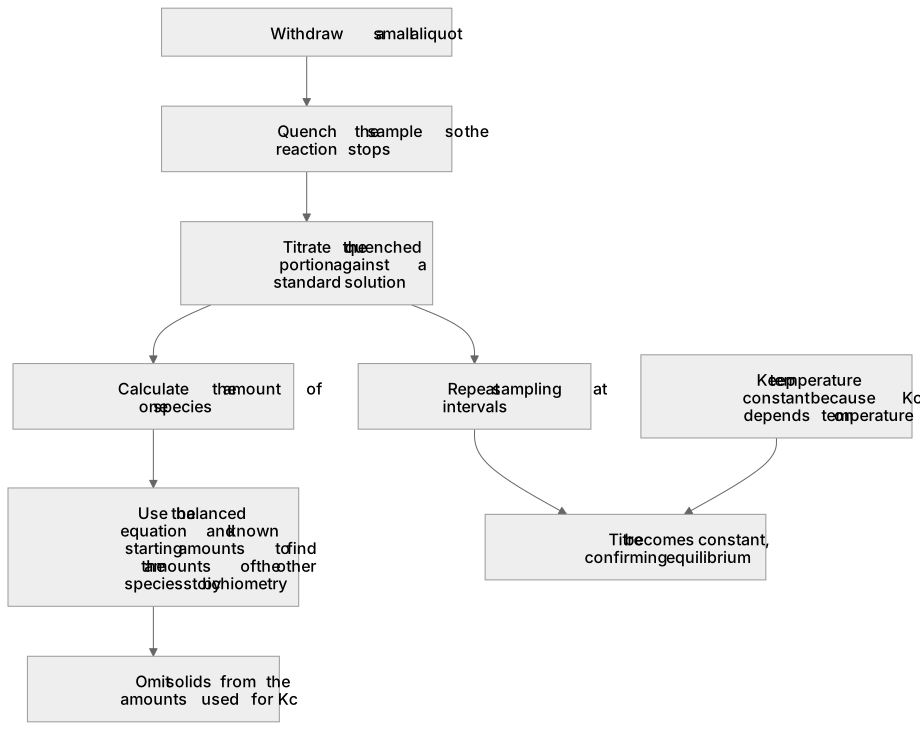
Key words
Say what each word means before you turn the card.
Quenching and sampling
Try answering aloud or in your head before turning the card.
Titration against a standard solution
Try answering aloud or in your head before turning the card.
Stoichiometric calculation of amounts
Try answering aloud or in your head before turning the card.
Constant temperature and constant titre
Try answering aloud or in your head before turning the card.
See every definition
- Quenching and sampling
- Withdrawing a small aliquot and stopping the reaction quickly so that the equilibrium composition is fixed before measurement.
- Titration against a standard solution
- Titrating the quenched portion against a standard solution and using the result to calculate the amount of one species.
- Stoichiometric calculation of amounts
- Using the balanced equation and the known starting amounts to work out the amounts of the other species from the measured amount of one species.
- Constant temperature and constant titre
- Keeping temperature constant because Kc depends on temperature, and repeating the measurement at intervals until the titre is constant to confirm equilibrium has been reached.
Label the diagram
Some boxes have lost their names. Pick the right name for each number.
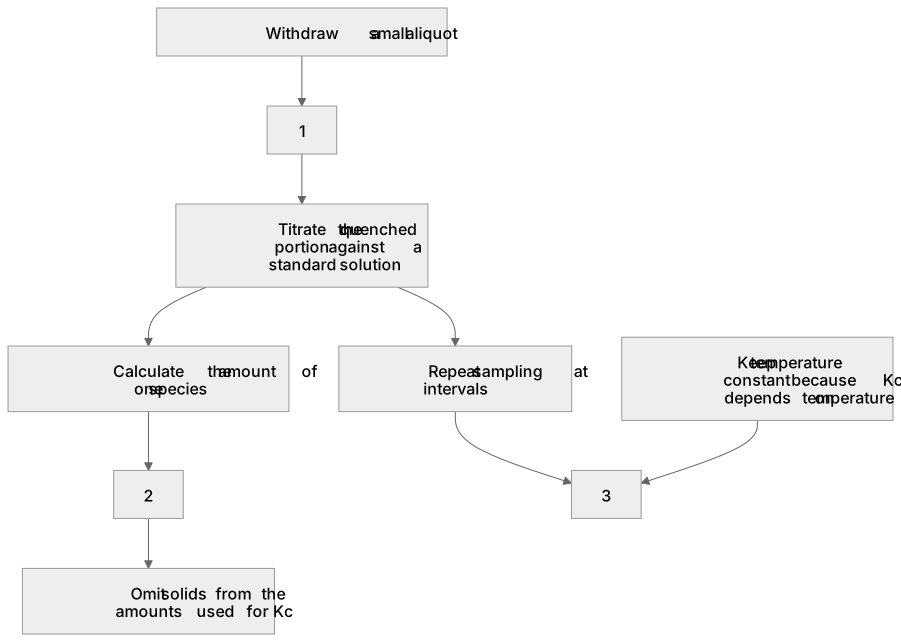
1Box 1
2Box 2
3Box 3
There is more to this lesson
The full lesson goes on to check your understanding and help you earn the marks. Create a free account to carry on, with your progress saved.
A week of Premium from your first lesson · Then the free plan continues · No card, no charge
Test your understanding of How far?: (c) the techniques and procedures used to determine quantities present at equilibrium
Active recall beats re-reading. Take an instant quiz now to test what you’ve learned and lock it into long-term memory.
A week of Premium from your first lesson · Then the free plan continues · No card, no charge