OCR · A-Level · Chemistry
Course version: H432 · Version from Sept 2017
(d) expressions for Kc and Kp for homogeneous and heterogeneous equilibria…
Full specification wording
How far?: (d) expressions for Kc and Kp for homogeneous and heterogeneous equilibria (see also 3.2.3 f)
An equilibrium constant expression is built from the balanced equation.
- Point 4 of 9
- 4 key terms
Study notes
From the teaching notes for this specification point.
The idea
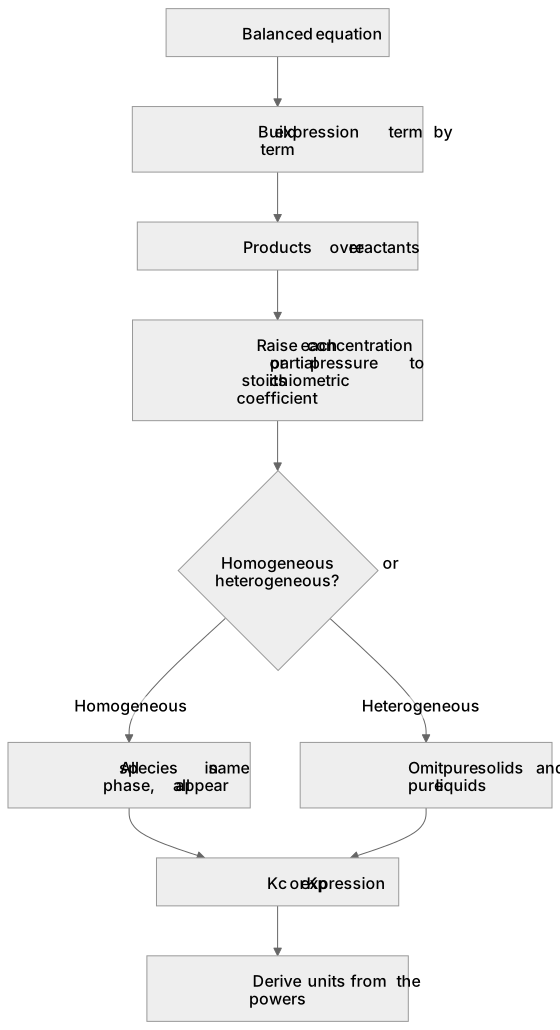
An equilibrium constant expression is built from the balanced equation. For Kc, each concentration is raised to the power of its stoichiometric coefficient, products over reactants. For Kp, each partial pressure is used in the same way. In a homogeneous equilibrium all species are in the same phase, so all appear in the expression. In a heterogeneous equilibrium a pure solid or pure liquid has constant activity and is omitted, so only gaseous or dissolved species appear. For example, for CaCO₃(s) ⇌ CaO(s) + CO₂(g), Kc = [CO₂] and Kp = p(CO₂). Partial pressure is calculated as mole fraction multiplied by total pressure, and units of Kc and Kp follow from the powers used.
What earns the marks
- Writes products over reactants with each concentration or partial pressure raised to its stoichiometric coefficient.
- Omits pure solids and pure liquids from heterogeneous expressions because their activity is constant.
- Calculates a partial pressure as mole fraction multiplied by total pressure before substituting into Kp.
- Derives the units of Kc or Kp from the powers in the expression.
Common mistakes and how to put them right
Includes a pure solid such as CaCO₃ in the expression.
Put it right: Omit pure solids and liquids and keep only gaseous or dissolved species.
Raises concentrations to the wrong power.
Put it right: Use the stoichiometric coefficient from the balanced equation.
Uses total pressure instead of partial pressure in Kp.
Put it right: Multiply mole fraction by total pressure first.
Exam tips
- Write the balanced equation first, then build the expression term by term.
- Check each species' phase and delete pure solids and liquids before finalising.
- Work out units by cancelling the powers in the expression.
Try the lesson
The start of the How far?: (d) expressions for Kc and Kp for homogeneous and heterogeneous equilibria (see also 3.2.3 f) lesson, made from teaching notes for this specification point.
Listen
An equilibrium constant expression is built from the balanced equation. For Kc, each concentration is raised to the power of its stoichiometric coefficient, products over reactants. For Kp, each partial pressure is used in the same way. In a homogeneous equilibrium all species are in the same phase, so all appear in the expression. In a heterogeneous equilibrium a pure solid or pure liquid has constant activity and is omitted, so only gaseous or dissolved species appear. For example, for CaCO₃(s) ⇌ CaO(s) + CO₂(g), Kc = [CO₂] and Kp = p(CO₂). Partial pressure is calculated as mole fraction multiplied by total pressure, and units of Kc and Kp follow from the powers used. A strong answer earns marks for these points. Writes products over reactants with each concentration or partial pressure raised to its stoichiometric coefficient. Omits pure solids and pure liquids from heterogeneous expressions because their activity is constant. Calculates a partial pressure as mole fraction multiplied by total pressure before substituting into Kp. Derives the units of Kc or Kp from the powers in the expression. Exam tip: Write the balanced equation first, then build the expression term by term.
See it
Key words
Say what each word means before you turn the card.
Kc and Kp expressions
Try answering aloud or in your head before turning the card.
Homogeneous versus heterogeneous equilibria
Try answering aloud or in your head before turning the card.
Partial pressure from mole fraction
Try answering aloud or in your head before turning the card.
Units of equilibrium constants
Try answering aloud or in your head before turning the card.
See every definition
- Kc and Kp expressions
- Built from the balanced equation, with products over reactants and each concentration or partial pressure raised to the power of its stoichiometric coefficient.
- Homogeneous versus heterogeneous equilibria
- In a homogeneous equilibrium all species are in the same phase and all appear in the expression, whereas in a heterogeneous equilibrium a pure solid or pure liquid has constant activity and is omitted.
- Partial pressure from mole fraction
- Calculated as mole fraction multiplied by total pressure before substituting into Kp.
- Units of equilibrium constants
- The units of Kc and Kp follow from the powers used in the expression.
There is more to this lesson
The full lesson goes on to check your understanding and help you earn the marks. Create a free account to carry on, with your progress saved.
A week of Premium from your first lesson · Then the free plan continues · No card, no charge
Test your understanding of How far?: (d) expressions for Kc and Kp for homogeneous and heterogeneous equilibria (see also 3.2.3 f)
Active recall beats re-reading. Take an instant quiz now to test what you’ve learned and lock it into long-term memory.
A week of Premium from your first lesson · Then the free plan continues · No card, no charge