OCR · A-Level · Chemistry
Course version: H432 · Version from Sept 2017
(f) for a first order reaction, determination of the rate constant, k,…
Full specification wording
How fast?: (f) for a first order reaction, determination of the rate constant, k, from the constant half-life, t₁/₂, using the relationship: k = ln 2/t₁/₂
For a first order reaction the half-life is constant: the time for the concentration of the reactant to fall from any value to half that value stays the same as the reaction proceeds.
- Point 8 of 18
- 4 key terms
Study notes
From the teaching notes for this specification point.
The idea
For a first order reaction the half-life is constant: the time for the concentration of the reactant to fall from any value to half that value stays the same as the reaction proceeds. Because t₁/₂ does not depend on concentration, it can be measured once and used to find the rate constant with k = ln 2 / t₁/₂. Here ln 2 ≈ 0.693. If t₁/₂ is in seconds, k comes out in s⁻¹; if t₁/₂ is in minutes, convert to seconds first, or report k in min⁻¹ consistently. Example: t₁/₂ = 120 s gives k = 0.693 / 120 s = 5.78 × 10⁻³ s⁻¹. A larger k means a shorter half-life and a faster reaction.
What earns the marks
- Uses k = ln 2 / t₁/₂ with ln 2 taken as 0.693.
- States that the half-life of a first order reaction is constant and independent of concentration.
- Converts t₁/₂ to seconds before calculating k in s⁻¹, or keeps units consistent throughout.
- Recognises that a shorter half-life corresponds to a larger rate constant.
- Calculates k correctly for a given half-life, for example k = 0.693 / 120 s = 5.78 × 10⁻³ s⁻¹.
Common mistakes and how to put them right
Uses k = t₁/₂ / ln 2 instead of k = ln 2 / t₁/₂.
Put it right: Divide ln 2 by the half-life.
Leaves the half-life in minutes but reports k in s⁻¹.
Put it right: Convert the time to seconds first.
Treats the half-life as changing with concentration for a first order reaction.
Put it right: State that it is constant.
Uses the natural logarithm of the concentration instead of ln 2.
Put it right: The constant in the relationship is ln 2 ≈ 0.693.
Exam tips
- Write the equation k = ln 2 / t₁/₂ before substituting numbers so the rearrangement is clear.
- Check the units of t₁/₂ and give k with the matching reciprocal unit, such as s⁻¹.
- Use the constant half-life as evidence that a reaction is first order before applying the relationship.
Try the lesson
The start of the How fast?: (f) for a first order reaction, determination of the rate constant, k, from the constant half-life, t₁/₂, using the relationship: k = ln 2/t₁/₂ lesson, made from teaching notes for this specification point.
Listen
For a first order reaction the half-life is constant: the time for the concentration of the reactant to fall from any value to half that value stays the same as the reaction proceeds. Because t₁/₂ does not depend on concentration, it can be measured once and used to find the rate constant with k = ln 2 / t₁/₂. Here ln 2 ≈ 0.693. If t₁/₂ is in seconds, k comes out in s⁻¹; if t₁/₂ is in minutes, convert to seconds first, or report k in min⁻¹ consistently. Example: t₁/₂ = 120 s gives k = 0.693 / 120 s = 5.78 × 10⁻³ s⁻¹. A larger k means a shorter half-life and a faster reaction. A strong answer earns marks for these points. Uses k = ln 2 / t₁/₂ with ln 2 taken as 0.693. States that the half-life of a first order reaction is constant and independent of concentration. Converts t₁/₂ to seconds before calculating k in s⁻¹, or keeps units consistent throughout. Recognises that a shorter half-life corresponds to a larger rate constant. Exam tip: Write the equation k = ln 2 / t₁/₂ before substituting numbers so the rearrangement is clear.
See it
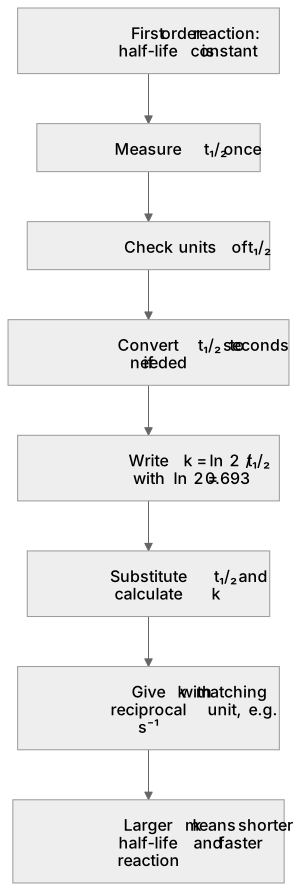
Put it in order
Put these steps in the order they happen.
- 1. Write k = ln 2 / t₁/₂ with ln 2 = 0.693
- 2. Larger k means shorter half-life and faster reaction
- 3. Substitute t₁/₂ and calculate k
- 4. First order reaction: half-life is constant
- 5. Measure t₁/₂ once
- 6. Give k with matching reciprocal unit, e.g. s⁻¹
- 7. Check units of t₁/₂
- 8. Convert t₁/₂ to seconds if needed
Key words
Say what each word means before you turn the card.
First order kinetics
Try answering aloud or in your head before turning the card.
Constant half-life
Try answering aloud or in your head before turning the card.
Rate constant determination
Try answering aloud or in your head before turning the card.
Units of k
Try answering aloud or in your head before turning the card.
See every definition
- First order kinetics
- A reaction in which the half-life is constant and independent of concentration, so the time for the reactant concentration to fall from any value to half that value stays the same as the reaction proceeds.
- Constant half-life
- The time for the concentration of the reactant to fall from any value to half that value stays the same as the reaction proceeds, and does not depend on concentration.
- Rate constant determination
- Finding the rate constant, k, from the constant half-life, t₁/₂, using the relationship k = ln 2/t₁/₂, with ln 2 taken as 0.693.
- Units of k
- If t₁/₂ is in seconds, k comes out in s⁻¹; if t₁/₂ is in minutes, convert to seconds first, or report k in min⁻¹ consistently.
Label the diagram
Some boxes have lost their names. Pick the right name for each number.
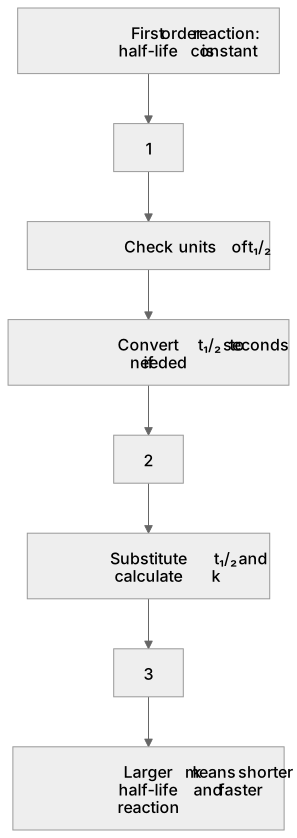
1Box 1
2Box 2
3Box 3
There is more to this lesson
The full lesson goes on to check your understanding and help you earn the marks. Create a free account to carry on, with your progress saved.
A week of Premium from your first lesson · Then the free plan continues · No card, no charge
Test your understanding of How fast?: (f) for a first order reaction, determination of the rate constant, k, from the constant half-life, t₁/₂, using the relationship: k = ln 2/t₁/₂
Active recall beats re-reading. Take an instant quiz now to test what you’ve learned and lock it into long-term memory.
A week of Premium from your first lesson · Then the free plan continues · No card, no charge