OCR · A-Level · Chemistry
Course version: H432 · Version from Sept 2017
(i) the exponential relationship between the rate constant, k and…
Full specification wording
How fast?: (i) the exponential relationship between the rate constant, k and temperature, T given by the Arrhenius equation, k = Ae^(–Ea/RT)
The Arrhenius equation k = Ae^(–Ea/RT) shows that k rises exponentially as T increases, because T appears in the exponent –Ea/RT.
- Point 17 of 18
- 4 key terms
Study notes
From the teaching notes for this specification point.
The idea
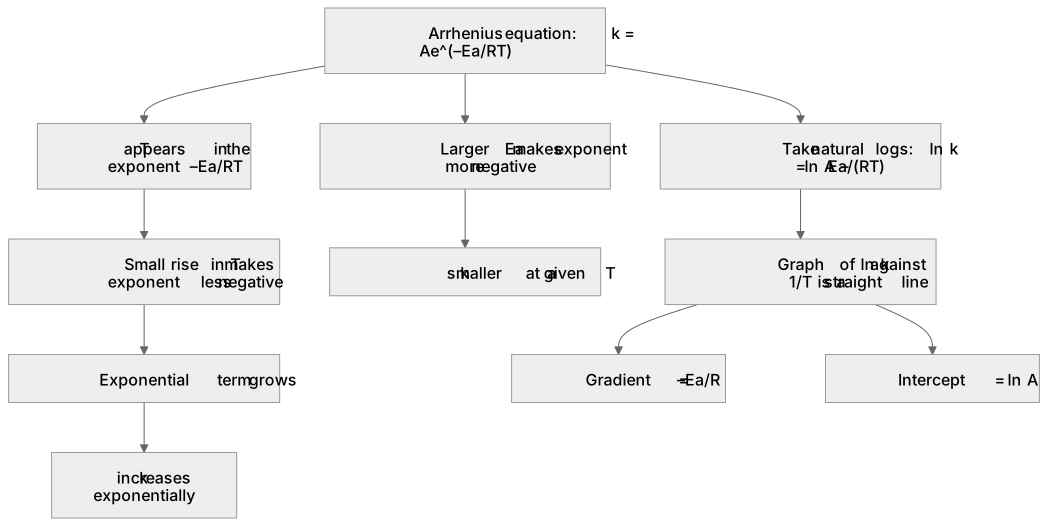
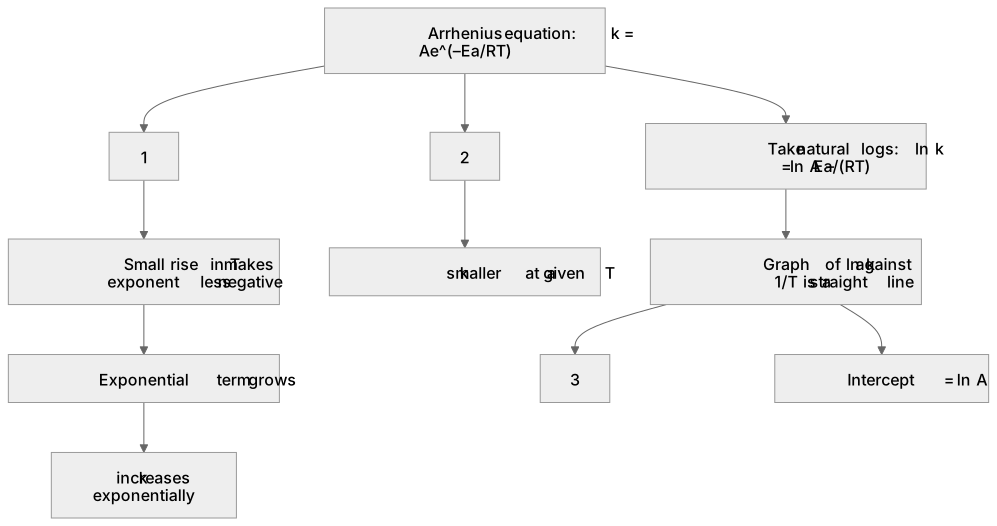
The Arrhenius equation k = Ae^(–Ea/RT) shows that k rises exponentially as T increases, because T appears in the exponent –Ea/RT. Here A is the pre-exponential factor, Ea the activation energy in J mol⁻¹, R the gas constant 8.314 J K⁻¹ mol⁻¹ and T the temperature in kelvin. A small rise in T makes the exponent less negative, so the exponential term grows and k increases; a larger Ea makes the exponent more negative and k smaller at a given T. Taking natural logs gives ln k = ln A – Ea/(RT), so a graph of ln k against 1/T is a straight line of gradient –Ea/R and intercept ln A. In a multiple-choice item, check the exponent sign, the kelvin conversion and the units before choosing an option.
What earns the marks
- Identifies that k increases exponentially with temperature because T appears in the exponent of the Arrhenius expression.
- States that Ea is the activation energy in J mol⁻¹ and R is the gas constant 8.314 J K⁻¹ mol⁻¹, with T in kelvin.
- Explains that a larger activation energy produces a more negative exponent and therefore a smaller rate constant at a fixed temperature.
- Uses the logarithmic form ln k = ln A – Ea/(RT) to link a graph of ln k against 1/T to a gradient of –Ea/R.
Common mistakes and how to put them right
Substitutes temperature in degrees Celsius into the exponent.
Put it right: Convert to kelvin by adding 273 before calculating.
Reads the gradient of a ln k against 1/T graph as positive Ea/R.
Put it right: The gradient is –Ea/R, so Ea = –R × gradient.
Treats the relationship as linear in T.
Put it right: The dependence is exponential because T sits in the exponent.
Exam tips
- Write the exponent as –Ea/(RT) and check the sign before evaluating, since a sign slip reverses the predicted trend.
- Convert any temperature given in °C to K as a visible first step, then substitute R = 8.314 J K⁻¹ mol⁻¹.
- For graph questions, identify the axes as ln k and 1/T and use gradient = –Ea/R to find Ea, converting to kJ mol⁻¹ if asked.
Try the lesson
The start of the How fast?: (i) the exponential relationship between the rate constant, k and temperature, T given by the Arrhenius equation, k = Ae^(–Ea/RT) lesson, made from teaching notes for this specification point.
Listen
The Arrhenius equation k = Ae^(–Ea/RT) shows that k rises exponentially as T increases, because T appears in the exponent –Ea/RT. Here A is the pre-exponential factor, Ea the activation energy in J mol⁻¹, R the gas constant 8.314 J K⁻¹ mol⁻¹ and T the temperature in kelvin. A small rise in T makes the exponent less negative, so the exponential term grows and k increases; a larger Ea makes the exponent more negative and k smaller at a given T. Taking natural logs gives ln k = ln A – Ea/(RT), so a graph of ln k against 1/T is a straight line of gradient –Ea/R and intercept ln A. In a multiple-choice item, check the exponent sign, the kelvin conversion and the units before choosing an option. A strong answer earns marks for these points. Identifies that k increases exponentially with temperature because T appears in the exponent of the Arrhenius expression. States that Ea is the activation energy in J mol⁻¹ and R is the gas constant 8.314 J K⁻¹ mol⁻¹, with T in kelvin. Explains that a larger activation energy produces a more negative exponent and therefore a smaller rate constant at a fixed temperature. Uses the logarithmic form ln k = ln A – Ea/(RT) to link a graph of ln k against 1/T to a gradient of –Ea/R. Exam tip: Write the exponent as –Ea/(RT) and check the sign before evaluating, since a sign slip reverses the predicted trend.
See it
Key words
Say what each word means before you turn the card.
Exponential dependence of k on temperature
Try answering aloud or in your head before turning the card.
Role of activation energy and the pre-exponential factor
Try answering aloud or in your head before turning the card.
Logarithmic form and graphical determination of Ea
Try answering aloud or in your head before turning the card.
Unit consistency: kelvin, J mol⁻¹ and J K⁻¹ mol⁻¹
Try answering aloud or in your head before turning the card.
See every definition
- Exponential dependence of k on temperature
- The rate constant k rises exponentially as temperature T increases, because T appears in the exponent –Ea/RT of the Arrhenius equation.
- Role of activation energy and the pre-exponential factor
- A is the pre-exponential factor and Ea the activation energy in J mol⁻¹; a larger Ea makes the exponent more negative and k smaller at a given T.
- Logarithmic form and graphical determination of Ea
- Taking natural logs gives ln k = ln A – Ea/(RT), so a graph of ln k against 1/T is a straight line of gradient –Ea/R and intercept ln A.
- Unit consistency: kelvin, J mol⁻¹ and J K⁻¹ mol⁻¹
- R is the gas constant 8.314 J K⁻¹ mol⁻¹, Ea is in J mol⁻¹ and T must be in kelvin, so convert from degrees Celsius by adding 273.
Label the diagram
Some boxes have lost their names. Pick the right name for each number.
1Box 1
2Box 2
3Box 3
There is more to this lesson
The full lesson goes on to check your understanding and help you earn the marks. Create a free account to carry on, with your progress saved.
A week of Premium from your first lesson · Then the free plan continues · No card, no charge
Test your understanding of How fast?: (i) the exponential relationship between the rate constant, k and temperature, T given by the Arrhenius equation, k = Ae^(–Ea/RT)
Active recall beats re-reading. Take an instant quiz now to test what you’ve learned and lock it into long-term memory.
A week of Premium from your first lesson · Then the free plan continues · No card, no charge