OCR · A-Level · Chemistry
Course version: H432 · Version from Sept 2017
(a) explanation of the term lattice enthalpy (formation of 1 mol of ionic…
Full specification wording
Lattice enthalpy: (a) explanation of the term lattice enthalpy (formation of 1 mol of ionic lattice from gaseous ions, ∆LEH) and use as a measure of the strength of ionic bonding in a giant ionic lattice (see also 2.2.2 b–c)
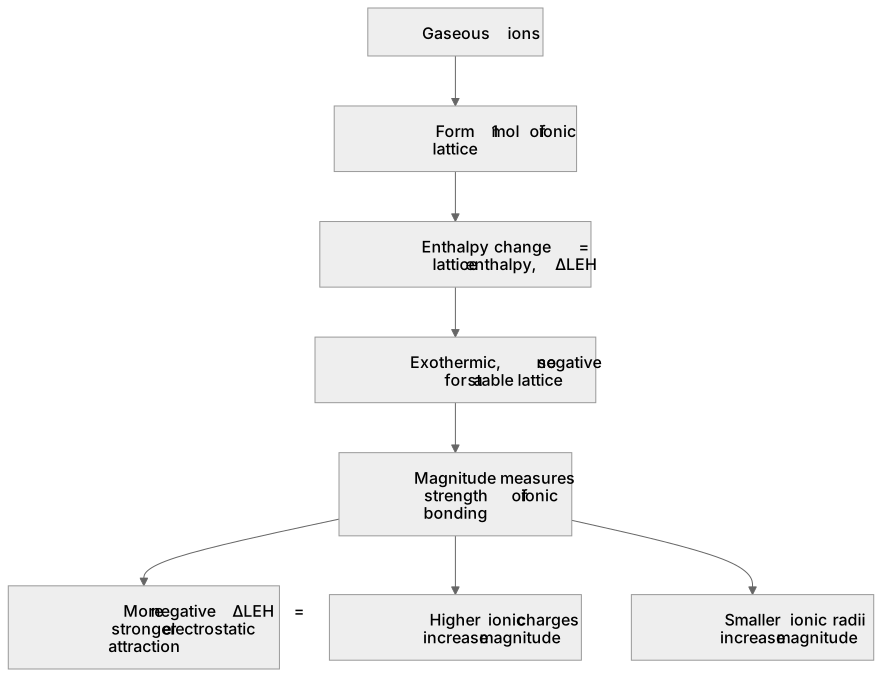
Lattice enthalpy, ΔLEH, is the enthalpy change when one mole of an ionic lattice forms from its gaseous ions, and it is exothermic, so a stable lattice has a negative value.
- Point 1 of 9
- 4 key terms
Study notes
From the teaching notes for this specification point.
The idea
Lattice enthalpy, ΔLEH, is the enthalpy change when one mole of an ionic lattice forms from its gaseous ions, and it is exothermic, so a stable lattice has a negative value. Its magnitude measures the strength of ionic bonding in a giant ionic lattice: the more negative ΔLEH, the stronger the electrostatic attraction holding the oppositely charged ions together. Strength increases with higher ionic charges and smaller ionic radii, because these raise the attraction between ions. For example, MgO has a much more negative lattice enthalpy than NaCl since Mg²⁺ and O²⁻ are doubly charged and smaller than Na⁺ and Cl⁻. This links back to the ionic bonding ideas in 2.2.2 b–c.
What earns the marks
- Defines lattice enthalpy as the enthalpy change when one mole of an ionic lattice forms from its gaseous ions, symbol ΔLEH.
- States that lattice enthalpy is exothermic and therefore negative for a stable giant ionic lattice.
- Uses the magnitude of lattice enthalpy as a measure of the strength of ionic bonding in a giant ionic lattice.
- Explains that higher ionic charges and smaller ionic radii increase the magnitude of lattice enthalpy by strengthening electrostatic attraction.
Common mistakes and how to put them right
Defines lattice enthalpy as the energy needed to separate a lattice into gaseous ions.
Put it right by stating it is the formation of one mole of lattice from gaseous ions, giving a negative value.
Forgets the one mole and gaseous ions conditions.
Put it right: Include both, because the definition depends on forming one mole of lattice from gaseous ions.
Claims a less negative lattice enthalpy means stronger ionic bonding.
Put it right: Reverse this, since a more negative value means stronger bonding.
Exam tips
- Quote the full definition with one mole, ionic lattice and gaseous ions, as each idea can earn credit.
- Give the sign of ΔLEH and explain that a negative value shows energy is released on lattice formation.
- Compare two lattices by referring to ionic charge and ionic radius to justify the difference in strength.
Try the lesson
The start of the Lattice enthalpy: (a) explanation of the term lattice enthalpy (formation of 1 mol of ionic lattice from gaseous ions, ∆LEH) and use as a measure of the strength of ionic bonding in a giant ionic lattice (see also 2.2.2 b–c) lesson, made from teaching notes for this specification point.
Listen
Lattice enthalpy, ΔLEH, is the enthalpy change when one mole of an ionic lattice forms from its gaseous ions, and it is exothermic, so a stable lattice has a negative value. Its magnitude measures the strength of ionic bonding in a giant ionic lattice: the more negative ΔLEH, the stronger the electrostatic attraction holding the oppositely charged ions together. Strength increases with higher ionic charges and smaller ionic radii, because these raise the attraction between ions. For example, MgO has a much more negative lattice enthalpy than NaCl since Mg²⁺ and O²⁻ are doubly charged and smaller than Na⁺ and Cl⁻. This links back to the ionic bonding ideas in 2.2.2 b–c. A strong answer earns marks for these points. Defines lattice enthalpy as the enthalpy change when one mole of an ionic lattice forms from its gaseous ions, symbol ΔLEH. States that lattice enthalpy is exothermic and therefore negative for a stable giant ionic lattice. Uses the magnitude of lattice enthalpy as a measure of the strength of ionic bonding in a giant ionic lattice. Explains that higher ionic charges and smaller ionic radii increase the magnitude of lattice enthalpy by strengthening electrostatic attraction. A common slip: Defines lattice enthalpy as the energy needed to separate a lattice into gaseous ions. Instead, stating it is the formation of one mole of lattice from gaseous ions, giving a negative value. Exam tip: Quote the full definition with one mole, ionic lattice and gaseous ions, as each idea can earn credit.
See it
Key words
Say what each word means before you turn the card.
lattice enthalpy
Try answering aloud or in your head before turning the card.
exothermic lattice formation
Try answering aloud or in your head before turning the card.
measure of ionic bond strength
Try answering aloud or in your head before turning the card.
ionic charge and radius
Try answering aloud or in your head before turning the card.
See every definition
- lattice enthalpy
- The enthalpy change when one mole of an ionic lattice forms from its gaseous ions, with symbol ΔLEH.
- exothermic lattice formation
- Lattice enthalpy is exothermic, so a stable giant ionic lattice has a negative value.
- measure of ionic bond strength
- The magnitude of lattice enthalpy measures the strength of ionic bonding in a giant ionic lattice, where a more negative ΔLEH means stronger electrostatic attraction.
- ionic charge and radius
- Higher ionic charges and smaller ionic radii increase the magnitude of lattice enthalpy by strengthening electrostatic attraction between the oppositely charged ions.
Label the diagram
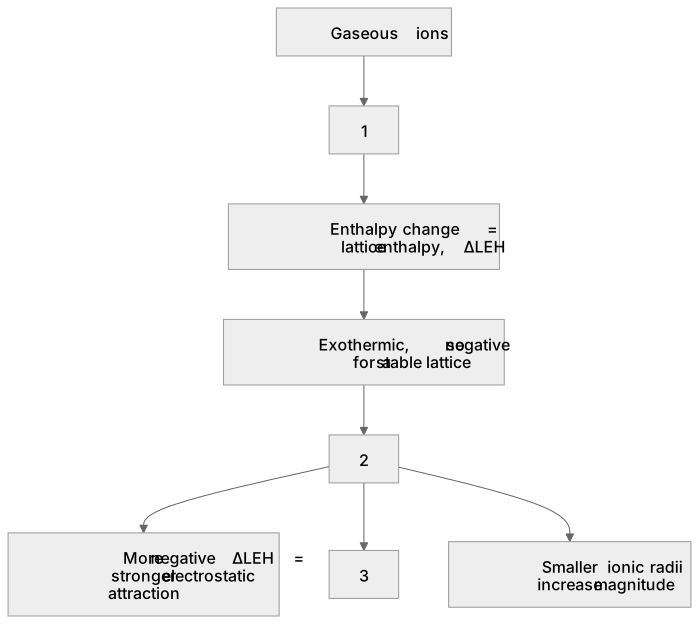
Some boxes have lost their names. Pick the right name for each number.
1Box 1
2Box 2
3Box 3
There is more to this lesson
The full lesson goes on to check your understanding and help you earn the marks. Create a free account to carry on, with your progress saved.
A week of Premium from your first lesson · Then the free plan continues · No card, no charge
Test your understanding of Lattice enthalpy: (a) explanation of the term lattice enthalpy (formation of 1 mol of ionic lattice from gaseous ions, ∆LEH) and use as a measure of the strength of ionic bonding in a giant ionic lattice (see also 2.2.2 b–c)
Active recall beats re-reading. Take an instant quiz now to test what you’ve learned and lock it into long-term memory.
A week of Premium from your first lesson · Then the free plan continues · No card, no charge