OCR · A-Level · Chemistry
Course version: H432 · Version from Sept 2017
Lattice enthalpy: Born–Haber and related enthalpy cycles
A Born–Haber cycle applies Hess's law to build an ionic solid from its elements through gaseous ions, so the lattice enthalpy is obtained indirectly because it cannot be measured directly.
- Point 2 of 9
- 4 key terms
Study notes
From the teaching notes for this specification point.
The idea
A Born–Haber cycle applies Hess's law to build an ionic solid from its elements through gaseous ions, so the lattice enthalpy is obtained indirectly because it cannot be measured directly. Starting from the elements in their standard states, you atomise each element (using enthalpy of atomisation, and bond enthalpy for a diatomic such as Cl₂), then ionise the metal (first and, for Mg, second ionisation enthalpy), add the electron affinity terms for the non-metal, and finally apply the lattice enthalpy to form the solid. For NaCl the cycle links Na(s) + ½Cl₂(g) → NaCl(s) to the sum of atomisation, ionisation, electron affinity and lattice terms. For MgCl₂ you must include two Cl atoms and the second ionisation enthalpy of Mg.
What earns the marks
- Applies Hess's law so the enthalpy of formation equals the sum of atomisation, ionisation, electron affinity and lattice enthalpy terms with correct signs.
- Includes the second ionisation enthalpy of magnesium when constructing the cycle for MgCl₂.
- Uses bond dissociation enthalpy for chlorine and doubles the chlorine terms to supply two chloride ions in MgCl₂.
- Assigns a negative sign to the exothermic lattice enthalpy of formation and to the first electron affinity of chlorine.
- Recognises that the second electron affinity of oxygen is endothermic and carries a positive sign.
Common mistakes and how to put them right
Omits the second ionisation enthalpy of magnesium.
Put it right: Include both first and second ionisation steps for a 2⁺ ion.
Treats the lattice enthalpy of formation as endothermic.
Put it right: Assign it a negative sign because forming the solid releases energy.
Forgets to double the chlorine atomisation and electron affinity terms for MgCl₂.
Put it right: Scale them to two chloride ions.
Exam tips
- Sketch the cycle with arrows before substituting numbers so each term is placed correctly.
- Check the overall sign of the enthalpy of formation against whether the formation is exothermic or endothermic.
- List every energy term for the specific compound before adding, since MgCl₂ needs more terms than NaCl.
Try the lesson
The start of the Lattice enthalpy: Born–Haber and related enthalpy cycles lesson, made from teaching notes for this specification point.
Listen
A Born–Haber cycle applies Hess's law to build an ionic solid from its elements through gaseous ions, so the lattice enthalpy is obtained indirectly because it cannot be measured directly. Starting from the elements in their standard states, you atomise each element (using enthalpy of atomisation, and bond enthalpy for a diatomic such as Cl₂), then ionise the metal (first and, for Mg, second ionisation enthalpy), add the electron affinity terms for the non-metal, and finally apply the lattice enthalpy to form the solid. For NaCl the cycle links Na(s) + ½Cl₂(g) → NaCl(s) to the sum of atomisation, ionisation, electron affinity and lattice terms. For MgCl₂ you must include two Cl atoms and the second ionisation enthalpy of Mg. A strong answer earns marks for these points. Applies Hess's law so the enthalpy of formation equals the sum of atomisation, ionisation, electron affinity and lattice enthalpy terms with correct signs. Includes the second ionisation enthalpy of magnesium when constructing the cycle for MgCl₂. Uses bond dissociation enthalpy for chlorine and doubles the chlorine terms to supply two chloride ions in MgCl₂. Assigns a negative sign to the exothermic lattice enthalpy of formation and to the first electron affinity of chlorine. Exam tip: Sketch the cycle with arrows before substituting numbers so each term is placed correctly.
See it
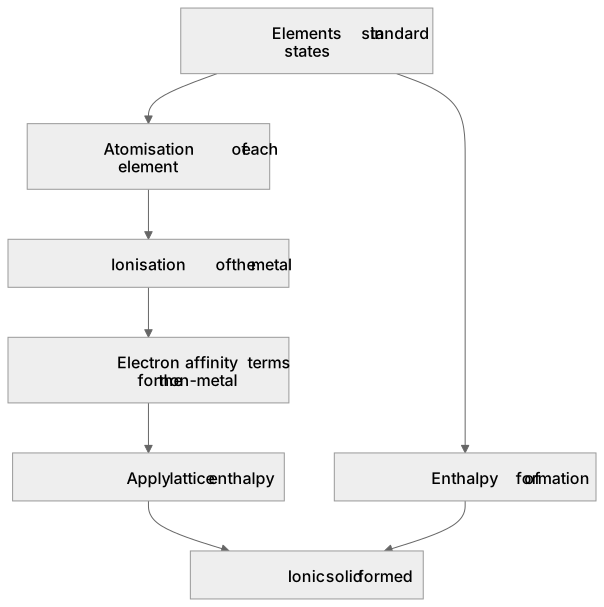
Key words
Say what each word means before you turn the card.
Born–Haber cycle
Try answering aloud or in your head before turning the card.
Enthalpy of atomisation
Try answering aloud or in your head before turning the card.
Ionisation enthalpy
Try answering aloud or in your head before turning the card.
Electron affinity
Try answering aloud or in your head before turning the card.
See every definition
- Born–Haber cycle
- Applies Hess's law to build an ionic solid from its elements through gaseous ions, so the lattice enthalpy is obtained indirectly because it cannot be measured directly.
- Enthalpy of atomisation
- Used to atomise each element starting from the elements in their standard states, with bond enthalpy used for a diatomic such as Cl₂.
- Ionisation enthalpy
- The metal is ionised, using first and, for Mg, second ionisation enthalpy, and both first and second steps are included for a 2⁺ ion.
- Electron affinity
- Terms for the non-metal are added, with the first electron affinity of chlorine given a negative sign and the second electron affinity of oxygen endothermic with a positive sign.
Label the diagram
Some boxes have lost their names. Pick the right name for each number.
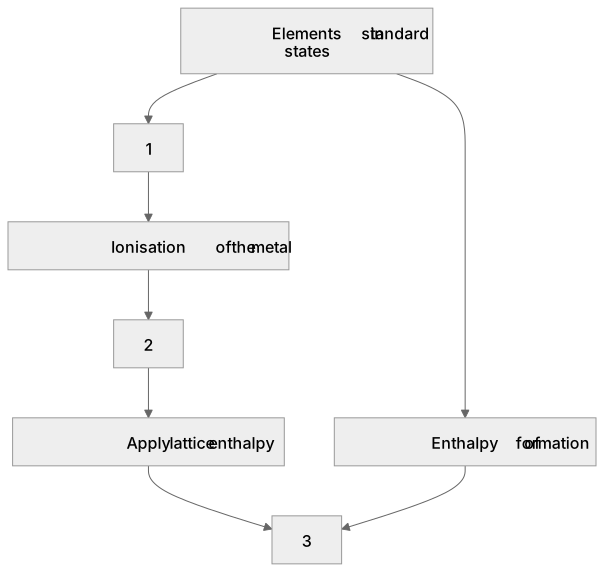
1Box 1
2Box 2
3Box 3
There is more to this lesson
The full lesson goes on to check your understanding and help you earn the marks. Create a free account to carry on, with your progress saved.
A week of Premium from your first lesson · Then the free plan continues · No card, no charge
Test your understanding of Lattice enthalpy: Born–Haber and related enthalpy cycles
Active recall beats re-reading. Take an instant quiz now to test what you’ve learned and lock it into long-term memory.
A week of Premium from your first lesson · Then the free plan continues · No card, no charge