OCR · A-Level · Chemistry
Course version: H432 · Version from Sept 2017
(d) use of the enthalpy change of solution of a simple ionic solid (e.g.…
Full specification wording
Lattice enthalpy: (d) use of the enthalpy change of solution of a simple ionic solid (e.g. NaCl, MgCl₂) and relevant energy terms (enthalpy change of hydration and lattice enthalpy) for:
Enthalpy change of solution, ΔsolH, is the enthalpy change when one mole of an ionic solid dissolves in water to form a very dilute solution.
- Point 8 of 9
- 4 key terms
Study notes
From the teaching notes for this specification point.
The idea
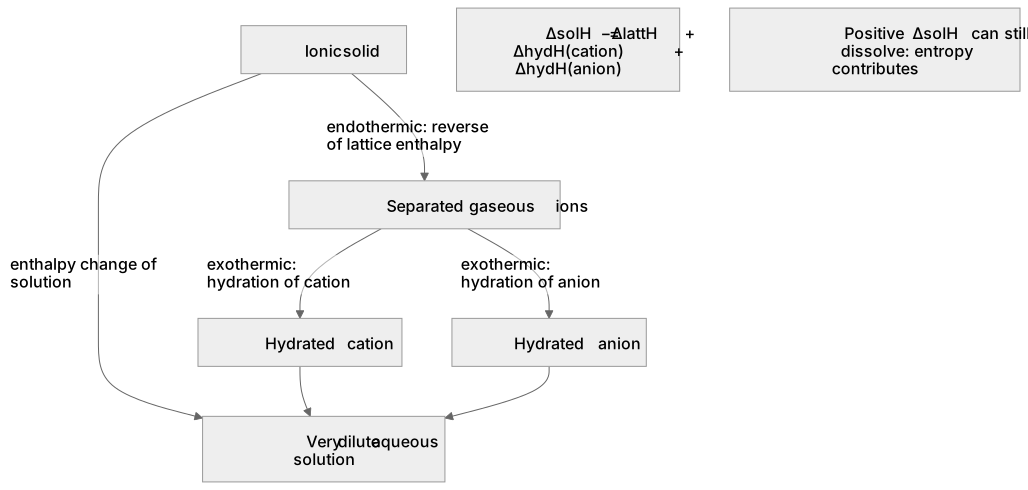
Enthalpy change of solution, ΔsolH, is the enthalpy change when one mole of an ionic solid dissolves in water to form a very dilute solution. It can be broken into two energy terms. Breaking the lattice is endothermic: the reverse of lattice enthalpy, so +ΔlattH (lattice enthalpy is defined as exothermic for formation). Hydrating the separated gaseous ions is exothermic: ΔhydH for each ion. So ΔsolH = ΔlattH(formation, negative) reversed to positive, plus the hydration enthalpies. For NaCl the lattice term is large and positive and the two hydration terms are negative; the sum is small and slightly endothermic, yet NaCl still dissolves because entropy increases. Never claim dissolving requires hydration to outweigh lattice energy.
What earns the marks
- Identifies ΔsolH as the enthalpy change when one mole of an ionic solid dissolves to form a very dilute aqueous solution.
- Breaks the process into an endothermic lattice-breaking step equal in magnitude to lattice enthalpy and exothermic hydration of the gaseous ions.
- Combines the terms as ΔsolH = −ΔlattH + ΔhydH(cation) + ΔhydH(anion), keeping signs consistent with the exothermic lattice enthalpy of formation.
- Recognises that a solid can dissolve even when ΔsolH is positive or slightly endothermic, because the overall feasibility also depends on entropy.
- Applies the cycle to a named simple solid such as NaCl or MgCl₂, using the correct number of ions for the formula.
Common mistakes and how to put them right
Adds lattice enthalpy with its exothermic sign instead of reversing it to positive for lattice breaking.
Put it right: Reverse the sign before summing.
Claims a solid dissolves only when hydration energy exceeds lattice energy.
Put it right: Recognise that entropy also drives dissolution and endothermic dissolution is possible.
Uses one hydration enthalpy for a formula unit of MgCl₂ rather than two for the two chloride ions.
Put it right: Multiply by the ion count.
Confuses enthalpy change of solution with enthalpy change of hydration.
Put it right: Keep solution as solid to aqueous ions and hydration as gaseous ion to aqueous ion.
Exam tips
- Write the full cycle with arrows before substituting numbers, so each sign is visible.
- Check the ion count from the formula: MgCl₂ needs two chloride hydration terms.
- Remember lattice enthalpy is defined exothermically for formation, so lattice breaking is its positive reverse.
- Do not use ΔsolH sign alone to predict solubility; state that entropy contributes.
Try the lesson
The start of the Lattice enthalpy: (d) use of the enthalpy change of solution of a simple ionic solid (e.g. NaCl, MgCl₂) and relevant energy terms (enthalpy change of hydration and lattice enthalpy) for: lesson, made from teaching notes for this specification point.
Listen
Enthalpy change of solution, ΔsolH, is the enthalpy change when one mole of an ionic solid dissolves in water to form a very dilute solution. It can be broken into two energy terms. Breaking the lattice is endothermic: the reverse of lattice enthalpy, so +ΔlattH (lattice enthalpy is defined as exothermic for formation). Hydrating the separated gaseous ions is exothermic: ΔhydH for each ion. So ΔsolH = ΔlattH(formation, negative) reversed to positive, plus the hydration enthalpies. For NaCl the lattice term is large and positive and the two hydration terms are negative; the sum is small and slightly endothermic, yet NaCl still dissolves because entropy increases. Never claim dissolving requires hydration to outweigh lattice energy. A strong answer earns marks for these points. Identifies ΔsolH as the enthalpy change when one mole of an ionic solid dissolves to form a very dilute aqueous solution. Breaks the process into an endothermic lattice-breaking step equal in magnitude to lattice enthalpy and exothermic hydration of the gaseous ions. Combines the terms as ΔsolH = −ΔlattH + ΔhydH(cation) + ΔhydH(anion), keeping signs consistent with the exothermic lattice enthalpy of formation. Recognises that a solid can dissolve even when ΔsolH is positive or slightly endothermic, because the overall feasibility also depends on entropy. Exam tip: Write the full cycle with arrows before substituting numbers, so each sign is visible.
See it
Key words
Say what each word means before you turn the card.
Enthalpy change of solution
Try answering aloud or in your head before turning the card.
Enthalpy change of hydration
Try answering aloud or in your head before turning the card.
Lattice enthalpy
Try answering aloud or in your head before turning the card.
Entropy
Try answering aloud or in your head before turning the card.
See every definition
- Enthalpy change of solution
- The enthalpy change when one mole of an ionic solid dissolves in water to form a very dilute solution.
- Enthalpy change of hydration
- The exothermic enthalpy change when the separated gaseous ions are hydrated.
- Lattice enthalpy
- Defined as exothermic for formation, so breaking the lattice is its positive reverse.
- Entropy
- Increases on dissolution, so a solid can dissolve even when the enthalpy change of solution is positive or slightly endothermic.
Label the diagram
Some boxes have lost their names. Pick the right name for each number.
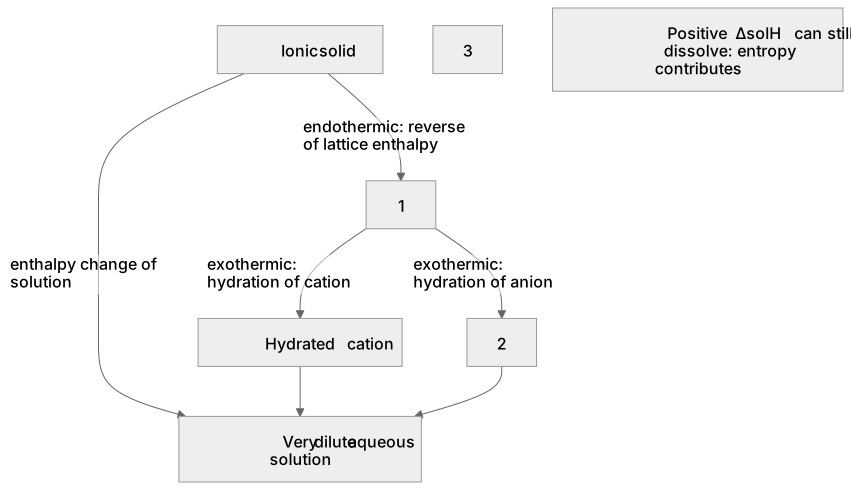
1Box 1
2Box 2
3Box 3
There is more to this lesson
The full lesson goes on to check your understanding and help you earn the marks. Create a free account to carry on, with your progress saved.
A week of Premium from your first lesson · Then the free plan continues · No card, no charge
Test your understanding of Lattice enthalpy: (d) use of the enthalpy change of solution of a simple ionic solid (e.g. NaCl, MgCl₂) and relevant energy terms (enthalpy change of hydration and lattice enthalpy) for:
Active recall beats re-reading. Take an instant quiz now to test what you’ve learned and lock it into long-term memory.
A week of Premium from your first lesson · Then the free plan continues · No card, no charge