OCR · A-Level · Chemistry
Course version: H432 · Version from Sept 2017
(ii) enthalpy change of hydration (dissolving of 1 mol of gaseous ions in…
Full specification wording
Lattice enthalpy: (ii) enthalpy change of hydration (dissolving of 1 mol of gaseous ions in water, ∆hydH)
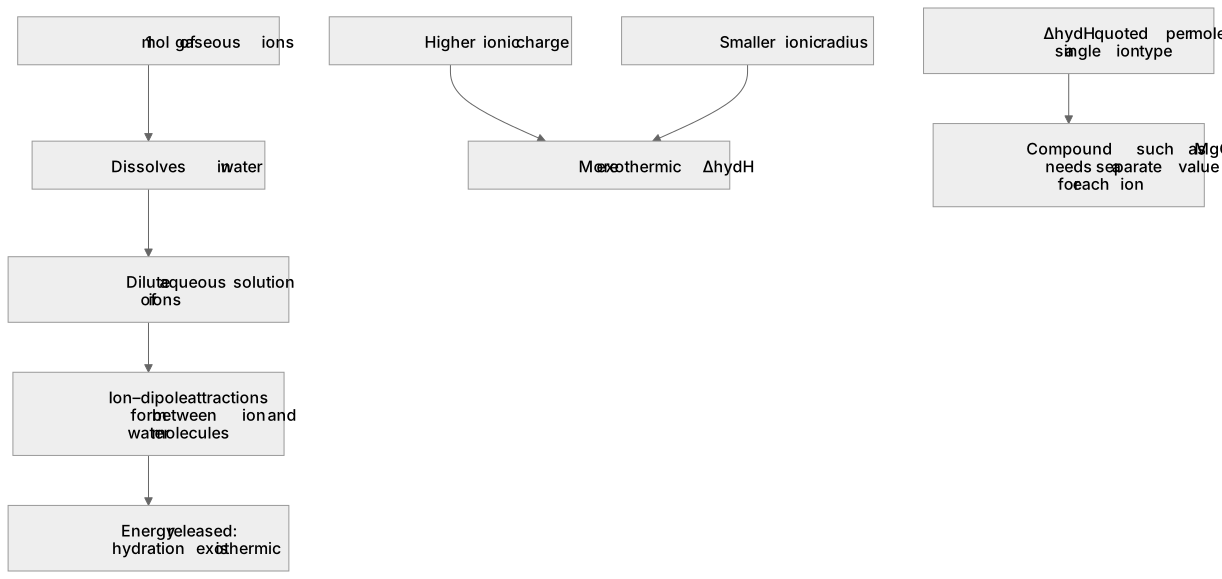
The enthalpy change of hydration, ∆hydH, is the enthalpy change when 1 mol of gaseous ions dissolves in water to form a dilute aqueous solution of ions.
- Point 7 of 9
- 4 key terms
Study notes
From the teaching notes for this specification point.
The idea
The enthalpy change of hydration, ∆hydH, is the enthalpy change when 1 mol of gaseous ions dissolves in water to form a dilute aqueous solution of ions. The ions start as free gaseous ions and end surrounded by water molecules, so the process is always exothermic for a single ion type: energy is released as ion–dipole attractions form between the ion and the δ⁻ oxygen or δ⁺ hydrogen ends of water. Because the definition fixes the amount at 1 mol of gaseous ions, ∆hydH is quoted per mole of that ion, so a compound such as MgCl₂ involves two separate hydration values, one for Mg²⁺ and one for Cl⁻. A larger charge and a smaller ionic radius give a more exothermic ∆hydH, so Mg²⁺ releases more energy than Na⁺.
What earns the marks
- States that ∆hydH is the enthalpy change when 1 mol of gaseous ions dissolves in water to form a dilute aqueous solution.
- Identifies that hydration of gaseous ions is exothermic because ion–dipole attractions form between ions and water molecules.
- Explains that ∆hydH is quoted per mole of a single ion type, so a compound needs a separate value for each ion.
- Relates a more exothermic ∆hydH to a higher ionic charge and a smaller ionic radius.
Common mistakes and how to put them right
Confuses ∆hydH with lattice enthalpy.
Put it right: Keep ∆hydH as gaseous ions going into water and lattice enthalpy as gaseous ions forming a solid.
Treats ∆hydH as endothermic.
Put it right by noting that energy is released when ion–dipole attractions form.
Applies one ∆hydH value to a whole formula unit such as MgCl₂.
Put it right by using separate values for Mg²⁺ and each Cl⁻ ion.
Exam tips
- Learn the definition word for word, including '1 mol of gaseous ions' and 'in water', because the wording carries the marks.
- Check the sign: for a single ion type ∆hydH is negative, so a positive value signals an error.
- When a question gives two ions, write both hydration terms separately before combining them.
Try the lesson
The start of the Lattice enthalpy: (ii) enthalpy change of hydration (dissolving of 1 mol of gaseous ions in water, ∆hydH) lesson, made from teaching notes for this specification point.
Listen
The enthalpy change of hydration, ∆hydH, is the enthalpy change when 1 mol of gaseous ions dissolves in water to form a dilute aqueous solution of ions. The ions start as free gaseous ions and end surrounded by water molecules, so the process is always exothermic for a single ion type: energy is released as ion–dipole attractions form between the ion and the δ⁻ oxygen or δ⁺ hydrogen ends of water. Because the definition fixes the amount at 1 mol of gaseous ions, ∆hydH is quoted per mole of that ion, so a compound such as MgCl₂ involves two separate hydration values, one for Mg²⁺ and one for Cl⁻. A larger charge and a smaller ionic radius give a more exothermic ∆hydH, so Mg²⁺ releases more energy than Na⁺. A strong answer earns marks for these points. States that ∆hydH is the enthalpy change when 1 mol of gaseous ions dissolves in water to form a dilute aqueous solution. Identifies that hydration of gaseous ions is exothermic because ion–dipole attractions form between ions and water molecules. Explains that ∆hydH is quoted per mole of a single ion type, so a compound needs a separate value for each ion. Relates a more exothermic ∆hydH to a higher ionic charge and a smaller ionic radius. A common slip: Treats ∆hydH as endothermic. Instead, noting that energy is released when ion–dipole attractions form. Exam tip: Learn the definition word for word, including '1 mol of gaseous ions' and 'in water', because the wording carries the marks.
See it
Key words
Say what each word means before you turn the card.
Enthalpy change of hydration
Try answering aloud or in your head before turning the card.
Exothermic nature of ion–dipole attraction
Try answering aloud or in your head before turning the card.
Per-mole basis for a single ion type
Try answering aloud or in your head before turning the card.
Charge and radius effects on ∆hydH
Try answering aloud or in your head before turning the card.
See every definition
- Enthalpy change of hydration
- The enthalpy change when 1 mol of gaseous ions dissolves in water to form a dilute aqueous solution of ions.
- Exothermic nature of ion–dipole attraction
- Energy is released as ion–dipole attractions form between the ion and the δ⁻ oxygen or δ⁺ hydrogen ends of water, so the process is always exothermic for a single ion type.
- Per-mole basis for a single ion type
- Because the definition fixes the amount at 1 mol of gaseous ions, ∆hydH is quoted per mole of that ion, so a compound such as MgCl₂ involves two separate hydration values.
- Charge and radius effects on ∆hydH
- A larger charge and a smaller ionic radius give a more exothermic ∆hydH, so Mg²⁺ releases more energy than Na⁺.
Label the diagram
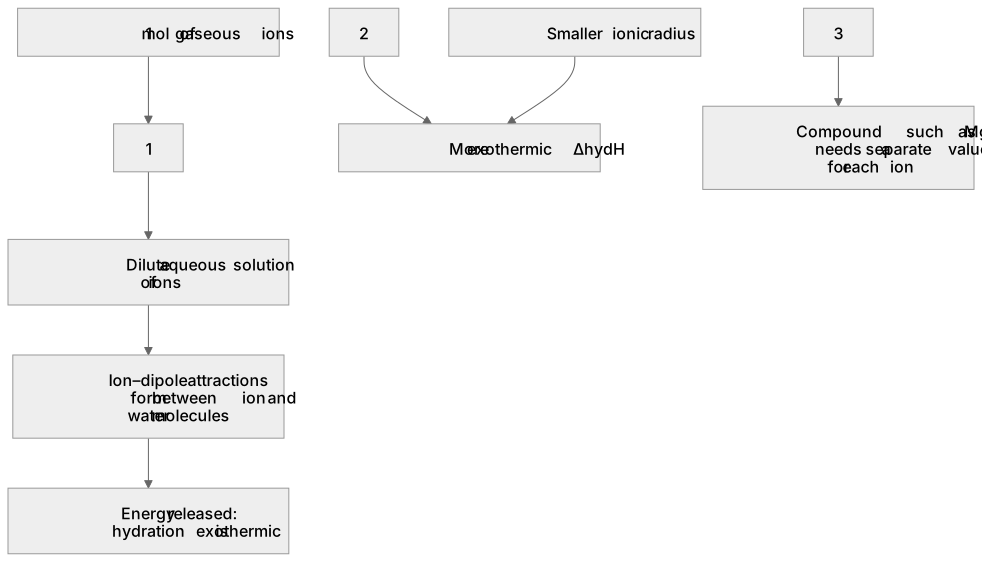
Some boxes have lost their names. Pick the right name for each number.
1Box 1
2Box 2
3Box 3
There is more to this lesson
The full lesson goes on to check your understanding and help you earn the marks. Create a free account to carry on, with your progress saved.
A week of Premium from your first lesson · Then the free plan continues · No card, no charge
Test your understanding of Lattice enthalpy: (ii) enthalpy change of hydration (dissolving of 1 mol of gaseous ions in water, ∆hydH)
Active recall beats re-reading. Take an instant quiz now to test what you’ve learned and lock it into long-term memory.
A week of Premium from your first lesson · Then the free plan continues · No card, no charge