OCR · A-Level · Chemistry
Course version: H432 · Version from Sept 2017
• distillation and heating under reflux
Full specification wording
Nitrogen compounds, polymers and synthesis - 6.2.5 Organic synthesis: • distillation and heating under reflux
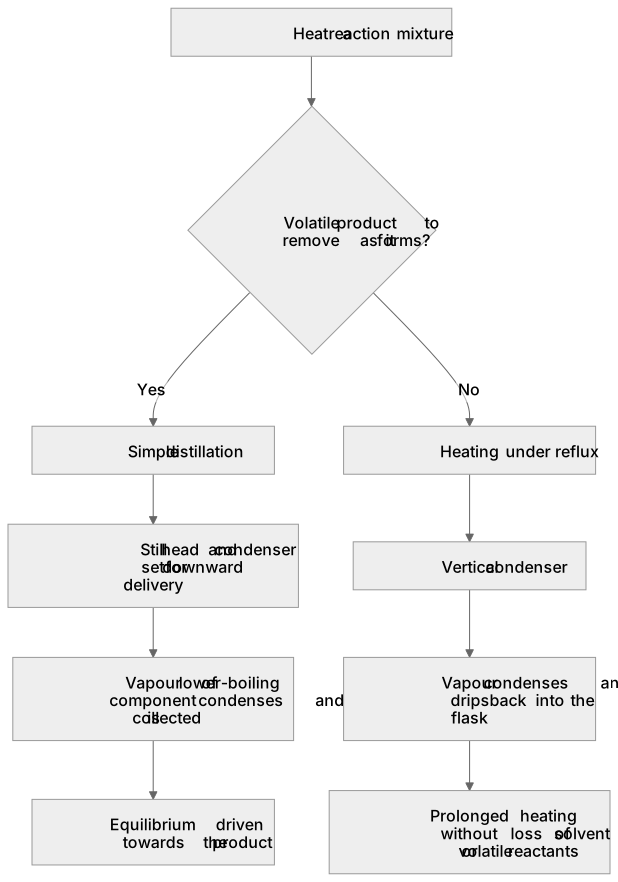
Distillation and heating under reflux are the two standard techniques for heating a reaction mixture, and the choice depends on whether a volatile product must be removed as it forms.
- Point 4 of 11
- 4 key terms
Study notes
From the teaching notes for this specification point.
The idea
Distillation and heating under reflux are the two standard techniques for heating a reaction mixture, and the choice depends on whether a volatile product must be removed as it forms. In simple distillation the reaction flask is fitted with a still head and condenser, and the vapour of the lower-boiling component leaves the flask, condenses and is collected, so an equilibrium such as an esterification is driven towards the product. Under reflux the flask carries a vertical condenser: vapour rises, condenses on the cool inner surface and drips back, so the mixture can be boiled for a long period without losing solvent or volatile reactants. Reflux suits slow reactions needing prolonged heating, for example oxidising a primary alcohol to a carboxylic acid with acidified dichromate(VI). Distillation suits separating a product from the reaction mixture by boiling point.
What earns the marks
- Identifies distillation as removing a volatile product from the reaction mixture as it forms.
- Identifies reflux as returning condensed vapour to the flask so prolonged heating is possible without loss of volatile components.
- Selects reflux for a slow reaction that needs extended heating, such as oxidising an alcohol to a carboxylic acid.
- Selects distillation when the product has a lower boiling point than the remaining mixture and must be collected.
- States that the reflux condenser is mounted vertically while the distillation condenser is set for downward delivery of the distillate.
- Recognises that anti-bumping granules and an open system prevent violent boiling and pressure build-up.
Common mistakes and how to put them right
Confuses the two techniques by describing a vertical condenser as part of distillation.
Put it right: Keep the vertical reflux condenser for returning vapour and the angled condenser for collecting distillate.
Assumes reflux increases the yield by removing product.
Put it right: State that reflux prevents loss of volatile reactants and solvent during prolonged heating.
Claims distillation is used to heat a mixture for hours without loss.
Put it right by assigning long heating periods to reflux.
Ignores the need for an open apparatus.
Put it right: Note that a sealed system risks pressure build-up and apparatus failure.
Exam tips
- Read the stem for the words 'prolonged heating' or 'collect the product' and match them to reflux or distillation respectively.
- Justify the choice by referring to boiling points and to whether the product must be removed to shift the position of equilibrium.
- Mention the practical features, such as the vertical condenser, anti-bumping granules and open top, to show understanding of the apparatus.
Try the lesson
The start of the Nitrogen compounds, polymers and synthesis - 6.2.5 Organic synthesis: • distillation and heating under reflux lesson, made from teaching notes for this specification point.
Listen
Distillation and heating under reflux are the two standard techniques for heating a reaction mixture, and the choice depends on whether a volatile product must be removed as it forms. In simple distillation the reaction flask is fitted with a still head and condenser, and the vapour of the lower-boiling component leaves the flask, condenses and is collected, so an equilibrium such as an esterification is driven towards the product. Under reflux the flask carries a vertical condenser: vapour rises, condenses on the cool inner surface and drips back, so the mixture can be boiled for a long period without losing solvent or volatile reactants. Reflux suits slow reactions needing prolonged heating, for example oxidising a primary alcohol to a carboxylic acid with acidified dichromate(VI). Distillation suits separating a product from the reaction mixture by boiling point. A strong answer earns marks for these points. Identifies distillation as removing a volatile product from the reaction mixture as it forms. Identifies reflux as returning condensed vapour to the flask so prolonged heating is possible without loss of volatile components. Selects reflux for a slow reaction that needs extended heating, such as oxidising an alcohol to a carboxylic acid. Selects distillation when the product has a lower boiling point than the remaining mixture and must be collected. A common slip: Claims distillation is used to heat a mixture for hours without loss. Instead, assigning long heating periods to reflux. Exam tip: Read the stem for the words 'prolonged heating' or 'collect the product' and match them to reflux or distillation respectively.
See it
Key words
Say what each word means before you turn the card.
Distillation
Try answering aloud or in your head before turning the card.
Heating under reflux
Try answering aloud or in your head before turning the card.
Position of equilibrium
Try answering aloud or in your head before turning the card.
Safe laboratory practice in organic synthesis
Try answering aloud or in your head before turning the card.
See every definition
- Distillation
- A technique in which the vapour of the lower-boiling component leaves the flask, condenses and is collected, separating a product from the reaction mixture by boiling point.
- Heating under reflux
- A technique in which a vertical condenser returns condensed vapour to the flask, so the mixture can be boiled for a long period without losing solvent or volatile reactants.
- Position of equilibrium
- Shifted towards the product when a volatile product is removed as it forms, as in an esterification.
- Safe laboratory practice in organic synthesis
- Using anti-bumping granules and an open system to prevent violent boiling and pressure build-up.
There is more to this lesson
The full lesson goes on to check your understanding and help you earn the marks. Create a free account to carry on, with your progress saved.
A week of Premium from your first lesson · Then the free plan continues · No card, no charge
Test your understanding of Nitrogen compounds, polymers and synthesis - 6.2.5 Organic synthesis: • distillation and heating under reflux
Active recall beats re-reading. Take an instant quiz now to test what you’ve learned and lock it into long-term memory.
A week of Premium from your first lesson · Then the free plan continues · No card, no charge