OCR · A-Level · Chemistry
Course version: H432 · Version from Sept 2017
(ii) purification of an organic solid
Full specification wording
Nitrogen compounds, polymers and synthesis - 6.2.5 Organic synthesis: (ii) purification of an organic solid
An organic solid made in the laboratory is usually contaminated with soluble impurities and with some of the solvent used to crystallise it.
- Point 5 of 11
- 4 key terms
Study notes
From the teaching notes for this specification point.
The idea
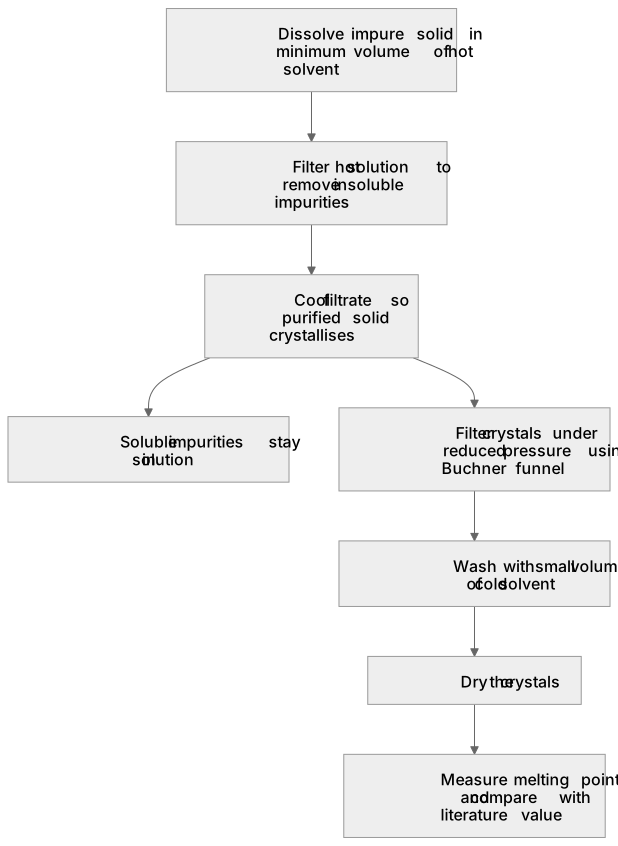
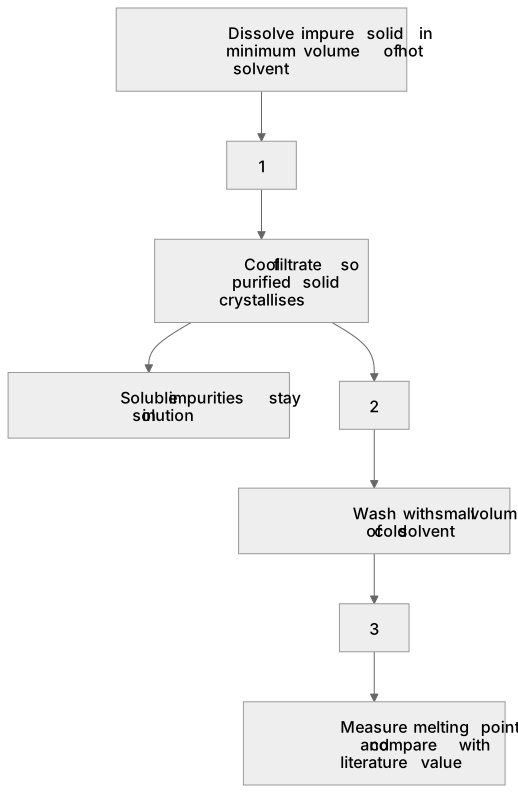
An organic solid made in the laboratory is usually contaminated with soluble impurities and with some of the solvent used to crystallise it. Purification typically uses recrystallisation: the impure solid is dissolved in the minimum volume of hot solvent, the hot solution is filtered to remove insoluble impurities, and the filtrate is cooled so the purified solid crystallises while soluble impurities stay in solution. The crystals are then filtered off under reduced pressure using a Buchner funnel, washed with a small volume of cold solvent and dried. Choosing a solvent in which the solid is very soluble when hot but only slightly soluble when cold is essential. Purity is checked by measuring the melting point and comparing it with the literature value; a sharp melting point close to the accepted value indicates a pure sample, while a depressed or broad range indicates impurities.
What earns the marks
- Describes dissolving the impure solid in the minimum volume of hot solvent to form a saturated solution.
- Describes filtering the hot solution to remove insoluble impurities before cooling.
- Explains that cooling crystallises the purified solid while soluble impurities remain in the filtrate.
- Describes filtering the crystals under reduced pressure, washing with cold solvent and drying.
- States that a suitable recrystallisation solvent dissolves the solid readily when hot but only sparingly when cold.
- Uses a melting point determination, compared with the literature value, to assess purity.
Common mistakes and how to put them right
Uses a large excess of hot solvent.
Put it right by dissolving in the minimum volume so the solution is saturated and crystallisation is effective.
Cools the solution before filtering off insoluble impurities.
Put it right: Filter while hot so the impurities are removed before crystallisation.
Washes the crystals with hot solvent.
Put it right: Use cold solvent so the purified solid is not redissolved.
Treats a broad or depressed melting range as evidence of purity.
Put it right: Recognise that it indicates residual impurity.
Exam tips
- Sequence the steps clearly: dissolve hot, filter hot, cool, filter under reduced pressure, wash cold, dry.
- Explain the role of each step rather than listing it, for example why the minimum volume of solvent matters.
- Link the melting point result to purity by comparing the measured value and range with the accepted value.
Try the lesson
The start of the Nitrogen compounds, polymers and synthesis - 6.2.5 Organic synthesis: (ii) purification of an organic solid lesson, made from teaching notes for this specification point.
Listen
An organic solid made in the laboratory is usually contaminated with soluble impurities and with some of the solvent used to crystallise it. Purification typically uses recrystallisation: the impure solid is dissolved in the minimum volume of hot solvent, the hot solution is filtered to remove insoluble impurities, and the filtrate is cooled so the purified solid crystallises while soluble impurities stay in solution. The crystals are then filtered off under reduced pressure using a Buchner funnel, washed with a small volume of cold solvent and dried. Choosing a solvent in which the solid is very soluble when hot but only slightly soluble when cold is essential. Purity is checked by measuring the melting point and comparing it with the literature value; a sharp melting point close to the accepted value indicates a pure sample, while a depressed or broad range indicates impurities. A strong answer earns marks for these points. Describes dissolving the impure solid in the minimum volume of hot solvent to form a saturated solution. Describes filtering the hot solution to remove insoluble impurities before cooling. Explains that cooling crystallises the purified solid while soluble impurities remain in the filtrate. Describes filtering the crystals under reduced pressure, washing with cold solvent and drying. A common slip: Uses a large excess of hot solvent. Instead, dissolving in the minimum volume so the solution is saturated and crystallisation is effective. Exam tip: Sequence the steps clearly: dissolve hot, filter hot, cool, filter under reduced pressure, wash cold, dry.
See it
Key words
Say what each word means before you turn the card.
Recrystallisation of organic solids
Try answering aloud or in your head before turning the card.
Solubility and choice of solvent
Try answering aloud or in your head before turning the card.
Filtration under reduced pressure
Try answering aloud or in your head before turning the card.
Melting point as a test of purity
Try answering aloud or in your head before turning the card.
See every definition
- Recrystallisation of organic solids
- The impure solid is dissolved in the minimum volume of hot solvent, the hot solution is filtered, and the filtrate is cooled so the purified solid crystallises while soluble impurities stay in solution.
- Solubility and choice of solvent
- Choosing a solvent in which the solid is very soluble when hot but only slightly soluble when cold is essential.
- Filtration under reduced pressure
- The crystals are filtered off under reduced pressure using a Buchner funnel, washed with a small volume of cold solvent and dried.
- Melting point as a test of purity
- A sharp melting point close to the accepted value indicates a pure sample, while a depressed or broad range indicates impurities.
Label the diagram
Some boxes have lost their names. Pick the right name for each number.
1Box 1
2Box 2
3Box 3
There is more to this lesson
The full lesson goes on to check your understanding and help you earn the marks. Create a free account to carry on, with your progress saved.
A week of Premium from your first lesson · Then the free plan continues · No card, no charge
Test your understanding of Nitrogen compounds, polymers and synthesis - 6.2.5 Organic synthesis: (ii) purification of an organic solid
Active recall beats re-reading. Take an instant quiz now to test what you’ve learned and lock it into long-term memory.
A week of Premium from your first lesson · Then the free plan continues · No card, no charge