OCR · A-Level · Chemistry
Course version: H432 · Version from Sept 2017
(i) organic preparation
Full specification wording
Nitrogen compounds, polymers and synthesis - 6.2.5 Organic synthesis: (i) organic preparation
This clause concerns the practical preparation of an organic compound in the laboratory, not planning a route on paper.
- Point 2 of 11
- 4 key terms
Study notes
From the teaching notes for this specification point.
The idea
This clause concerns the practical preparation of an organic compound in the laboratory, not planning a route on paper. A learner carries out a preparation by choosing suitable apparatus, assembling it correctly, heating or stirring as the method requires, then isolating the product by techniques such as filtration under reduced pressure, solvent extraction, drying with a drying agent and distillation. Purity is checked by measuring a melting point and comparing it with a data value, and yield is calculated from the mass obtained and the theoretical maximum. Assessment looks at whether the learner selects and uses equipment safely and records observations and results accurately.
What earns the marks
- Selects apparatus suited to the reaction conditions, such as a round-bottomed flask with a reflux condenser when prolonged heating is needed.
- Assembles the apparatus so that joints are greased and secured and the condenser water flows in at the lower inlet and out at the upper outlet.
- Isolates the crude product using a separating funnel or filtration under reduced pressure before purification.
- Purifies the product by distillation or recrystallisation and checks purity against a quoted melting point.
- Calculates the percentage yield from the mass of purified product and the theoretical mass from the balanced equation.
Common mistakes and how to put them right
Treats the clause as drawing a retrosynthetic route on paper.
Put it right: Describe instead the glassware, heating method and work-up steps actually carried out at the bench.
Omits the purification and purity-check stage.
Put it right: Include distillation or recrystallisation and a melting-point comparison.
Ignores safety and scale.
Put it right: State the hazard controls and the quantities used in the preparation.
Exam tips
- Read the question stem to see whether it asks about apparatus, procedure, purification or yield, and answer that part directly.
- Name each piece of apparatus and say what it does in the preparation rather than listing equipment without purpose.
- Show the yield calculation with the theoretical moles worked out from the equation before dividing.
Try the lesson
The start of the Nitrogen compounds, polymers and synthesis - 6.2.5 Organic synthesis: (i) organic preparation lesson, made from teaching notes for this specification point.
Listen
This clause concerns the practical preparation of an organic compound in the laboratory, not planning a route on paper. A learner carries out a preparation by choosing suitable apparatus, assembling it correctly, heating or stirring as the method requires, then isolating the product by techniques such as filtration under reduced pressure, solvent extraction, drying with a drying agent and distillation. Purity is checked by measuring a melting point and comparing it with a data value, and yield is calculated from the mass obtained and the theoretical maximum. Assessment looks at whether the learner selects and uses equipment safely and records observations and results accurately. A strong answer earns marks for these points. Selects apparatus suited to the reaction conditions, such as a round-bottomed flask with a reflux condenser when prolonged heating is needed. Assembles the apparatus so that joints are greased and secured and the condenser water flows in at the lower inlet and out at the upper outlet. Isolates the crude product using a separating funnel or filtration under reduced pressure before purification. Purifies the product by distillation or recrystallisation and checks purity against a quoted melting point. Exam tip: Read the question stem to see whether it asks about apparatus, procedure, purification or yield, and answer that part directly.
See it
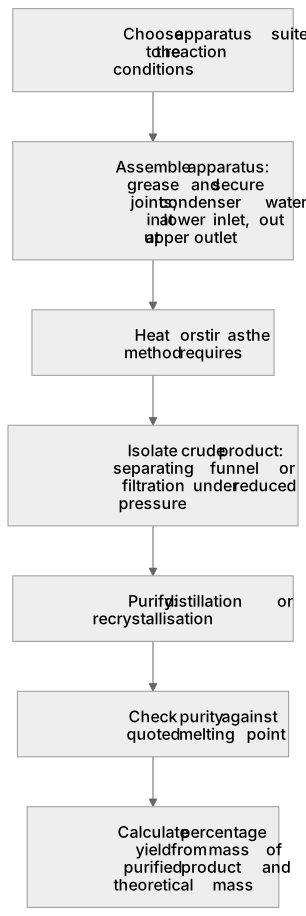
Put it in order
Put these steps in the order they happen.
- 1. Calculate percentage yield from mass of purified product and theoretical mass
- 2. Check purity against a quoted melting point
- 3. Heat or stir as the method requires
- 4. Purify: distillation or recrystallisation
- 5. Choose apparatus suited to the reaction conditions
- 6. Assemble apparatus: grease and secure joints; condenser water in at lower inlet, out at upper outlet
- 7. Isolate crude product: separating funnel or filtration under reduced pressure
Key words
Say what each word means before you turn the card.
Practical apparatus selection
Try answering aloud or in your head before turning the card.
Heating under reflux
Try answering aloud or in your head before turning the card.
Product isolation and purification
Try answering aloud or in your head before turning the card.
Percentage yield and purity checks
Try answering aloud or in your head before turning the card.
See every definition
- Practical apparatus selection
- Choosing equipment suited to the reaction conditions, such as a round-bottomed flask with a reflux condenser when prolonged heating is needed.
- Heating under reflux
- Prolonged heating carried out with a reflux condenser, with joints greased and secured and condenser water flowing in at the lower inlet and out at the upper outlet.
- Product isolation and purification
- Obtaining the crude product using a separating funnel or filtration under reduced pressure, then purifying it by distillation or recrystallisation and checking purity against a quoted melting point.
- Percentage yield and purity checks
- Calculating the percentage yield from the mass of purified product and the theoretical mass from the balanced equation, and checking purity against a quoted melting point.
Label the diagram
Some boxes have lost their names. Pick the right name for each number.
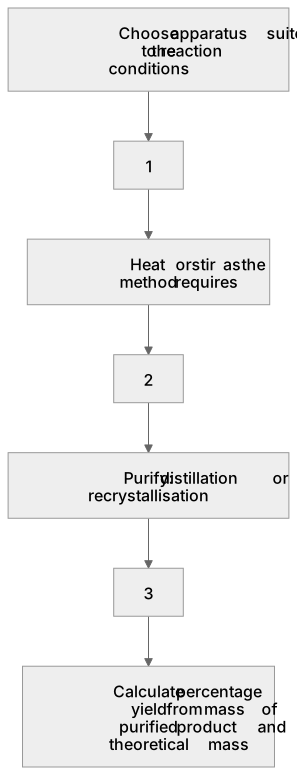
1Box 1
2Box 2
3Box 3
There is more to this lesson
The full lesson goes on to check your understanding and help you earn the marks. Create a free account to carry on, with your progress saved.
A week of Premium from your first lesson · Then the free plan continues · No card, no charge
Test your understanding of Nitrogen compounds, polymers and synthesis - 6.2.5 Organic synthesis: (i) organic preparation
Active recall beats re-reading. Take an instant quiz now to test what you’ve learned and lock it into long-term memory.
A week of Premium from your first lesson · Then the free plan continues · No card, no charge