OCR · A-Level · Chemistry
Course version: H432 · Version from Sept 2017
(ii) prediction of properties and reactions
Full specification wording
Nitrogen compounds, polymers and synthesis - 6.2.5 Organic synthesis: (ii) prediction of properties and reactions
Synthesis planning depends on predicting how a chosen functional group will behave before you commit to a route.
- Point 11 of 11
- 4 key terms
Study notes
From the teaching notes for this specification point.
The idea
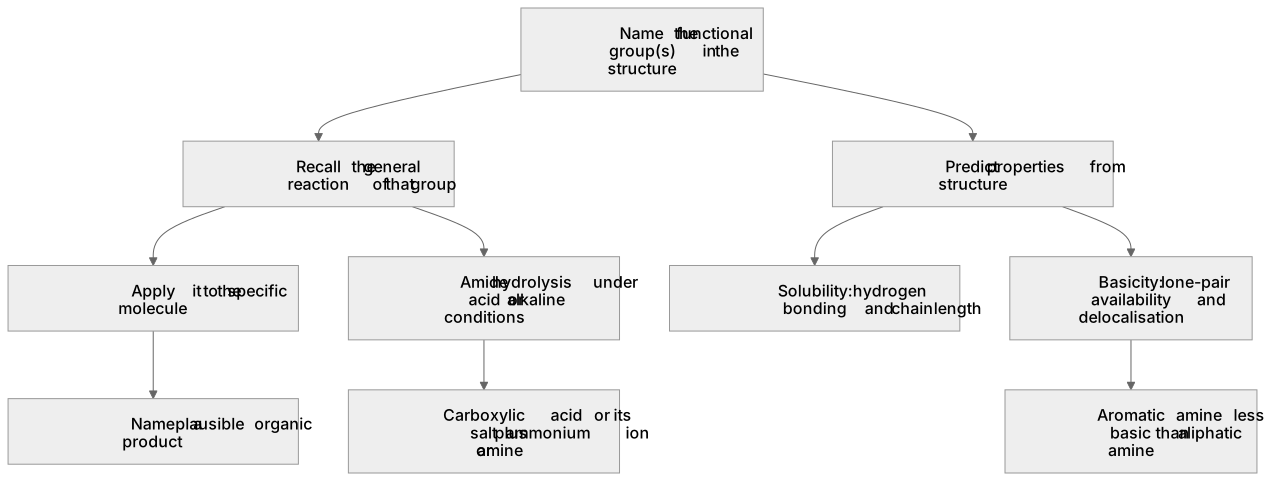
Synthesis planning depends on predicting how a chosen functional group will behave before you commit to a route. In this sub-topic you use the reaction chemistry of nitrogen compounds and related groups to forecast properties and reactions. For example, you predict that a primary amine such as ethylamine acts as a nucleophile and a base, forming an amide with an acyl chloride, whereas a phenylamine-type aromatic amine is far less basic because its lone pair is delocalised into the ring. You also predict solubility from hydrogen bonding and chain length, and predict that an amide hydrolyses under acid or alkaline conditions to give a carboxylic acid or its salt plus an ammonium ion or amine. Prediction means naming the functional group, recalling the general reaction of that group, then applying it to the specific molecule in the question.
What earns the marks
- Identifies the functional group or groups present in the given structure before predicting behaviour.
- States the general reaction type that the named functional group undergoes, such as nucleophilic addition or hydrolysis.
- Applies the general reaction to the specific molecule, naming a plausible organic product.
- Explains a property such as basicity or solubility by reference to structure, for example lone-pair availability or hydrogen bonding.
- Distinguishes an aromatic amine from an aliphatic amine when predicting relative base strength.
Common mistakes and how to put them right
Treats every amine as equally basic.
Put it right: Compare lone-pair availability and delocalisation instead.
Predicts a product without first naming the reacting functional group.
Put it right: Identify the group, then apply its general reaction.
Assumes an amide is unreactive towards hydrolysis.
Put it right: Recall that acid or alkali hydrolysis gives the acid or salt plus the nitrogen-containing product.
Ignores hydrogen bonding when predicting solubility.
Put it right: Link N–H or O–H bonds to interaction with water.
Exam tips
- Underline the functional group in the displayed structure before choosing an answer.
- Recall the general reaction for each group, then check which option applies it correctly to the molecule shown.
- Eliminate options that contradict a known property, such as an aromatic amine being strongly basic.
- Check that the named product conserves every carbon atom in the starting molecule.
Try the lesson
The start of the Nitrogen compounds, polymers and synthesis - 6.2.5 Organic synthesis: (ii) prediction of properties and reactions lesson, made from teaching notes for this specification point.
Listen
Synthesis planning depends on predicting how a chosen functional group will behave before you commit to a route. In this sub-topic you use the reaction chemistry of nitrogen compounds and related groups to forecast properties and reactions. For example, you predict that a primary amine such as ethylamine acts as a nucleophile and a base, forming an amide with an acyl chloride, whereas a phenylamine-type aromatic amine is far less basic because its lone pair is delocalised into the ring. You also predict solubility from hydrogen bonding and chain length, and predict that an amide hydrolyses under acid or alkaline conditions to give a carboxylic acid or its salt plus an ammonium ion or amine. Prediction means naming the functional group, recalling the general reaction of that group, then applying it to the specific molecule in the question. A strong answer earns marks for these points. Identifies the functional group or groups present in the given structure before predicting behaviour. States the general reaction type that the named functional group undergoes, such as nucleophilic addition or hydrolysis. Applies the general reaction to the specific molecule, naming a plausible organic product. Explains a property such as basicity or solubility by reference to structure, for example lone-pair availability or hydrogen bonding. Exam tip: Underline the functional group in the displayed structure before choosing an answer.
See it
Key words
Say what each word means before you turn the card.
Functional group recognition
Try answering aloud or in your head before turning the card.
Structure–property relationships
Try answering aloud or in your head before turning the card.
Basicity of amines
Try answering aloud or in your head before turning the card.
Hydrolysis of amides
Try answering aloud or in your head before turning the card.
See every definition
- Functional group recognition
- Naming the functional group or groups present in the given structure before predicting behaviour.
- Structure–property relationships
- Explaining a property such as basicity or solubility by reference to structure, for example lone-pair availability or hydrogen bonding.
- Basicity of amines
- Distinguishing an aromatic amine from an aliphatic amine when predicting relative base strength, since a phenylamine-type aromatic amine is far less basic because its lone pair is delocalised into the ring.
- Hydrolysis of amides
- Predicting that an amide hydrolyses under acid or alkaline conditions to give a carboxylic acid or its salt plus an ammonium ion or amine.
Label the diagram
Some boxes have lost their names. Pick the right name for each number.
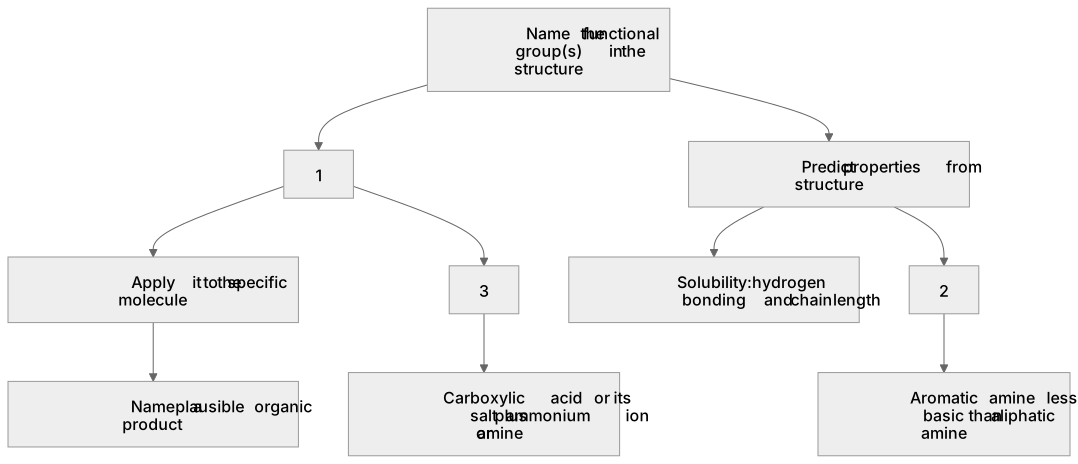
1Box 1
2Box 2
3Box 3
There is more to this lesson
The full lesson goes on to check your understanding and help you earn the marks. Create a free account to carry on, with your progress saved.
A week of Premium from your first lesson · Then the free plan continues · No card, no charge
Test your understanding of Nitrogen compounds, polymers and synthesis - 6.2.5 Organic synthesis: (ii) prediction of properties and reactions
Active recall beats re-reading. Take an instant quiz now to test what you’ve learned and lock it into long-term memory.
A week of Premium from your first lesson · Then the free plan continues · No card, no charge