OCR · A-Level · Chemistry
Course version: H432 · Version from Sept 2017
(i) identification of individual functional groups
Full specification wording
Nitrogen compounds, polymers and synthesis - 6.2.5 Organic synthesis: (i) identification of individual functional groups
This sub-statement asks you to identify each functional group in an organic molecule individually.
- Point 10 of 11
- 4 key terms
Study notes
From the teaching notes for this specification point.
The idea
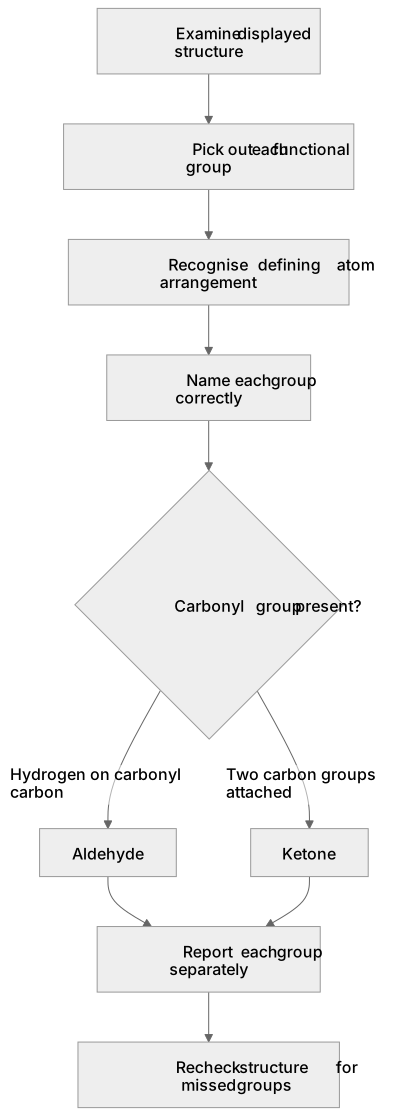
This sub-statement asks you to identify each functional group in an organic molecule individually. You examine the displayed structure and pick out every group, naming each one correctly: for instance an alcohol, an aldehyde, a ketone, a carboxylic acid, an amine, an amide, an ester or a halogenoalkane. Identification means recognising the arrangement of atoms that defines the group, not just spotting a single atom. For example, a carbon double-bonded to an oxygen with a hydrogen attached is an aldehyde, whereas the same carbonyl with two carbon groups attached is a ketone. You then report each group separately so that later synthesis or reaction questions can build on an accurate list.
What earns the marks
- Recognises the defining atom arrangement of each functional group in the structure.
- Names each functional group using correct chemical terminology.
- Separates an aldehyde from a ketone by checking what is bonded to the carbonyl carbon.
- Lists every functional group present rather than stopping at the first one found.
Common mistakes and how to put them right
Calls any carbonyl group an aldehyde without checking for a hydrogen on the carbonyl carbon.
Put it right: Distinguish aldehyde from ketone.
Names a group by a single atom alone, such as calling a hydroxyl oxygen an alcohol.
Put it right: Identify the whole group.
Stops after naming one group in a polyfunctional molecule.
Put it right: Continue until all groups are listed.
Exam tips
- Trace the bonds around each candidate group before committing to a name.
- Use the full systematic name of the group, not a vague description.
- Recheck the structure once more after listing groups to catch any missed.
Try the lesson
The start of the Nitrogen compounds, polymers and synthesis - 6.2.5 Organic synthesis: (i) identification of individual functional groups lesson, made from teaching notes for this specification point.
Listen
This sub-statement asks you to identify each functional group in an organic molecule individually. You examine the displayed structure and pick out every group, naming each one correctly: for instance an alcohol, an aldehyde, a ketone, a carboxylic acid, an amine, an amide, an ester or a halogenoalkane. Identification means recognising the arrangement of atoms that defines the group, not just spotting a single atom. For example, a carbon double-bonded to an oxygen with a hydrogen attached is an aldehyde, whereas the same carbonyl with two carbon groups attached is a ketone. You then report each group separately so that later synthesis or reaction questions can build on an accurate list. A strong answer earns marks for these points. Recognises the defining atom arrangement of each functional group in the structure. Names each functional group using correct chemical terminology. Separates an aldehyde from a ketone by checking what is bonded to the carbonyl carbon. Lists every functional group present rather than stopping at the first one found. Exam tip: Trace the bonds around each candidate group before committing to a name.
See it
Key words
Say what each word means before you turn the card.
Functional group identification
Try answering aloud or in your head before turning the card.
Carbonyl group distinction
Try answering aloud or in your head before turning the card.
Systematic nomenclature
Try answering aloud or in your head before turning the card.
Structure reading
Try answering aloud or in your head before turning the card.
See every definition
- Functional group identification
- Recognising the arrangement of atoms that defines each group in a displayed structure, not just spotting a single atom, and reporting each group separately.
- Carbonyl group distinction
- Separating an aldehyde from a ketone by checking what is bonded to the carbonyl carbon, since a hydrogen attached means an aldehyde and two carbon groups mean a ketone.
- Systematic nomenclature
- Naming each functional group using correct chemical terminology, using the full systematic name of the group rather than a vague description.
- Structure reading
- Tracing the bonds around each candidate group in the displayed structure before committing to a name, and rechecking the structure after listing groups to catch any missed.
There is more to this lesson
The full lesson goes on to check your understanding and help you earn the marks. Create a free account to carry on, with your progress saved.
A week of Premium from your first lesson · Then the free plan continues · No card, no charge
Test your understanding of Nitrogen compounds, polymers and synthesis - 6.2.5 Organic synthesis: (i) identification of individual functional groups
Active recall beats re-reading. Take an instant quiz now to test what you’ve learned and lock it into long-term memory.
A week of Premium from your first lesson · Then the free plan continues · No card, no charge