OCR · A-Level · Chemistry
Course version: H432 · Version from Sept 2017
Periodicity: (ii) classification of elements into s-, p- and d-blocks
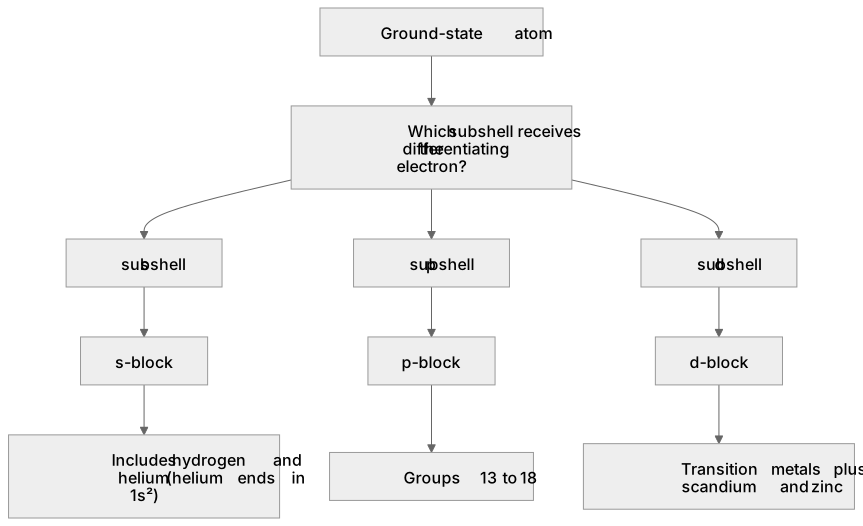
Block classification depends on which subshell receives the differentiating electron in the ground-state atom.
- Point 5 of 11
- 4 key terms
Study notes
From the teaching notes for this specification point.
The idea
Block classification depends on which subshell receives the differentiating electron in the ground-state atom. An element belongs to the s-block when its highest-energy electron enters an s subshell, to the p-block when it enters a p subshell, and to the d-block when it enters a d subshell. So hydrogen and helium sit in the s-block, groups 13 to 18 form the p-block, and the transition metals plus scandium and zinc occupy the d-block. Learn to read a configuration such as 1s² 2s² 2p⁶ 3s² 3p⁶ 4s² 3d¹⁰ 4p¹ and identify the last-filled subshell as p, placing the element in the p-block. Remember that helium is s-block despite sitting above neon, and that zinc is d-block even though it forms no partly filled d subshell in its common ion.
What earns the marks
- Identifies the subshell receiving the differentiating electron in the ground-state configuration.
- Assigns s-block elements to those whose outer electron enters an s subshell.
- Assigns p-block elements to those whose outer electron enters a p subshell.
- Assigns d-block elements to those whose outer electron enters a d subshell.
- Places helium in the s-block because its configuration ends in 1s².
- Places zinc in the d-block because its final electron enters the 3d subshell.
Common mistakes and how to put them right
Counts the number of electrons in the d subshell rather than identifying the subshell last filled.
Put it right: Use the subshell receiving the differentiating electron.
Places helium in the p-block because of its group 18 position.
Put it right: Recognise that its configuration ends in 1s².
Excludes zinc from the d-block because Zn²⁺ has a full d subshell.
Put it right: Classify the neutral atom's filling instead.
Assumes all d-block elements are transition metals.
Put it right: Note that scandium and zinc are d-block but not transition metals by the usual definition.
Exam tips
- Write out the full electron configuration before deciding the block, then circle the subshell that gains the final electron.
- Check the periodic table position against your configuration to confirm the block assignment.
- For ions, return to the neutral atom's configuration before classifying the block.
Try the lesson
The start of the Periodicity: (ii) classification of elements into s-, p- and d-blocks lesson, made from teaching notes for this specification point.
Listen
Block classification depends on which subshell receives the differentiating electron in the ground-state atom. An element belongs to the s-block when its highest-energy electron enters an s subshell, to the p-block when it enters a p subshell, and to the d-block when it enters a d subshell. So hydrogen and helium sit in the s-block, groups 13 to 18 form the p-block, and the transition metals plus scandium and zinc occupy the d-block. Learn to read a configuration such as 1s² 2s² 2p⁶ 3s² 3p⁶ 4s² 3d¹⁰ 4p¹ and identify the last-filled subshell as p, placing the element in the p-block. Remember that helium is s-block despite sitting above neon, and that zinc is d-block even though it forms no partly filled d subshell in its common ion. A strong answer earns marks for these points. Identifies the subshell receiving the differentiating electron in the ground-state configuration. Assigns s-block elements to those whose outer electron enters an s subshell. Assigns p-block elements to those whose outer electron enters a p subshell. Assigns d-block elements to those whose outer electron enters a d subshell. Exam tip: Write out the full electron configuration before deciding the block, then circle the subshell that gains the final electron.
See it
Key words
Say what each word means before you turn the card.
Differentiating electron
Try answering aloud or in your head before turning the card.
s-block
Try answering aloud or in your head before turning the card.
p-block
Try answering aloud or in your head before turning the card.
d-block
Try answering aloud or in your head before turning the card.
See every definition
- Differentiating electron
- The electron whose entry into a subshell in the ground-state atom determines the block to which an element belongs.
- s-block
- Elements whose highest-energy electron enters an s subshell, including hydrogen and helium.
- p-block
- Elements whose highest-energy electron enters a p subshell, formed by groups 13 to 18.
- d-block
- Elements whose highest-energy electron enters a d subshell, occupied by the transition metals plus scandium and zinc.
Label the diagram
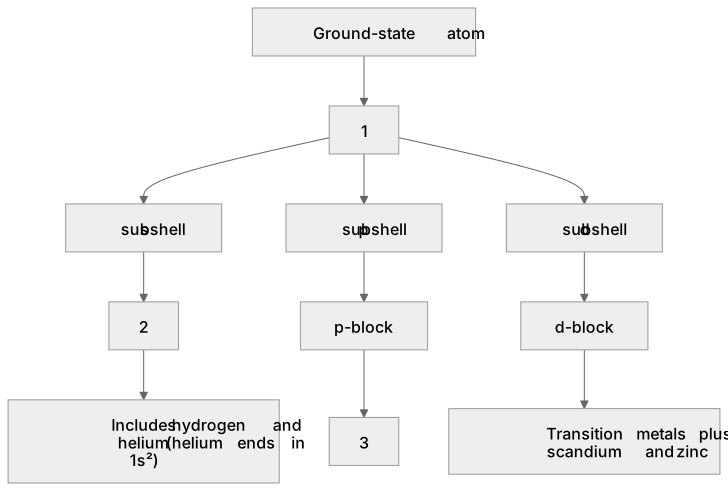
Some boxes have lost their names. Pick the right name for each number.
1Box 1
2Box 2
3Box 3
There is more to this lesson
The full lesson goes on to check your understanding and help you earn the marks. Create a free account to carry on, with your progress saved.
A week of Premium from your first lesson · Then the free plan continues · No card, no charge
Test your understanding of Periodicity: (ii) classification of elements into s-, p- and d-blocks
Active recall beats re-reading. Take an instant quiz now to test what you’ve learned and lock it into long-term memory.
A week of Premium from your first lesson · Then the free plan continues · No card, no charge