OCR · A-Level · Chemistry
Course version: H432 · Version from Sept 2017
(ii) prediction from successive ionisation energies of the number of…
Full specification wording
Periodicity: (ii) prediction from successive ionisation energies of the number of electrons in each shell of an atom and the group of an element
Successive ionisation energies are the energies needed to remove electrons one at a time from a gaseous atom.
- Point 7 of 11
- 4 key terms
Study notes
From the teaching notes for this specification point.
The idea
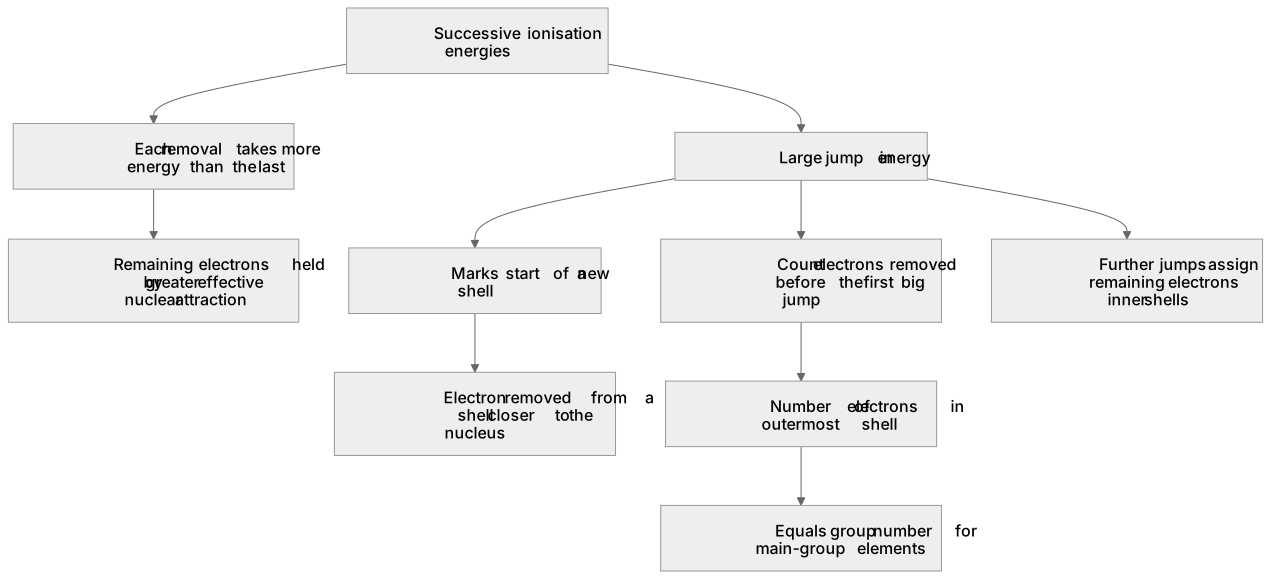
Successive ionisation energies are the energies needed to remove electrons one at a time from a gaseous atom. Each removal takes more energy than the last because the remaining electrons are held by a progressively larger effective nuclear charge relative to fewer electrons. A large jump in energy marks the start of a new shell: the electrons removed before the jump were in the outer shell, and the jump occurs when an electron is taken from a shell closer to the nucleus. Count the electrons removed before the first big jump to find the number in the outermost shell, which equals the group number for main-group elements. Repeat for each subsequent jump to assign electrons to each shell.
For example: Three electrons removed before a large jump indicate three outer electrons and Group 3.
What earns the marks
- Identifies that a large jump in successive ionisation energy marks removal of an electron from a shell closer to the nucleus.
- Counts the electrons removed before the first large jump to give the number of electrons in the outermost shell.
- Relates the number of outer-shell electrons to the group number for a main-group element.
- Uses further jumps to assign the remaining electrons to successive inner shells.
- Explains that each successive removal requires more energy because the remaining electrons experience a greater effective nuclear attraction.
Common mistakes and how to put them right
Counts the electron removed at the jump as part of the outer shell.
Put it right by counting only the electrons removed before the jump.
Treats every increase in energy as a shell change.
Put it right by identifying only the large jumps as shell boundaries.
Equates the number of outer electrons directly with the period.
Put it right by linking outer electrons to the group.
Ignores the general rise between jumps.
Put it right by explaining it through increasing effective nuclear attraction on the remaining electrons.
Exam tips
- Look for the largest proportional jump, not just any increase, when locating a shell boundary.
- Count electrons removed before the first big jump to find the group number.
- Check the total number of electrons against the element's electron configuration to confirm your shell assignment.
- State the reason for the jump — removal from a shell closer to the nucleus — rather than only quoting the number.
Try the lesson
The start of the Periodicity: (ii) prediction from successive ionisation energies of the number of electrons in each shell of an atom and the group of an element lesson, made from teaching notes for this specification point.
Listen
Successive ionisation energies are the energies needed to remove electrons one at a time from a gaseous atom. Each removal takes more energy than the last because the remaining electrons are held by a progressively larger effective nuclear charge relative to fewer electrons. A large jump in energy marks the start of a new shell: the electrons removed before the jump were in the outer shell, and the jump occurs when an electron is taken from a shell closer to the nucleus. Count the electrons removed before the first big jump to find the number in the outermost shell, which equals the group number for main-group elements. Repeat for each subsequent jump to assign electrons to each shell. For example, three electrons removed before a large jump indicate three outer electrons and Group 3. A strong answer earns marks for these points. Identifies that a large jump in successive ionisation energy marks removal of an electron from a shell closer to the nucleus. Counts the electrons removed before the first large jump to give the number of electrons in the outermost shell. Relates the number of outer-shell electrons to the group number for a main-group element. Uses further jumps to assign the remaining electrons to successive inner shells. A common slip: Counts the electron removed at the jump as part of the outer shell. Instead, counting only the electrons removed before the jump. Exam tip: Look for the largest proportional jump, not just any increase, when locating a shell boundary.
See it
Key words
Say what each word means before you turn the card.
Successive ionisation energies
Try answering aloud or in your head before turning the card.
Shell boundaries and large jumps
Try answering aloud or in your head before turning the card.
Outer-shell electron count
Try answering aloud or in your head before turning the card.
Group number prediction
Try answering aloud or in your head before turning the card.
See every definition
- Successive ionisation energies
- The energies needed to remove electrons one at a time from a gaseous atom, with each removal taking more energy than the last.
- Shell boundaries and large jumps
- A large jump in energy marks the start of a new shell, occurring when an electron is taken from a shell closer to the nucleus.
- Outer-shell electron count
- The number in the outermost shell is found by counting the electrons removed before the first big jump.
- Group number prediction
- The number of electrons in the outermost shell equals the group number for main-group elements.
Label the diagram
Some boxes have lost their names. Pick the right name for each number.
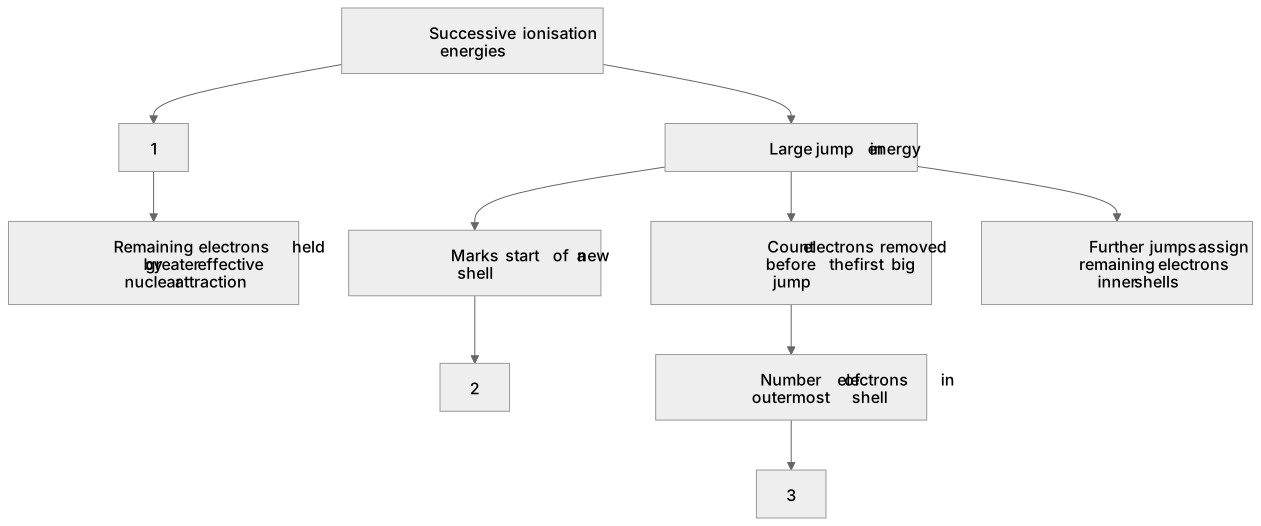
1Box 1
2Box 2
3Box 3
There is more to this lesson
The full lesson goes on to check your understanding and help you earn the marks. Create a free account to carry on, with your progress saved.
A week of Premium from your first lesson · Then the free plan continues · No card, no charge
Test your understanding of Periodicity: (ii) prediction from successive ionisation energies of the number of electrons in each shell of an atom and the group of an element
Active recall beats re-reading. Take an instant quiz now to test what you’ve learned and lock it into long-term memory.
A week of Premium from your first lesson · Then the free plan continues · No card, no charge