OCR · A-Level · Chemistry
Course version: H432 · Version from Sept 2017
Polyesters and polyamides: (i) the ester groups in polyesters
Polyesters such as PET contain many ester linkages, –COO–, formed by condensation between a dicarboxylic acid and a diol.
- Point 6 of 11
- 4 key terms
Study notes
From the teaching notes for this specification point.
The idea
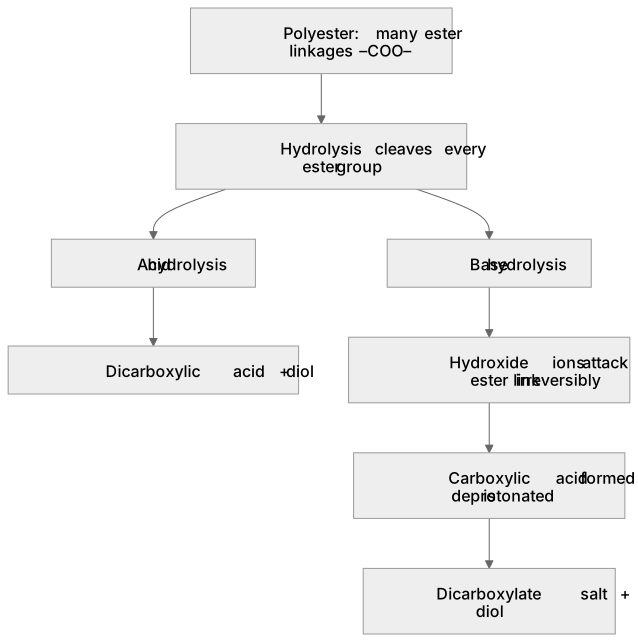
Polyesters such as PET contain many ester linkages, –COO–, formed by condensation between a dicarboxylic acid and a diol. Under acid hydrolysis, each ester link is broken by water with acid catalysis, giving the parent dicarboxylic acid and the diol; heating with dilute acid and water drives the reaction. Under base hydrolysis, hydroxide ions attack the ester link irreversibly, giving the dicarboxylate salt (for example the sodium salt of the diacid) and the diol, because the carboxylic acid formed is deprotonated to the carboxylate. So acid hydrolysis returns acid plus alcohol, while base hydrolysis returns carboxylate salt plus alcohol. Recognise that the polymer backbone is cleaved at every ester group, so the products are the monomers (or their salts), not a single small molecule.
What earns the marks
- Identifies the ester linkage –COO– as the reactive group repeated along the polyester chain.
- States that acid hydrolysis of the ester groups gives the dicarboxylic acid and the diol.
- States that base hydrolysis of the ester groups gives the dicarboxylate salt and the diol.
- Explains that hydroxide ions deprotonate the carboxylic acid formed, so the salt is the product in base hydrolysis.
- Recognises that hydrolysis cleaves the polymer at each ester group to regenerate the monomers or their salts.
Common mistakes and how to put them right
Claims that base hydrolysis gives the free carboxylic acid.
Put it right by stating that the carboxylate salt and the diol are formed.
Treats the polyester as giving one small molecule on hydrolysis.
Put it right by stating that every ester link is cleaved to give the monomers or their salts.
Confuses the products of acid and base hydrolysis.
Put it right by pairing acid hydrolysis with acid plus diol and base hydrolysis with carboxylate salt plus diol.
Exam tips
- Write the repeat unit and mark each ester link before predicting products, so you cleave the right bonds.
- Name the functional groups in the products explicitly: carboxylic acid or carboxylate salt, plus alcohol.
- Use the phrase 'dicarboxylic acid' or 'dicarboxylate salt' to show you know both acid groups are present.
Try the lesson
The start of the Polyesters and polyamides: (i) the ester groups in polyesters lesson, made from teaching notes for this specification point.
Listen
Polyesters such as PET contain many ester linkages, –COO–, formed by condensation between a dicarboxylic acid and a diol. Under acid hydrolysis, each ester link is broken by water with acid catalysis, giving the parent dicarboxylic acid and the diol; heating with dilute acid and water drives the reaction. Under base hydrolysis, hydroxide ions attack the ester link irreversibly, giving the dicarboxylate salt (for example the sodium salt of the diacid) and the diol, because the carboxylic acid formed is deprotonated to the carboxylate. So acid hydrolysis returns acid plus alcohol, while base hydrolysis returns carboxylate salt plus alcohol. Recognise that the polymer backbone is cleaved at every ester group, so the products are the monomers (or their salts), not a single small molecule. A strong answer earns marks for these points. Identifies the ester linkage –COO– as the reactive group repeated along the polyester chain. States that acid hydrolysis of the ester groups gives the dicarboxylic acid and the diol. States that base hydrolysis of the ester groups gives the dicarboxylate salt and the diol. Explains that hydroxide ions deprotonate the carboxylic acid formed, so the salt is the product in base hydrolysis. A common slip: Claims that base hydrolysis gives the free carboxylic acid. Instead, stating that the carboxylate salt and the diol are formed. Exam tip: Write the repeat unit and mark each ester link before predicting products, so you cleave the right bonds.
See it
Key words
Say what each word means before you turn the card.
Ester linkage structure in polyesters
Try answering aloud or in your head before turning the card.
Acid hydrolysis of esters
Try answering aloud or in your head before turning the card.
Base hydrolysis of esters
Try answering aloud or in your head before turning the card.
Regeneration of monomers from condensation polymers
Try answering aloud or in your head before turning the card.
See every definition
- Ester linkage structure in polyesters
- The ester groups in polyesters are the –COO– linkages repeated along the chain, formed by condensation between a dicarboxylic acid and a diol.
- Acid hydrolysis of esters
- Each ester link is broken by water with acid catalysis, giving the parent dicarboxylic acid and the diol, with heating with dilute acid and water driving the reaction.
- Base hydrolysis of esters
- Hydroxide ions attack the ester link irreversibly, giving the dicarboxylate salt and the diol, because the carboxylic acid formed is deprotonated to the carboxylate.
- Regeneration of monomers from condensation polymers
- The polymer backbone is cleaved at every ester group, so the products are the monomers or their salts, not a single small molecule.
Label the diagram
Some boxes have lost their names. Pick the right name for each number.
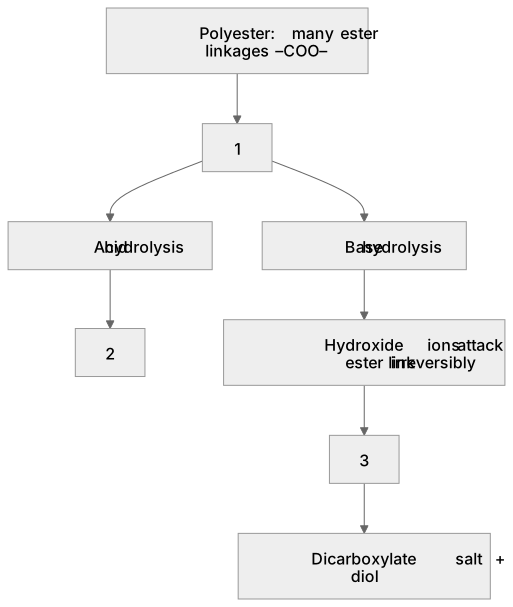
1Box 1
2Box 2
3Box 3
There is more to this lesson
The full lesson goes on to check your understanding and help you earn the marks. Create a free account to carry on, with your progress saved.
A week of Premium from your first lesson · Then the free plan continues · No card, no charge
Test your understanding of Polyesters and polyamides: (i) the ester groups in polyesters
Active recall beats re-reading. Take an instant quiz now to test what you’ve learned and lock it into long-term memory.
A week of Premium from your first lesson · Then the free plan continues · No card, no charge