OCR · A-Level · Chemistry
Course version: H432 · Version from Sept 2017
Polyesters and polyamides: (ii) the amide groups in polyamides
Polyamides are condensation polymers in which the repeat unit is joined by amide linkages, written as –CO–NH–.
- Point 7 of 11
- 4 key terms
Study notes
From the teaching notes for this specification point.
The idea
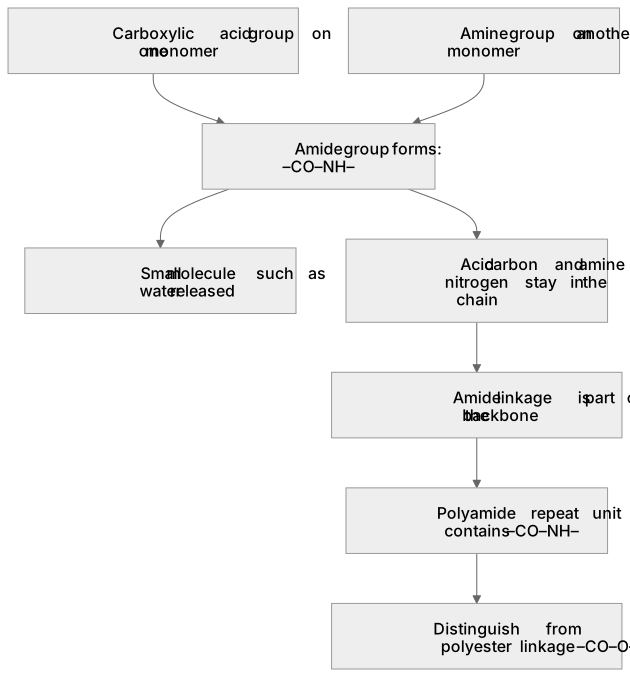
Polyamides are condensation polymers in which the repeat unit is joined by amide linkages, written as –CO–NH–. Each amide group forms when a carboxylic acid group on one monomer reacts with an amine group on another, releasing a small molecule such as water; the acid carbon and the amine nitrogen stay in the chain, so the linkage is a genuine part of the backbone rather than a side group. A familiar example is nylon-6,6, made from hexanedioic acid and 1,6-diaminohexane, whose repeat unit contains two amide groups. When you draw or read a repeat unit, locate the –CO–NH– unit, check the carbonyl carbon is bonded to the nitrogen, and confirm the chain continues from the carbonyl carbon on one side and from the nitrogen on the other. Recognising these groups lets you predict hydrolysis products and distinguish polyamides from polyesters, whose linkage is –CO–O–.
What earns the marks
- Identifies the amide linkage as –CO–NH– within the polymer backbone.
- States that the amide group forms when a carboxylic acid group reacts with an amine group with elimination of a small molecule such as water.
- Locates the carbonyl carbon bonded directly to the nitrogen in a drawn repeat unit.
- Distinguishes the amide linkage from the ester linkage –CO–O– found in polyesters.
- Recognises that each amide group is retained in the chain rather than lost as a small molecule.
Common mistakes and how to put them right
Places the oxygen between the carbonyl carbon and the nitrogen.
Put it right: Keep the amide linkage as –CO–NH– with no oxygen in the link.
Treats the amide group as a side branch.
Put it right: Show it as part of the continuous backbone chain.
Confuses the amide linkage with the ester linkage.
Put it right: Check whether the atom next to the carbonyl carbon is nitrogen or oxygen.
Omits the small molecule eliminated during condensation.
Put it right: State that water is released when the acid and amine groups join.
Exam tips
- Trace the backbone of the repeat unit and mark each –CO–NH– group before answering.
- Check the atom bonded to the carbonyl carbon: nitrogen confirms an amide, oxygen confirms an ester.
- Link the structure to the monomers by identifying which group supplied the acid carbon and which supplied the amine nitrogen.
Try the lesson
The start of the Polyesters and polyamides: (ii) the amide groups in polyamides lesson, made from teaching notes for this specification point.
Listen
Polyamides are condensation polymers in which the repeat unit is joined by amide linkages, written as –CO–NH–. Each amide group forms when a carboxylic acid group on one monomer reacts with an amine group on another, releasing a small molecule such as water; the acid carbon and the amine nitrogen stay in the chain, so the linkage is a genuine part of the backbone rather than a side group. A familiar example is nylon-6,6, made from hexanedioic acid and 1,6-diaminohexane, whose repeat unit contains two amide groups. When you draw or read a repeat unit, locate the –CO–NH– unit, check the carbonyl carbon is bonded to the nitrogen, and confirm the chain continues from the carbonyl carbon on one side and from the nitrogen on the other. Recognising these groups lets you predict hydrolysis products and distinguish polyamides from polyesters, whose linkage is –CO–O–. A strong answer earns marks for these points. Identifies the amide linkage as –CO–NH– within the polymer backbone. States that the amide group forms when a carboxylic acid group reacts with an amine group with elimination of a small molecule such as water. Locates the carbonyl carbon bonded directly to the nitrogen in a drawn repeat unit. Distinguishes the amide linkage from the ester linkage –CO–O– found in polyesters. Exam tip: Trace the backbone of the repeat unit and mark each –CO–NH– group before answering.
See it
Key words
Say what each word means before you turn the card.
Amide linkage
Try answering aloud or in your head before turning the card.
Polyamide
Try answering aloud or in your head before turning the card.
Amide group formation
Try answering aloud or in your head before turning the card.
Distinguishing polyamides from polyesters
Try answering aloud or in your head before turning the card.
See every definition
- Amide linkage
- The –CO–NH– unit within the polymer backbone, with the carbonyl carbon bonded directly to the nitrogen and no oxygen in the link.
- Polyamide
- A condensation polymer whose repeat unit is joined by amide linkages, with each amide group retained in the chain rather than lost as a small molecule.
- Amide group formation
- Forms when a carboxylic acid group on one monomer reacts with an amine group on another, releasing a small molecule such as water.
- Distinguishing polyamides from polyesters
- The amide linkage is –CO–NH–, whereas the ester linkage found in polyesters is –CO–O–.
Label the diagram
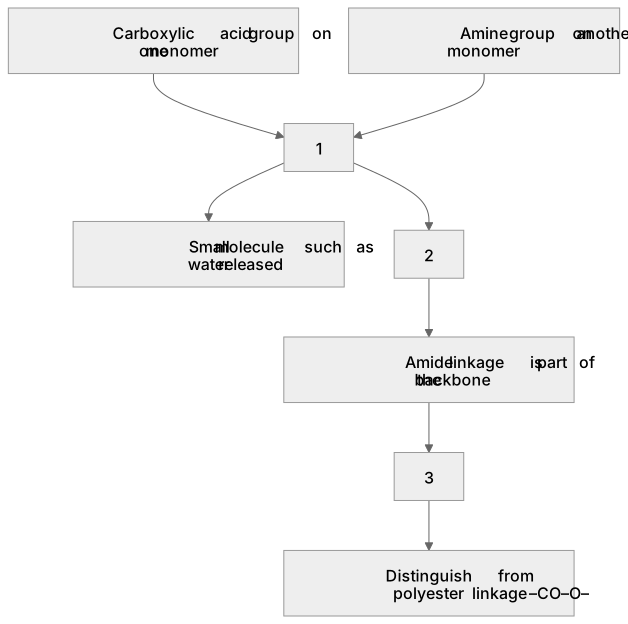
Some boxes have lost their names. Pick the right name for each number.
1Box 1
2Box 2
3Box 3
There is more to this lesson
The full lesson goes on to check your understanding and help you earn the marks. Create a free account to carry on, with your progress saved.
A week of Premium from your first lesson · Then the free plan continues · No card, no charge
Test your understanding of Polyesters and polyamides: (ii) the amide groups in polyamides
Active recall beats re-reading. Take an instant quiz now to test what you’ve learned and lock it into long-term memory.
A week of Premium from your first lesson · Then the free plan continues · No card, no charge