OCR · A-Level · Chemistry
Course version: H432 · Version from Sept 2017
Polyesters and polyamides: (i) the repeat unit from a given monomer(s)
A repeat unit is the smallest section of a polymer chain that, repeated many times, reproduces the whole structure.
- Point 9 of 11
- 3 key terms
Study notes
From the teaching notes for this specification point.
The idea
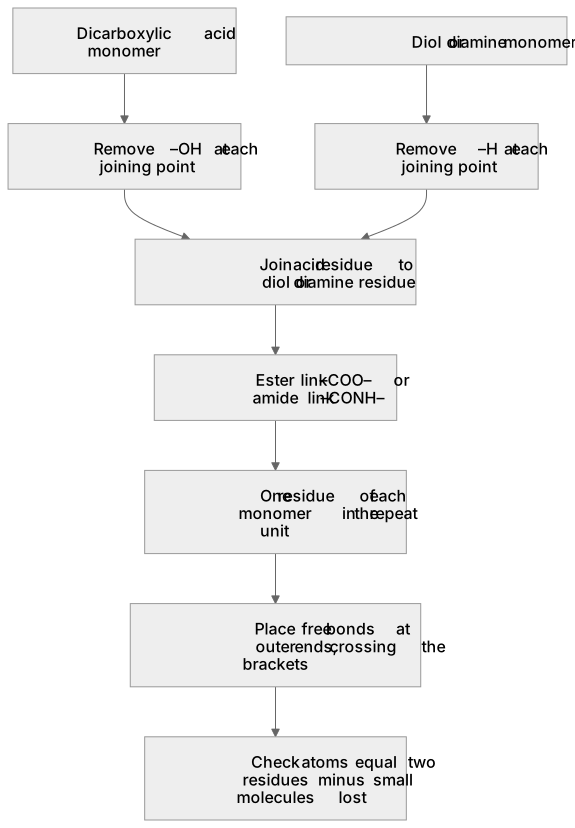
A repeat unit is the smallest section of a polymer chain that, repeated many times, reproduces the whole structure. For a polyester, take a dicarboxylic acid and a diol: the acid contributes a –COO– link and the diol contributes the other half of that ester link, so the repeat unit contains one residue of each monomer joined by two ester groups. For a polyamide, a dicarboxylic acid and a diamine give a repeat unit with –CONH– amide links. Draw the two monomer residues joined, then place the two free bonds at the outer ends of the repeat unit, shown crossing the brackets. Remove the –OH from the acid and the –H from the diol (or amine) at each joining point, and never leave the eliminated atoms inside the unit. Check that the repeat unit has the same atoms as the two residues minus the small molecules lost.
What earns the marks
- Places the two free bonds at the outer ends of the repeat unit so the unit can join to identical units on both sides.
- Joins the acid residue to the diol or diamine residue through the correct ester or amide link.
- Removes the eliminated –OH and –H atoms from the joining points so no stray hydrogen or oxygen remains.
- Includes one residue of each monomer in the repeat unit for a condensation copolymer.
- Shows the repeat unit inside brackets with the continuation bonds crossing the brackets.
Common mistakes and how to put them right
Leaves the –OH and –H atoms at the joining points inside the repeat unit.
Put it right: Remove them and show only the new ester or amide link.
Places the free bonds on the inner atoms of the chain.
Put it right: Move both free bonds to the outer ends of the repeat unit.
Draws only one monomer residue for a copolymer.
Put it right: Include one residue of each monomer joined by the link.
Writes the repeat unit without brackets or continuation bonds.
Put it right: Enclose it in brackets with bonds crossing them.
Exam tips
- Identify the functional groups on each monomer before drawing, then decide which atoms are eliminated at each join.
- Count the atoms in your repeat unit and compare with the two residues minus the small molecules lost.
- Show the continuation bonds clearly crossing the brackets so the examiner can see the unit repeats.
Try the lesson
The start of the Polyesters and polyamides: (i) the repeat unit from a given monomer(s) lesson, made from teaching notes for this specification point.
Listen
A repeat unit is the smallest section of a polymer chain that, repeated many times, reproduces the whole structure. For a polyester, take a dicarboxylic acid and a diol: the acid contributes a –COO– link and the diol contributes the other half of that ester link, so the repeat unit contains one residue of each monomer joined by two ester groups. For a polyamide, a dicarboxylic acid and a diamine give a repeat unit with –CONH– amide links. Draw the two monomer residues joined, then place the two free bonds at the outer ends of the repeat unit, shown crossing the brackets. Remove the –OH from the acid and the –H from the diol (or amine) at each joining point, and never leave the eliminated atoms inside the unit. Check that the repeat unit has the same atoms as the two residues minus the small molecules lost. A strong answer earns marks for these points. Places the two free bonds at the outer ends of the repeat unit so the unit can join to identical units on both sides. Joins the acid residue to the diol or diamine residue through the correct ester or amide link. Removes the eliminated –OH and –H atoms from the joining points so no stray hydrogen or oxygen remains. Includes one residue of each monomer in the repeat unit for a condensation copolymer. Exam tip: Identify the functional groups on each monomer before drawing, then decide which atoms are eliminated at each join.
See it
Key words
Say what each word means before you turn the card.
Repeat unit structure
Try answering aloud or in your head before turning the card.
Ester and amide links
Try answering aloud or in your head before turning the card.
Monomer residues and eliminated small molecules
Try answering aloud or in your head before turning the card.
See every definition
- Repeat unit structure
- The smallest section of a polymer chain that, repeated many times, reproduces the whole structure, shown inside brackets with the continuation bonds crossing the brackets.
- Ester and amide links
- A polyester repeat unit contains one residue of each monomer joined by two ester groups, while a polyamide repeat unit has –CONH– amide links.
- Monomer residues and eliminated small molecules
- The –OH from the acid and the –H from the diol or amine are removed at each joining point, and the eliminated atoms are never left inside the unit.
Label the diagram
Some boxes have lost their names. Pick the right name for each number.
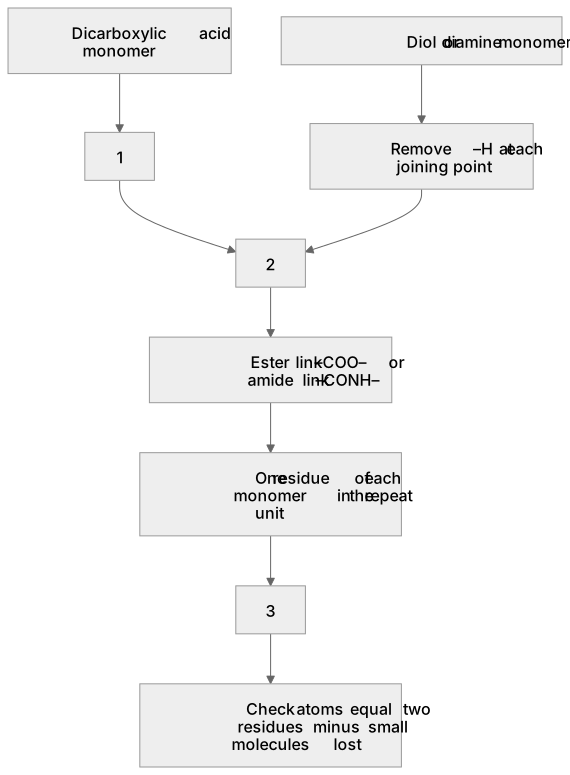
1Box 1
2Box 2
3Box 3
There is more to this lesson
The full lesson goes on to check your understanding and help you earn the marks. Create a free account to carry on, with your progress saved.
A week of Premium from your first lesson · Then the free plan continues · No card, no charge
Test your understanding of Polyesters and polyamides: (i) the repeat unit from a given monomer(s)
Active recall beats re-reading. Take an instant quiz now to test what you’ve learned and lock it into long-term memory.
A week of Premium from your first lesson · Then the free plan continues · No card, no charge