OCR · A-Level · Chemistry
Course version: H432 · Version from Sept 2017
(d) (i) explanation of the terms homogeneous and heterogeneous catalysts
Full specification wording
Reaction rates: (d) (i) explanation of the terms homogeneous and heterogeneous catalysts
Catalysts are classified by the phase relationship between the catalyst and the reactants.
- Point 8 of 14
- 4 key terms
Study notes
From the teaching notes for this specification point.
The idea
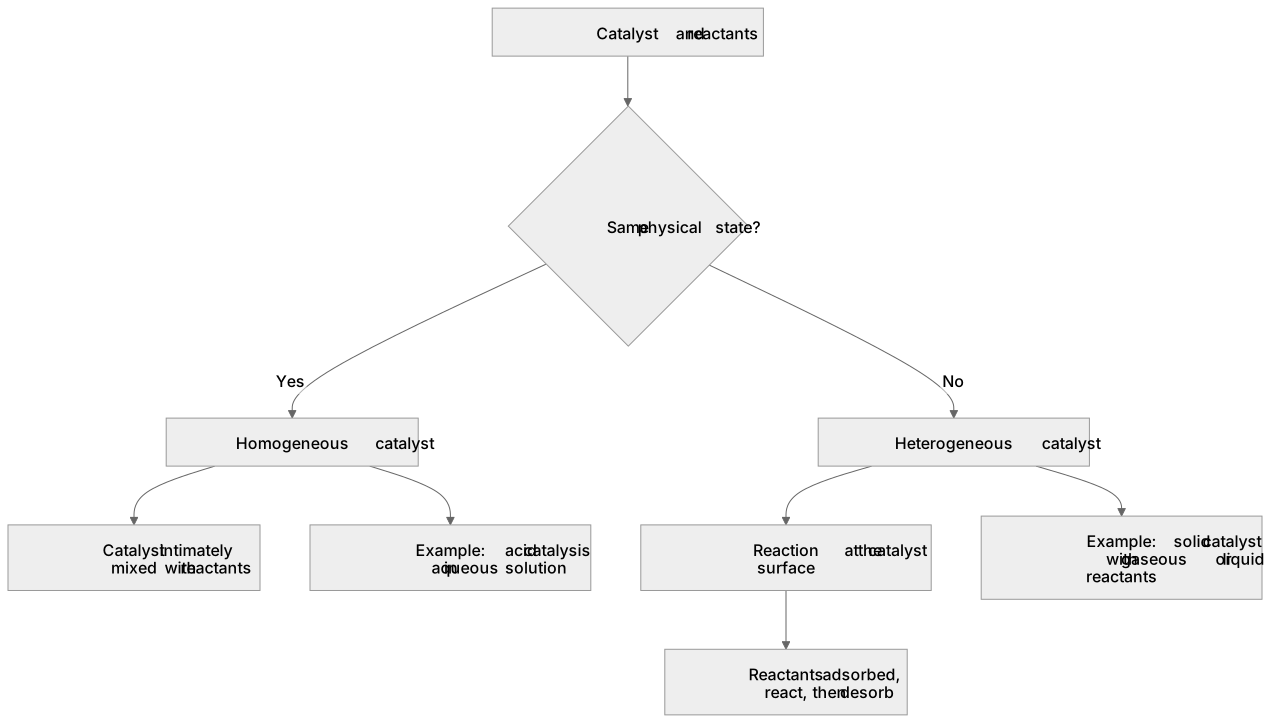
Catalysts are classified by the phase relationship between the catalyst and the reactants. A homogeneous catalyst is in the same physical state as the reactants, so it is usually dissolved in the same solution or present in the same gas mixture; an example is acid catalysis in aqueous solution, where hydrogen ions in solution catalyse a reaction between species also in solution. A heterogeneous catalyst is in a different physical state from the reactants, typically a solid catalyst with gaseous or liquid reactants; the reaction occurs at the catalyst surface, where reactant molecules are adsorbed, react and then desorb. Recognising the phase relationship lets you explain why heterogeneous catalysis depends on surface area while homogeneous catalysis depends on the catalyst being intimately mixed with the reactants.
What earns the marks
- Defines a homogeneous catalyst as one in the same physical state as the reactants.
- Defines a heterogeneous catalyst as one in a different physical state from the reactants.
- Gives a valid example of homogeneous catalysis in which catalyst and reactants share a phase, such as an aqueous acid catalyst.
- Gives a valid example of heterogeneous catalysis in which a solid catalyst acts on gaseous or liquid reactants.
- Explains that heterogeneous catalysis takes place at the surface of the catalyst, where reactants are adsorbed.
Common mistakes and how to put them right
Confuses the two terms by calling a solid catalyst with gaseous reactants homogeneous.
Put it right by checking whether catalyst and reactants share a physical state.
Defines the terms by whether the catalyst dissolves rather than by the physical states involved.
Put it right by basing the definition on the phase relationship.
Describes a heterogeneous catalyst as reacting in the bulk of the gas rather than at its surface.
Put it right by locating the reaction at the catalyst surface.
Omits an example when asked to explain the terms.
Put it right by supplying one clear example of each type.
Exam tips
- State the physical state of the catalyst and of the reactants explicitly when classifying a system.
- Use a familiar industrial or laboratory example to anchor each definition.
- For heterogeneous systems, mention adsorption at the surface to show why surface area matters.
- Read the question carefully to see whether it asks for a definition, an example, or both.
Try the lesson
The start of the Reaction rates: (d) (i) explanation of the terms homogeneous and heterogeneous catalysts lesson, made from teaching notes for this specification point.
Listen
Catalysts are classified by the phase relationship between the catalyst and the reactants. A homogeneous catalyst is in the same physical state as the reactants, so it is usually dissolved in the same solution or present in the same gas mixture; an example is acid catalysis in aqueous solution, where hydrogen ions in solution catalyse a reaction between species also in solution. A heterogeneous catalyst is in a different physical state from the reactants, typically a solid catalyst with gaseous or liquid reactants; the reaction occurs at the catalyst surface, where reactant molecules are adsorbed, react and then desorb. Recognising the phase relationship lets you explain why heterogeneous catalysis depends on surface area while homogeneous catalysis depends on the catalyst being intimately mixed with the reactants. A strong answer earns marks for these points. Defines a homogeneous catalyst as one in the same physical state as the reactants. Defines a heterogeneous catalyst as one in a different physical state from the reactants. Gives a valid example of homogeneous catalysis in which catalyst and reactants share a phase, such as an aqueous acid catalyst. Gives a valid example of heterogeneous catalysis in which a solid catalyst acts on gaseous or liquid reactants. A common slip: Confuses the two terms by calling a solid catalyst with gaseous reactants homogeneous. Instead, checking whether catalyst and reactants share a physical state. Exam tip: State the physical state of the catalyst and of the reactants explicitly when classifying a system.
See it
Key words
Say what each word means before you turn the card.
Homogeneous catalysis
Try answering aloud or in your head before turning the card.
Heterogeneous catalysis
Try answering aloud or in your head before turning the card.
Surface adsorption
Try answering aloud or in your head before turning the card.
Catalyst examples
Try answering aloud or in your head before turning the card.
See every definition
- Homogeneous catalysis
- A catalyst is in the same physical state as the reactants, so it is usually dissolved in the same solution or present in the same gas mixture.
- Heterogeneous catalysis
- A catalyst is in a different physical state from the reactants, typically a solid catalyst with gaseous or liquid reactants.
- Surface adsorption
- In heterogeneous catalysis the reaction occurs at the catalyst surface, where reactant molecules are adsorbed, react and then desorb.
- Catalyst examples
- Acid catalysis in aqueous solution, where hydrogen ions in solution catalyse a reaction between species also in solution, is an example of homogeneous catalysis.
There is more to this lesson
The full lesson goes on to check your understanding and help you earn the marks. Create a free account to carry on, with your progress saved.
A week of Premium from your first lesson · Then the free plan continues · No card, no charge
Test your understanding of Reaction rates: (d) (i) explanation of the terms homogeneous and heterogeneous catalysts
Active recall beats re-reading. Take an instant quiz now to test what you’ve learned and lock it into long-term memory.
A week of Premium from your first lesson · Then the free plan continues · No card, no charge