OCR · A-Level · Chemistry
Course version: H432 · Version from Sept 2017
(ii) explanation that catalysts have great economic importance and…
Full specification wording
Reaction rates: (ii) explanation that catalysts have great economic importance and benefits for increased sustainability by lowering temperatures and reducing energy demand from combustion of fossil fuels with resulting reduction in CO₂ emissions
A catalyst provides an alternative reaction pathway of lower activation energy, so a given rate is achieved at a lower temperature and with less heating.
- Point 9 of 14
- 4 key terms
Study notes
From the teaching notes for this specification point.
The idea
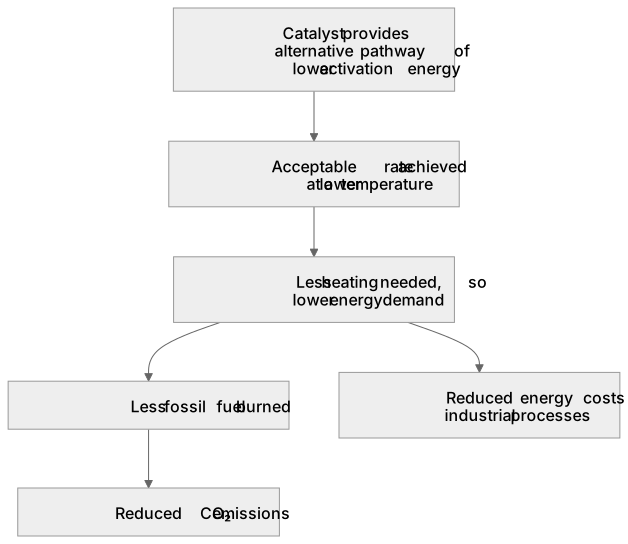
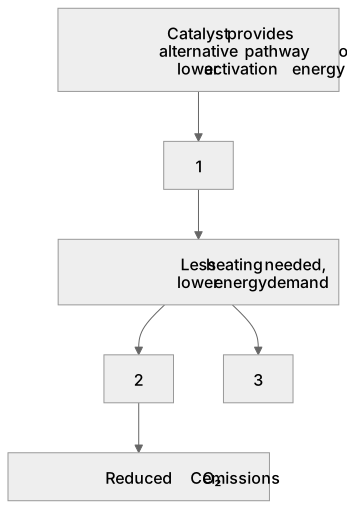
A catalyst provides an alternative reaction pathway of lower activation energy, so a given rate is achieved at a lower temperature and with less heating. This matters economically because energy is a major cost in industrial processes, and a lower operating temperature can reduce fuel consumption and equipment demands. It matters for sustainability because much industrial heating relies on burning fossil fuels; using less fuel lowers energy demand and therefore reduces the CO₂ emissions associated with that combustion. A strong answer links the chain explicitly: catalyst lowers activation energy, so a lower temperature gives an acceptable rate, so less fossil fuel is burned, so less CO₂ is released. Keep the link causal rather than listing benefits separately.
What earns the marks
- States that a catalyst provides an alternative pathway with a lower activation energy.
- Explains that the lower activation energy allows an acceptable rate at a lower temperature.
- Links lower energy demand to reduced combustion of fossil fuels.
- Connects reduced fossil-fuel combustion to lower CO₂ emissions.
- Identifies economic importance as reduced energy costs in industrial processes.
Common mistakes and how to put them right
Claims that a catalyst increases the yield of an equilibrium reaction.
Put it right by stating that a catalyst speeds the approach to equilibrium without changing the position of equilibrium.
Says a catalyst is used up in the reaction.
Put it right by stating that a catalyst is not consumed overall and can be used repeatedly.
Lists sustainability benefits without linking them to lower temperature and energy demand.
Put it right by tracing the causal chain from activation energy to CO₂ emissions.
Exam tips
- Write the causal chain in order: lower activation energy, lower temperature, less fossil fuel burned, less CO₂ emitted.
- Use the phrase 'alternative pathway of lower activation energy' rather than saying a catalyst 'lowers the activation energy of the reaction' loosely.
- Tie economic importance to energy costs and sustainability to emissions, so both clauses of the statement are addressed.
Try the lesson
The start of the Reaction rates: (ii) explanation that catalysts have great economic importance and benefits for increased sustainability by lowering temperatures and reducing energy demand from combustion of fossil fuels with resulting reduction in CO₂ emissions lesson, made from teaching notes for this specification point.
Listen
A catalyst provides an alternative reaction pathway of lower activation energy, so a given rate is achieved at a lower temperature and with less heating. This matters economically because energy is a major cost in industrial processes, and a lower operating temperature can reduce fuel consumption and equipment demands. It matters for sustainability because much industrial heating relies on burning fossil fuels; using less fuel lowers energy demand and therefore reduces the CO₂ emissions associated with that combustion. A strong answer links the chain explicitly: catalyst lowers activation energy, so a lower temperature gives an acceptable rate, so less fossil fuel is burned, so less CO₂ is released. Keep the link causal rather than listing benefits separately. A strong answer earns marks for these points. States that a catalyst provides an alternative pathway with a lower activation energy. Explains that the lower activation energy allows an acceptable rate at a lower temperature. Links lower energy demand to reduced combustion of fossil fuels. Connects reduced fossil-fuel combustion to lower CO₂ emissions. A common slip: Claims that a catalyst increases the yield of an equilibrium reaction. Instead, stating that a catalyst speeds the approach to equilibrium without changing the position of equilibrium. Exam tip: Write the causal chain in order: lower activation energy, lower temperature, less fossil fuel burned, less CO₂ emitted.
See it
Key words
Say what each word means before you turn the card.
Catalysis and activation energy
Try answering aloud or in your head before turning the card.
Rates of reaction and temperature
Try answering aloud or in your head before turning the card.
Economic importance of catalysts
Try answering aloud or in your head before turning the card.
Sustainability and CO₂ emissions
Try answering aloud or in your head before turning the card.
See every definition
- Catalysis and activation energy
- A catalyst provides an alternative reaction pathway of lower activation energy, so a given rate is achieved at a lower temperature.
- Rates of reaction and temperature
- The lower activation energy allows an acceptable rate at a lower temperature, and less heating is needed.
- Economic importance of catalysts
- Energy is a major cost in industrial processes, so reduced energy demand lowers energy costs.
- Sustainability and CO₂ emissions
- Much industrial heating relies on burning fossil fuels, so using less fuel lowers energy demand and reduces the CO₂ emissions associated with that combustion.
Label the diagram
Some boxes have lost their names. Pick the right name for each number.
1Box 1
2Box 2
3Box 3
There is more to this lesson
The full lesson goes on to check your understanding and help you earn the marks. Create a free account to carry on, with your progress saved.
A week of Premium from your first lesson · Then the free plan continues · No card, no charge
Test your understanding of Reaction rates: (ii) explanation that catalysts have great economic importance and benefits for increased sustainability by lowering temperatures and reducing energy demand from combustion of fossil fuels with resulting reduction in CO₂ emissions
Active recall beats re-reading. Take an instant quiz now to test what you’ve learned and lock it into long-term memory.
A week of Premium from your first lesson · Then the free plan continues · No card, no charge