OCR · A-Level · Chemistry
Course version: H432 · Version from Sept 2017
Reaction rates: (i) temperature changes
Temperature is one of the factors affecting reaction rate.
- Point 13 of 14
- 4 key terms
Study notes
From the teaching notes for this specification point.
The idea
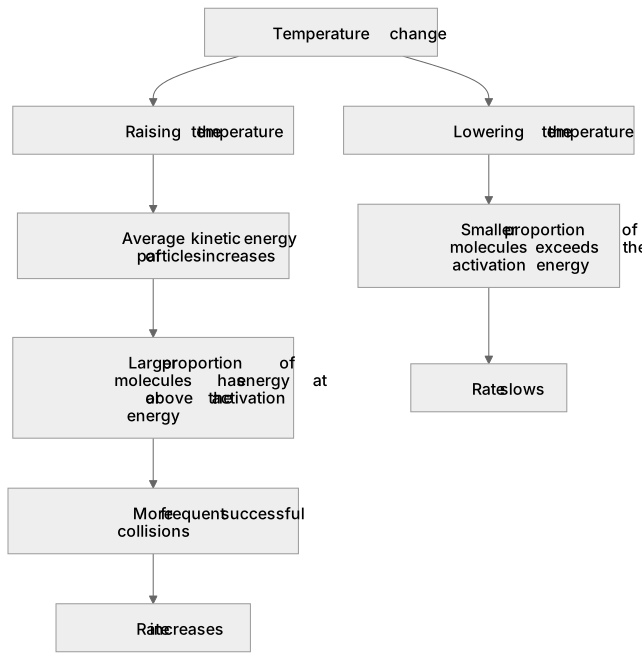
Temperature is one of the factors affecting reaction rate. Raising the temperature increases the average kinetic energy of the particles, so a larger proportion of molecules has energy at or above the activation energy. More frequent successful collisions result, so the rate increases. Lowering the temperature reduces the proportion exceeding the activation energy and slows the reaction. In a multiple-choice question, select the option that correctly links the temperature change to the proportion of molecules exceeding the activation energy and to the rate, and reject options that wrongly say the activation energy itself changes or that all molecules gain equal energy.
What earns the marks
- Selects the option stating that raising the temperature increases the proportion of molecules with energy at or above the activation energy.
- Selects the option linking the increased proportion exceeding the activation energy to a higher rate of successful collisions.
- Rejects options claiming that raising the temperature lowers the activation energy.
- Rejects options claiming that heating gives every molecule the same increase in energy.
Common mistakes and how to put them right
Chooses an option saying the activation energy decreases on heating.
Put it right: Keep the activation energy fixed and change the proportion exceeding it.
Chooses an option saying all molecules gain equal energy.
Put it right: Recognise that heating broadens the spread of energies.
Chooses an option that changes the proportion exceeding Ea but omits the effect on rate.
Put it right: Require the full causal link.
Exam tips
- Read every option and eliminate those that alter the activation energy rather than the proportion exceeding it.
- Look for the option that names both the proportion exceeding the activation energy and the effect on rate.
- Check the direction of the temperature change before choosing between faster and slower rate options.
Try the lesson
The start of the Reaction rates: (i) temperature changes lesson, made from teaching notes for this specification point.
Listen
Temperature is one of the factors affecting reaction rate. Raising the temperature increases the average kinetic energy of the particles, so a larger proportion of molecules has energy at or above the activation energy. More frequent successful collisions result, so the rate increases. Lowering the temperature reduces the proportion exceeding the activation energy and slows the reaction. In a multiple-choice question, select the option that correctly links the temperature change to the proportion of molecules exceeding the activation energy and to the rate, and reject options that wrongly say the activation energy itself changes or that all molecules gain equal energy. A strong answer earns marks for these points. Selects the option stating that raising the temperature increases the proportion of molecules with energy at or above the activation energy. Selects the option linking the increased proportion exceeding the activation energy to a higher rate of successful collisions. Rejects options claiming that raising the temperature lowers the activation energy. Rejects options claiming that heating gives every molecule the same increase in energy. Exam tip: Read every option and eliminate those that alter the activation energy rather than the proportion exceeding it.
See it
Key words
Say what each word means before you turn the card.
Temperature as a rate factor
Try answering aloud or in your head before turning the card.
Proportion of molecules exceeding activation energy
Try answering aloud or in your head before turning the card.
Collision frequency and rate
Try answering aloud or in your head before turning the card.
Fixed activation energy
Try answering aloud or in your head before turning the card.
See every definition
- Temperature as a rate factor
- Raising the temperature increases the average kinetic energy of the particles, so the rate increases; lowering it slows the reaction.
- Proportion of molecules exceeding activation energy
- Raising the temperature means a larger proportion of molecules has energy at or above the activation energy, while lowering it reduces that proportion.
- Collision frequency and rate
- A larger proportion of molecules with energy at or above the activation energy gives more frequent successful collisions, so the rate increases.
- Fixed activation energy
- The activation energy itself does not change with temperature; what changes is the proportion of molecules exceeding it.
Label the diagram
Some boxes have lost their names. Pick the right name for each number.
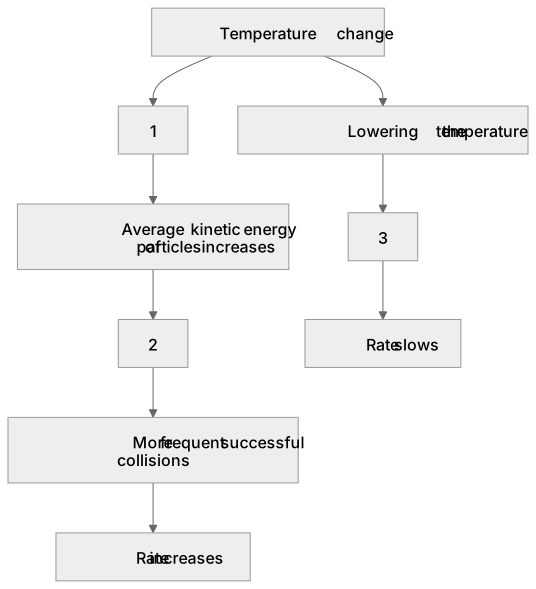
1Box 1
2Box 2
3Box 3
There is more to this lesson
The full lesson goes on to check your understanding and help you earn the marks. Create a free account to carry on, with your progress saved.
A week of Premium from your first lesson · Then the free plan continues · No card, no charge
Test your understanding of Reaction rates: (i) temperature changes
Active recall beats re-reading. Take an instant quiz now to test what you’ve learned and lock it into long-term memory.
A week of Premium from your first lesson · Then the free plan continues · No card, no charge