OCR · A-Level · Chemistry
Course version: H432 · Version from Sept 2017
Reaction rates: (ii) catalytic behaviour (see also 3.2.2 c).
A catalyst raises the rate of a reaction by providing an alternative route of lower activation energy, and it is not consumed overall.
- Point 14 of 14
- 4 key terms
Study notes
From the teaching notes for this specification point.
The idea
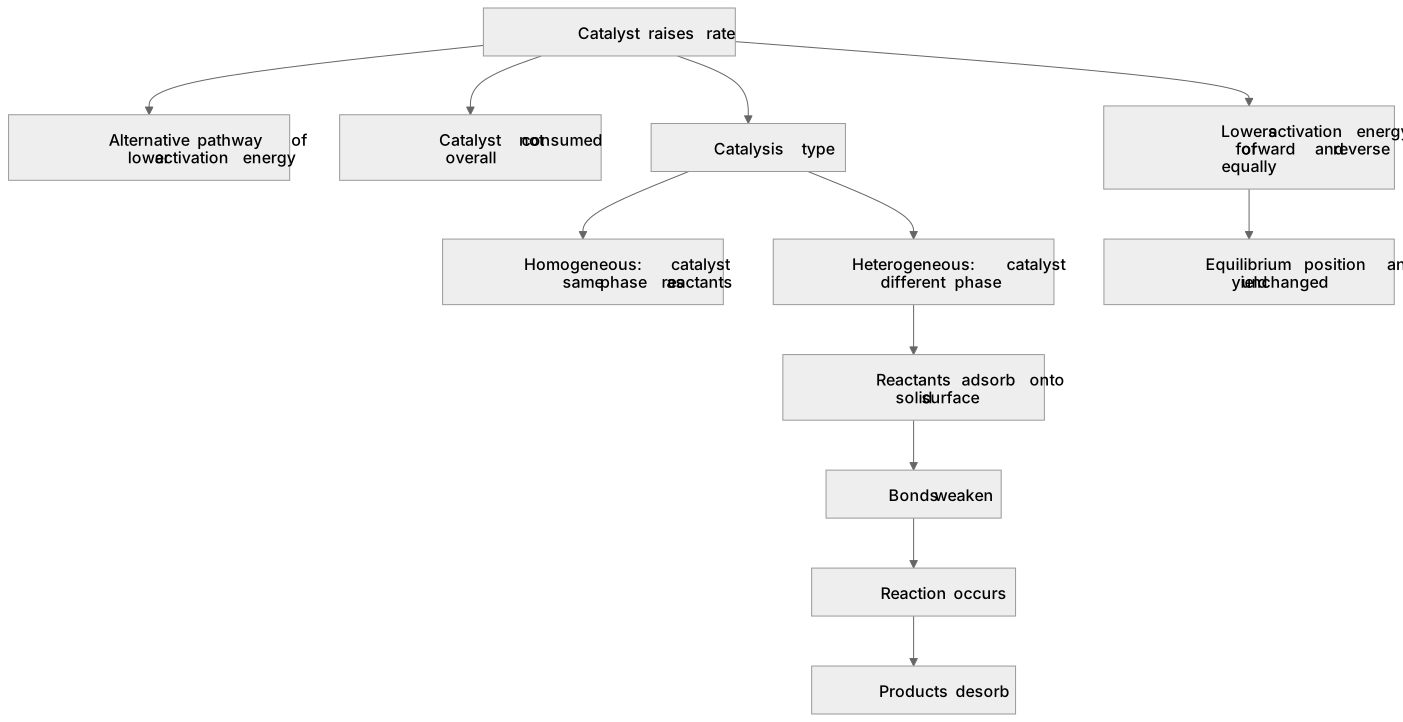
A catalyst raises the rate of a reaction by providing an alternative route of lower activation energy, and it is not consumed overall. In homogeneous catalysis the catalyst is in the same phase as the reactants, for example Fe²⁺/Fe³⁺ ions in the peroxodisulfate–iodide reaction; in heterogeneous catalysis the catalyst is in a different phase, typically a solid surface such as iron in the Haber process, where reactant molecules adsorb, bonds weaken, reaction occurs and products desorb. The catalyst lowers the activation energy for both the forward and reverse reactions equally, so it speeds the approach to equilibrium but does not change the position of equilibrium or the yield at equilibrium. Enzymes act as biological catalysts with high specificity. A catalyst may be poisoned by impurities that block active sites, which reduces its effectiveness.
What earns the marks
- States that a catalyst increases the rate of reaction by providing an alternative pathway of lower activation energy.
- Distinguishes homogeneous catalysis, where the catalyst is in the same phase as the reactants, from heterogeneous catalysis, where the phases differ.
- Explains that a catalyst lowers the activation energy of both forward and reverse reactions equally, so equilibrium position and yield are unchanged.
- Describes heterogeneous catalysis in terms of adsorption of reactants onto the solid surface, weakening of bonds, reaction and desorption of products.
- Identifies that a catalyst is not used up overall and can be recovered chemically unchanged at the end of the reaction.
- Explains that catalyst poisoning occurs when impurities block active sites and reduce catalytic effectiveness.
Common mistakes and how to put them right
Claims that a catalyst increases the equilibrium yield.
Put it right by stating that a catalyst changes only the rate of attainment of equilibrium, not its position.
Describes a catalyst as being used up in the reaction.
Put it right by stating that it is not consumed overall and is regenerated.
Confuses homogeneous and heterogeneous catalysis.
Put it right by checking whether catalyst and reactants share the same physical phase.
States that a catalyst lowers the activation energy of only the forward reaction.
Put it right by noting that both directions are lowered equally.
Exam tips
- Read the stem carefully to identify whether the question asks about rate, equilibrium position or yield, because a catalyst affects only rate and time to equilibrium.
- Link the type of catalysis to the physical state of catalyst and reactants before choosing an option.
- Eliminate options that claim a catalyst is consumed or that it shifts the position of equilibrium.
- Recall a named example such as iron in the Haber process to check heterogeneous surface catalysis reasoning.
Try the lesson
The start of the Reaction rates: (ii) catalytic behaviour (see also 3.2.2 c). lesson, made from teaching notes for this specification point.
Listen
A catalyst raises the rate of a reaction by providing an alternative route of lower activation energy, and it is not consumed overall. In homogeneous catalysis the catalyst is in the same phase as the reactants, for example Fe²⁺/Fe³⁺ ions in the peroxodisulfate–iodide reaction; in heterogeneous catalysis the catalyst is in a different phase, typically a solid surface such as iron in the Haber process, where reactant molecules adsorb, bonds weaken, reaction occurs and products desorb. The catalyst lowers the activation energy for both the forward and reverse reactions equally, so it speeds the approach to equilibrium but does not change the position of equilibrium or the yield at equilibrium. Enzymes act as biological catalysts with high specificity. A catalyst may be poisoned by impurities that block active sites, which reduces its effectiveness. A strong answer earns marks for these points. States that a catalyst increases the rate of reaction by providing an alternative pathway of lower activation energy. Distinguishes homogeneous catalysis, where the catalyst is in the same phase as the reactants, from heterogeneous catalysis, where the phases differ. Explains that a catalyst lowers the activation energy of both forward and reverse reactions equally, so equilibrium position and yield are unchanged. Describes heterogeneous catalysis in terms of adsorption of reactants onto the solid surface, weakening of bonds, reaction and desorption of products. A common slip: Claims that a catalyst increases the equilibrium yield. Instead, stating that a catalyst changes only the rate of attainment of equilibrium, not its position. Exam tip: Read the stem carefully to identify whether the question asks about rate, equilibrium position or yield, because a catalyst affects only rate and time to equilibrium.
See it
Key words
Say what each word means before you turn the card.
Catalysis and activation energy
Try answering aloud or in your head before turning the card.
Homogeneous and heterogeneous catalysis
Try answering aloud or in your head before turning the card.
Effect of catalysts on equilibrium
Try answering aloud or in your head before turning the card.
Catalyst poisoning and industrial application
Try answering aloud or in your head before turning the card.
See every definition
- Catalysis and activation energy
- A catalyst raises the rate of a reaction by providing an alternative route of lower activation energy, and it is not consumed overall.
- Homogeneous and heterogeneous catalysis
- In homogeneous catalysis the catalyst is in the same phase as the reactants; in heterogeneous catalysis the catalyst is in a different phase, typically a solid surface.
- Effect of catalysts on equilibrium
- The catalyst lowers the activation energy for both the forward and reverse reactions equally, so it speeds the approach to equilibrium but does not change the position of equilibrium or the yield at equilibrium.
- Catalyst poisoning and industrial application
- A catalyst may be poisoned by impurities that block active sites, which reduces its effectiveness.
Label the diagram
Some boxes have lost their names. Pick the right name for each number.
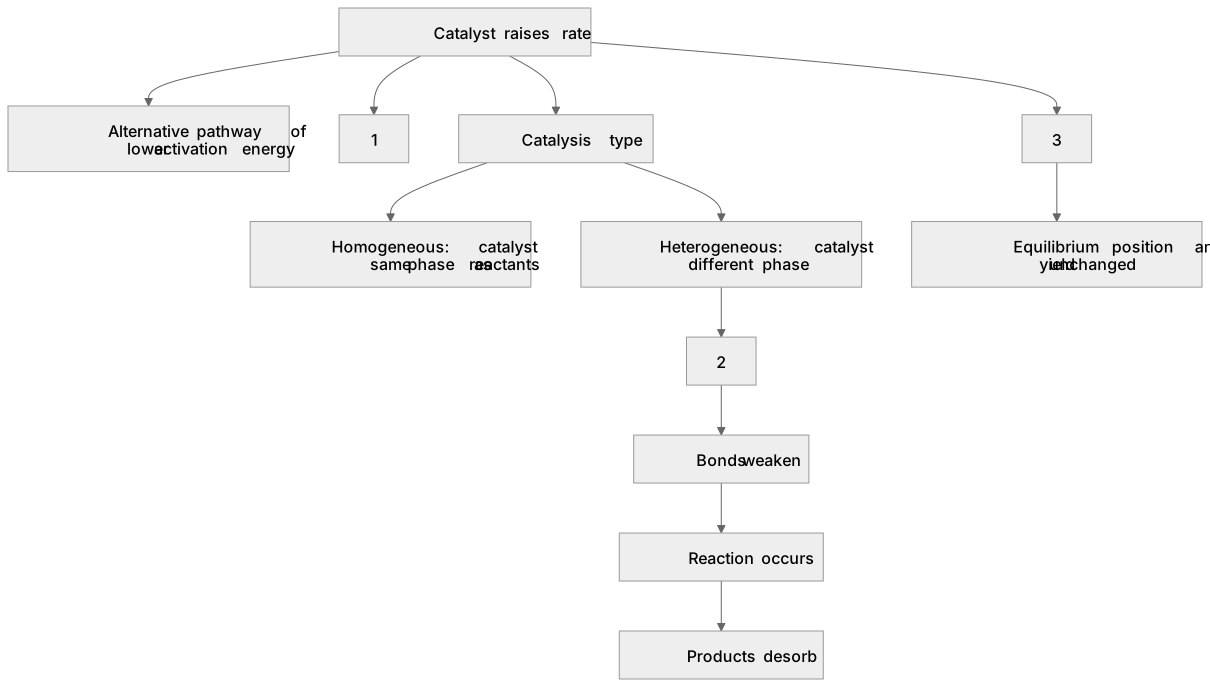
1Box 1
2Box 2
3Box 3
There is more to this lesson
The full lesson goes on to check your understanding and help you earn the marks. Create a free account to carry on, with your progress saved.
A week of Premium from your first lesson · Then the free plan continues · No card, no charge
Test your understanding of Reaction rates: (ii) catalytic behaviour (see also 3.2.2 c).
Active recall beats re-reading. Take an instant quiz now to test what you’ve learned and lock it into long-term memory.
A week of Premium from your first lesson · Then the free plan continues · No card, no charge