OCR · A-Level · Chemistry
Course version: H432 · Version from Sept 2017
(d) the techniques and procedures used when carrying out redox titrations…
Full specification wording
Redox and electrode potentials: (d) the techniques and procedures used when carrying out redox titrations including those involving Fe²⁺/MnO₄⁻ and I₂/S₂O₃²⁻ (see also 2.1.5 e–f)
You must know the practical techniques for redox titrations, applied to two systems.
- Point 4 of 14
- 4 key terms
Study notes
From the teaching notes for this specification point.
The idea
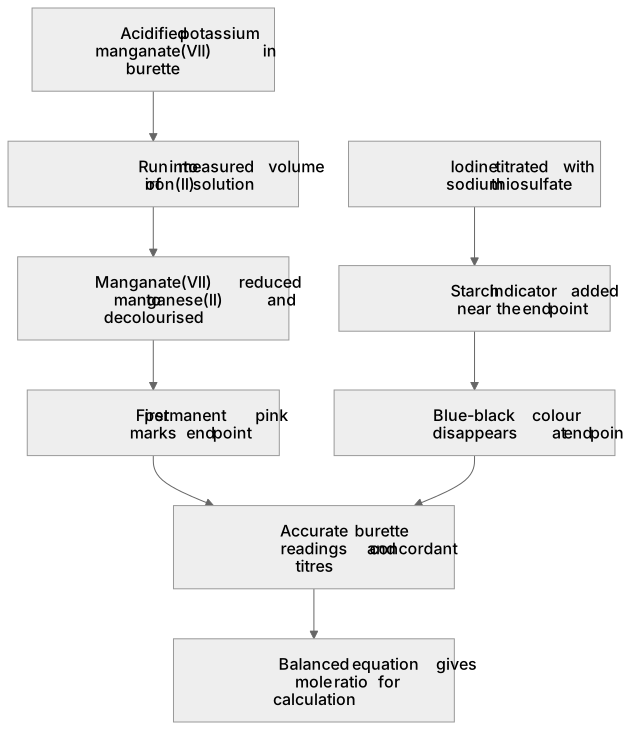
You must know the practical techniques for redox titrations, applied to two systems. In the Fe²⁺/MnO₄⁻ titration, acidified potassium manganate(VII) is added from a burette to a measured volume of iron(II) solution; MnO₄⁻ is self-indicating, turning from purple to colourless as it is reduced to Mn²⁺, with the first permanent pink marking the end point. In the I₂/S₂O₃²⁻ titration, iodine is titrated with sodium thiosulfate using starch indicator, which gives a blue-black colour that disappears at the end point. Both rely on accurate burette readings, concordant titres and mole-ratio calculations.
What earns the marks
- States that acidified potassium manganate(VII) is run from a burette into a measured volume of iron(II) solution until a permanent pink colour persists.
- Explains that manganate(VII) is self-indicating because it is decolourised as it is reduced to manganese(II).
- Describes titrating iodine with sodium thiosulfate using starch indicator, added near the end point, until the blue-black colour disappears.
- Uses the balanced equation to establish the mole ratio, for example five moles of Fe²⁺ react with one mole of MnO₄⁻, before calculating concentration.
- Identifies that acid is added to the manganate(VII) titration to supply H⁺ ions and that the acid must not itself be oxidised.
Common mistakes and how to put them right
Adds starch indicator at the start of the iodine titration.
Put it right: Add it when the solution is pale yellow so the colour change is sharp.
Uses hydrochloric acid to acidify the manganate(VII) titration.
Put it right: Use dilute sulfuric acid because chloride ions would be oxidised.
Ignores the stoichiometric ratio and treats reactants as reacting one to one.
Put it right: Apply the balanced equation to find the mole ratio.
Exam tips
- Learn the colour changes precisely: purple to colourless for manganate(VII), and blue-black to colourless for the starch-iodine complex.
- Write the balanced half-equations and combine them so the electron transfer gives the correct mole ratio before any calculation.
- State why each reagent is used, such as the role of acid or the timing of starch addition, because procedure questions often test the reason rather than the step.
Try the lesson
The start of the Redox and electrode potentials: (d) the techniques and procedures used when carrying out redox titrations including those involving Fe²⁺/MnO₄⁻ and I₂/S₂O₃²⁻ (see also 2.1.5 e–f) lesson, made from teaching notes for this specification point.
Listen
You must know the practical techniques for redox titrations, applied to two systems. In the Fe²⁺/MnO₄⁻ titration, acidified potassium manganate(VII) is added from a burette to a measured volume of iron(II) solution; MnO₄⁻ is self-indicating, turning from purple to colourless as it is reduced to Mn²⁺, with the first permanent pink marking the end point. In the I₂/S₂O₃²⁻ titration, iodine is titrated with sodium thiosulfate using starch indicator, which gives a blue-black colour that disappears at the end point. Both rely on accurate burette readings, concordant titres and mole-ratio calculations. A strong answer earns marks for these points. States that acidified potassium manganate(VII) is run from a burette into a measured volume of iron(II) solution until a permanent pink colour persists. Explains that manganate(VII) is self-indicating because it is decolourised as it is reduced to manganese(II). Describes titrating iodine with sodium thiosulfate using starch indicator, added near the end point, until the blue-black colour disappears. Uses the balanced equation to establish the mole ratio, for example five moles of Fe²⁺ react with one mole of MnO₄⁻, before calculating concentration. A common slip: Adds starch indicator at the start of the iodine titration. Instead, add it when the solution is pale yellow so the colour change is sharp. Exam tip: Learn the colour changes precisely: purple to colourless for manganate(VII), and blue-black to colourless for the starch-iodine complex.
See it
Key words
Say what each word means before you turn the card.
Self-indicating manganate(VII) titration of iron(II)
Try answering aloud or in your head before turning the card.
Starch-indicated iodine/thiosulfate titration
Try answering aloud or in your head before turning the card.
Burette technique and concordant titres
Try answering aloud or in your head before turning the card.
Mole-ratio calculations from balanced equations
Try answering aloud or in your head before turning the card.
See every definition
- Self-indicating manganate(VII) titration of iron(II)
- Acidified potassium manganate(VII) is run from a burette into a measured volume of iron(II) solution until a permanent pink colour persists, as manganate(VII) is decolourised when reduced to manganese(II).
- Starch-indicated iodine/thiosulfate titration
- Iodine is titrated with sodium thiosulfate using starch indicator, added near the end point, until the blue-black colour disappears.
- Burette technique and concordant titres
- Both titrations rely on accurate burette readings and concordant titres.
- Mole-ratio calculations from balanced equations
- The balanced equation is used to establish the mole ratio, for example five moles of Fe²⁺ react with one mole of MnO₄⁻, before calculating concentration.
Label the diagram
Some boxes have lost their names. Pick the right name for each number.
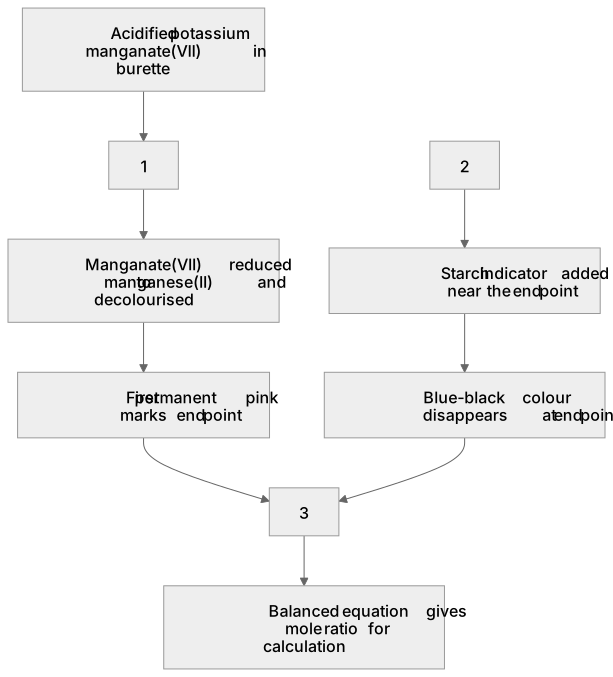
1Box 1
2Box 2
3Box 3
There is more to this lesson
The full lesson goes on to check your understanding and help you earn the marks. Create a free account to carry on, with your progress saved.
A week of Premium from your first lesson · Then the free plan continues · No card, no charge
Test your understanding of Redox and electrode potentials: (d) the techniques and procedures used when carrying out redox titrations including those involving Fe²⁺/MnO₄⁻ and I₂/S₂O₃²⁻ (see also 2.1.5 e–f)
Active recall beats re-reading. Take an instant quiz now to test what you’ve learned and lock it into long-term memory.
A week of Premium from your first lesson · Then the free plan continues · No card, no charge