OCR · A-Level · Chemistry
Course version: H432 · Version from Sept 2017
Redox and electrode potentials: (i) Fe²⁺/MnO₄⁻ and I₂/S₂O₃²⁻
These two redox systems are the standard titrations of the topic.
- Point 5 of 14
- 4 key terms
Study notes
From the teaching notes for this specification point.
The idea
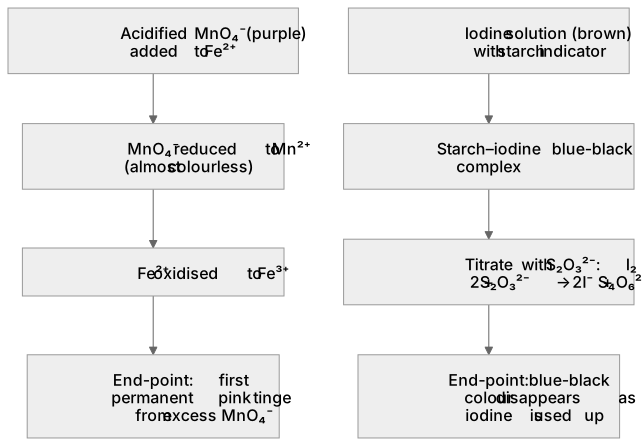
These two redox systems are the standard titrations of the topic. In Fe²⁺/MnO₄⁻, acidified manganate(VII) is the self-indicating titrant: MnO₄⁻ is purple and is reduced to almost colourless Mn²⁺, so the end-point is the first permanent pink tinge as excess MnO₄⁻ appears. The equation is MnO₄⁻ + 5Fe²⁺ + 8H⁺ → Mn²⁺ + 5Fe³⁺ + 4H₂O. In I₂/S₂O₃²⁻, iodine is titrated with thiosulfate: I₂ + 2S₂O₃²⁻ → 2I⁻ + S₄O₆²⁻. Iodine solution is brown; starch indicator gives a blue-black complex, and the end-point is when this blue-black colour disappears as iodine is used up. Recognise the colour changes, the mole ratios and the role of each reagent.
What earns the marks
- Identifies that acidified MnO₄⁻ is reduced to Mn²⁺ and oxidises Fe²⁺ to Fe³⁺.
- States that the manganate(VII) end-point is the first permanent pink colour from excess MnO₄⁻.
- Gives the iodine–thiosulfate equation I₂ + 2S₂O₃²⁻ → 2I⁻ + S₄O₆²⁻ with the 1:2 mole ratio.
- Describes the starch–iodine end-point as the disappearance of the blue-black colour.
- Applies the correct mole ratio (1 MnO₄⁻ to 5 Fe²⁺) in a calculation.
Common mistakes and how to put them right
Describes the manganate(VII) end-point as purple changing to colourless.
Put it right: The end-point is the first permanent pink as excess MnO₄⁻ appears.
Says the starch–iodine colour changes from brown to colourless.
Put it right: The starch complex is blue-black and it disappears at the end-point.
Uses a 1:1 mole ratio for MnO₄⁻ and Fe²⁺.
Put it right: The balanced equation gives 1:5.
Exam tips
- Learn both balanced equations and their mole ratios so you can apply them quickly.
- Link each colour change to the species responsible (excess MnO₄⁻, or loss of the starch–iodine complex).
- Check whether the question asks for the indicator colour or the solution colour before choosing.
Try the lesson
The start of the Redox and electrode potentials: (i) Fe²⁺/MnO₄⁻ and I₂/S₂O₃²⁻ lesson, made from teaching notes for this specification point.
Listen
These two redox systems are the standard titrations of the topic. In Fe²⁺/MnO₄⁻, acidified manganate(VII) is the self-indicating titrant: MnO₄⁻ is purple and is reduced to almost colourless Mn²⁺, so the end-point is the first permanent pink tinge as excess MnO₄⁻ appears. The equation is MnO₄⁻ + 5Fe²⁺ + 8H⁺ → Mn²⁺ + 5Fe³⁺ + 4H₂O. In I₂/S₂O₃²⁻, iodine is titrated with thiosulfate: I₂ + 2S₂O₃²⁻ → 2I⁻ + S₄O₆²⁻. Iodine solution is brown; starch indicator gives a blue-black complex, and the end-point is when this blue-black colour disappears as iodine is used up. Recognise the colour changes, the mole ratios and the role of each reagent. A strong answer earns marks for these points. Identifies that acidified MnO₄⁻ is reduced to Mn²⁺ and oxidises Fe²⁺ to Fe³⁺. States that the manganate(VII) end-point is the first permanent pink colour from excess MnO₄⁻. Gives the iodine–thiosulfate equation I₂ + 2S₂O₃²⁻ → 2I⁻ + S₄O₆²⁻ with the 1:2 mole ratio. Describes the starch–iodine end-point as the disappearance of the blue-black colour. Exam tip: Learn both balanced equations and their mole ratios so you can apply them quickly.
See it
Key words
Say what each word means before you turn the card.
Manganate(VII) as a self-indicating oxidant
Try answering aloud or in your head before turning the card.
Iodine–thiosulfate titration with starch indicator
Try answering aloud or in your head before turning the card.
Mole ratios from balanced redox equations
Try answering aloud or in your head before turning the card.
Recognising end-points from colour change
Try answering aloud or in your head before turning the card.
See every definition
- Manganate(VII) as a self-indicating oxidant
- Acidified manganate(VII) is purple and is reduced to almost colourless Mn²⁺, so the end-point is the first permanent pink tinge as excess MnO₄⁻ appears.
- Iodine–thiosulfate titration with starch indicator
- Iodine is titrated with thiosulfate, and starch indicator gives a blue-black complex whose disappearance marks the end-point as iodine is used up.
- Mole ratios from balanced redox equations
- The balanced equations give the ratios to apply, such as 1 MnO₄⁻ to 5 Fe²⁺ and the 1:2 mole ratio in the iodine–thiosulfate equation.
- Recognising end-points from colour change
- Each colour change is linked to the species responsible, either excess MnO₄⁻ or loss of the starch–iodine complex.
Label the diagram
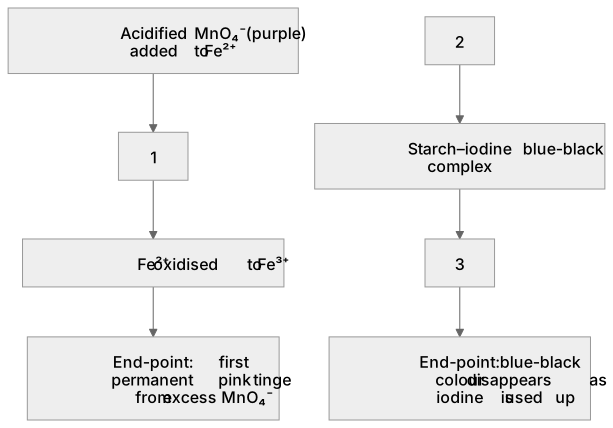
Some boxes have lost their names. Pick the right name for each number.
1Box 1
2Box 2
3Box 3
There is more to this lesson
The full lesson goes on to check your understanding and help you earn the marks. Create a free account to carry on, with your progress saved.
A week of Premium from your first lesson · Then the free plan continues · No card, no charge
Test your understanding of Redox and electrode potentials: (i) Fe²⁺/MnO₄⁻ and I₂/S₂O₃²⁻
Active recall beats re-reading. Take an instant quiz now to test what you’ve learned and lock it into long-term memory.
A week of Premium from your first lesson · Then the free plan continues · No card, no charge