OCR · A-Level · Chemistry
Course version: H432 · Version from Sept 2017
(i) metals or non-metals in contact with their ions in aqueous solution
Full specification wording
Redox and electrode potentials: (i) metals or non-metals in contact with their ions in aqueous solution
This clause describes the first common type of half-cell: a metal, or a non-metal, dipping into a solution containing its own ions.
- Point 9 of 14
- 3 key terms
Study notes
From the teaching notes for this specification point.
The idea
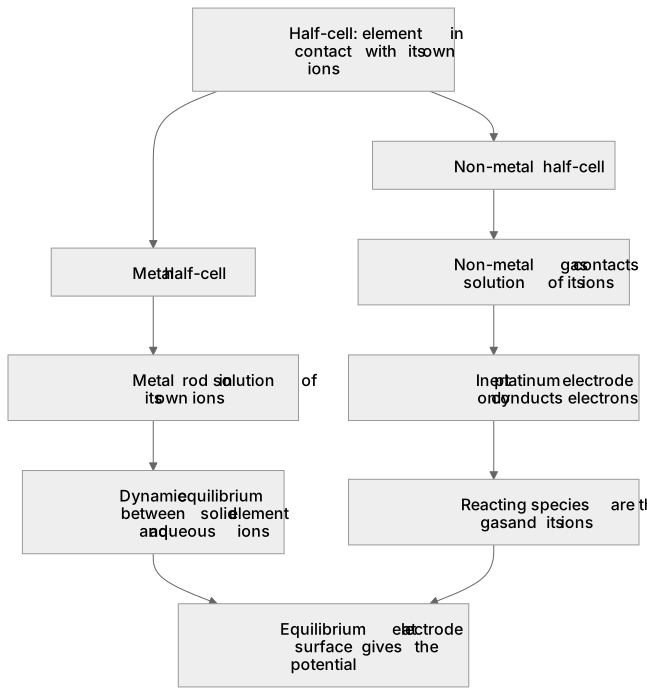
This clause describes the first common type of half-cell: a metal, or a non-metal, dipping into a solution containing its own ions. A metal electrode such as a copper rod in copper(II) sulfate solution, or a zinc rod in zinc sulfate solution, sets up an equilibrium between the solid element and its aqueous ions, for example Cu²⁺(aq) + 2e⁻ ⇌ Cu(s). A non-metal example is a platinum electrode passing chlorine gas into a solution of chloride ions, where Cl₂(g) + 2e⁻ ⇌ 2Cl⁻(aq) applies. The platinum is inert and only conducts; the reacting species are the gas and its ions. In each case the half-cell provides a potential because the forward and reverse reactions reach a dynamic equilibrium at the electrode surface. Recognise that the element and its ions must be the same substance, and that the aqueous ions are supplied by a solution of a soluble salt of that element.
What earns the marks
- Identifies a metal in contact with a solution of its own ions as a valid half-cell, for example a copper rod in copper(II) sulfate solution.
- Recognises that a non-metal such as chlorine can form a half-cell when it contacts a solution of its ions, with an inert platinum electrode conducting.
- States that the half-cell potential arises from a dynamic equilibrium between the element and its aqueous ions at the electrode surface.
- Distinguishes the reacting species from the inert electrode when a non-metal is used, noting that platinum only conducts electrons.
Common mistakes and how to put them right
Places a metal in a solution of a different metal's ions and calls it a valid half-cell.
Put it right by ensuring the element and its ions are the same substance.
Treats the platinum electrode as a reactant in a non-metal half-cell.
Put it right by identifying the gas and its ions as the reacting species and platinum as inert.
Describes the half-cell as having no equilibrium.
Put it right by stating that a dynamic equilibrium between element and ions sets the potential.
Exam tips
- Check that the element and the ions in solution are the same substance before accepting a half-cell.
- For a non-metal half-cell, name the inert electrode separately from the reacting gas and ions.
- Write the relevant half-equation with correct state symbols to show the equilibrium involved.
Try the lesson
The start of the Redox and electrode potentials: (i) metals or non-metals in contact with their ions in aqueous solution lesson, made from teaching notes for this specification point.
Listen
This clause describes the first common type of half-cell: a metal, or a non-metal, dipping into a solution containing its own ions. A metal electrode such as a copper rod in copper(II) sulfate solution, or a zinc rod in zinc sulfate solution, sets up an equilibrium between the solid element and its aqueous ions, for example Cu²⁺(aq) + 2e⁻ ⇌ Cu(s). A non-metal example is a platinum electrode passing chlorine gas into a solution of chloride ions, where Cl₂(g) + 2e⁻ ⇌ 2Cl⁻(aq) applies. The platinum is inert and only conducts; the reacting species are the gas and its ions. In each case the half-cell provides a potential because the forward and reverse reactions reach a dynamic equilibrium at the electrode surface. Recognise that the element and its ions must be the same substance, and that the aqueous ions are supplied by a solution of a soluble salt of that element. A strong answer earns marks for these points. Identifies a metal in contact with a solution of its own ions as a valid half-cell, for example a copper rod in copper(II) sulfate solution. Recognises that a non-metal such as chlorine can form a half-cell when it contacts a solution of its ions, with an inert platinum electrode conducting. States that the half-cell potential arises from a dynamic equilibrium between the element and its aqueous ions at the electrode surface. Distinguishes the reacting species from the inert electrode when a non-metal is used, noting that platinum only conducts electrons. A common slip: Places a metal in a solution of a different metal's ions and calls it a valid half-cell. Instead, ensuring the element and its ions are the same substance. Exam tip: Check that the element and the ions in solution are the same substance before accepting a half-cell.
See it
Key words
Say what each word means before you turn the card.
Half-cell construction
Try answering aloud or in your head before turning the card.
Dynamic equilibrium at electrodes
Try answering aloud or in your head before turning the card.
Inert platinum conduction
Try answering aloud or in your head before turning the card.
See every definition
- Half-cell construction
- A metal or non-metal in contact with its own ions in aqueous solution, where the aqueous ions are supplied by a solution of a soluble salt of that element.
- Dynamic equilibrium at electrodes
- The forward and reverse reactions reach a dynamic equilibrium at the electrode surface, and this provides the half-cell potential.
- Inert platinum conduction
- The platinum is inert and only conducts; the reacting species are the gas and its ions.
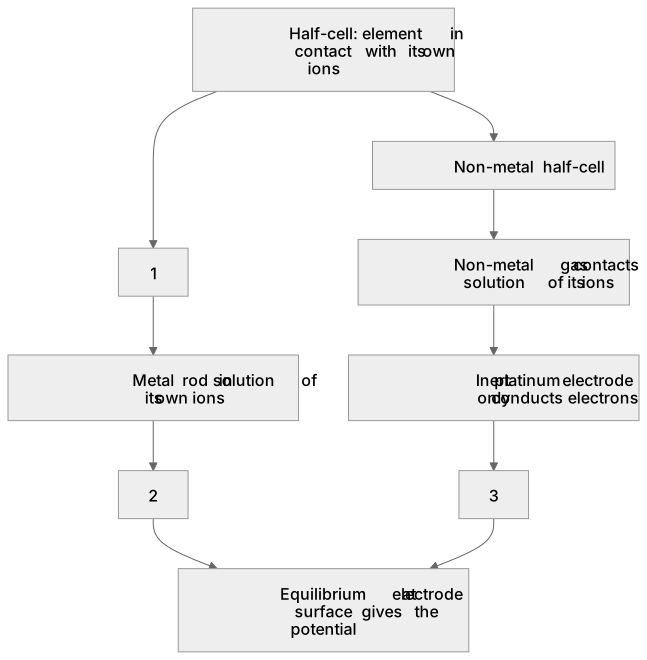
Label the diagram
Some boxes have lost their names. Pick the right name for each number.
1Box 1
2Box 2
3Box 3
There is more to this lesson
The full lesson goes on to check your understanding and help you earn the marks. Create a free account to carry on, with your progress saved.
A week of Premium from your first lesson · Then the free plan continues · No card, no charge
Test your understanding of Redox and electrode potentials: (i) metals or non-metals in contact with their ions in aqueous solution
Active recall beats re-reading. Take an instant quiz now to test what you’ve learned and lock it into long-term memory.
A week of Premium from your first lesson · Then the free plan continues · No card, no charge