OCR · A-Level · Chemistry
Course version: H432 · Version from Sept 2017
(j) application of principles of electrode potentials to modern storage…
Full specification wording
Redox and electrode potentials: (j) application of principles of electrode potentials to modern storage cells
This criterion asks you to apply electrode-potential principles to modern storage cells such as lithium-ion batteries.
- Point 13 of 14
- 4 key terms
Study notes
From the teaching notes for this specification point.
The idea
This criterion asks you to apply electrode-potential principles to modern storage cells such as lithium-ion batteries. For a cell, write the two half-equations, identify which electrode is oxidised and which is reduced, and combine the standard electrode potentials to give E°cell. The more positive (less negative) electrode potential marks the positive electrode where reduction occurs; the more negative marks the negative electrode where oxidation occurs. A positive E°cell indicates the discharge reaction is feasible under standard conditions. In a rechargeable storage cell the electrode reactions are reversible, so an external supply drives the reverse reaction to recharge it. Questions may ask you to select the correct half-equation, the correct electrode polarity, or the sign of E°cell.
What earns the marks
- Writes the two half-equations for the storage cell and identifies which is oxidation and which is reduction.
- Combines the standard electrode potentials to give E°cell and states whether the discharge reaction is feasible.
- Identifies the negative electrode as the one with the more negative electrode potential, where oxidation occurs.
- Explains that a rechargeable storage cell works because its electrode reactions are reversible when an external supply is applied.
Common mistakes and how to put them right
Adds the two electrode potentials with the wrong signs.
Put it right by using E°cell = E°(reduction) − E°(oxidation) with the values as tabulated.
Assigns the positive electrode to the more negative potential.
Put it right by linking the more positive potential to reduction at the positive electrode.
Treats a storage cell as irreversible.
Put it right by noting that rechargeable cells reverse their electrode reactions on charging.
Exam tips
- Write both half-equations first, then combine the potentials, so the sign of E°cell follows from the working.
- Check which electrode is oxidised before deciding polarity, since the negative electrode is where oxidation happens.
- Read the question's wording on standard conditions and reversibility before choosing an option.
Try the lesson
The start of the Redox and electrode potentials: (j) application of principles of electrode potentials to modern storage cells lesson, made from teaching notes for this specification point.
Listen
This criterion asks you to apply electrode-potential principles to modern storage cells such as lithium-ion batteries. For a cell, write the two half-equations, identify which electrode is oxidised and which is reduced, and combine the standard electrode potentials to give E°cell. The more positive (less negative) electrode potential marks the positive electrode where reduction occurs; the more negative marks the negative electrode where oxidation occurs. A positive E°cell indicates the discharge reaction is feasible under standard conditions. In a rechargeable storage cell the electrode reactions are reversible, so an external supply drives the reverse reaction to recharge it. Questions may ask you to select the correct half-equation, the correct electrode polarity, or the sign of E°cell. A strong answer earns marks for these points. Writes the two half-equations for the storage cell and identifies which is oxidation and which is reduction. Combines the standard electrode potentials to give E°cell and states whether the discharge reaction is feasible. Identifies the negative electrode as the one with the more negative electrode potential, where oxidation occurs. Explains that a rechargeable storage cell works because its electrode reactions are reversible when an external supply is applied. A common slip: Adds the two electrode potentials with the wrong signs. Instead, using E°cell = E°(reduction) − E°(oxidation) with the values as tabulated. Exam tip: Write both half-equations first, then combine the potentials, so the sign of E°cell follows from the working.
See it
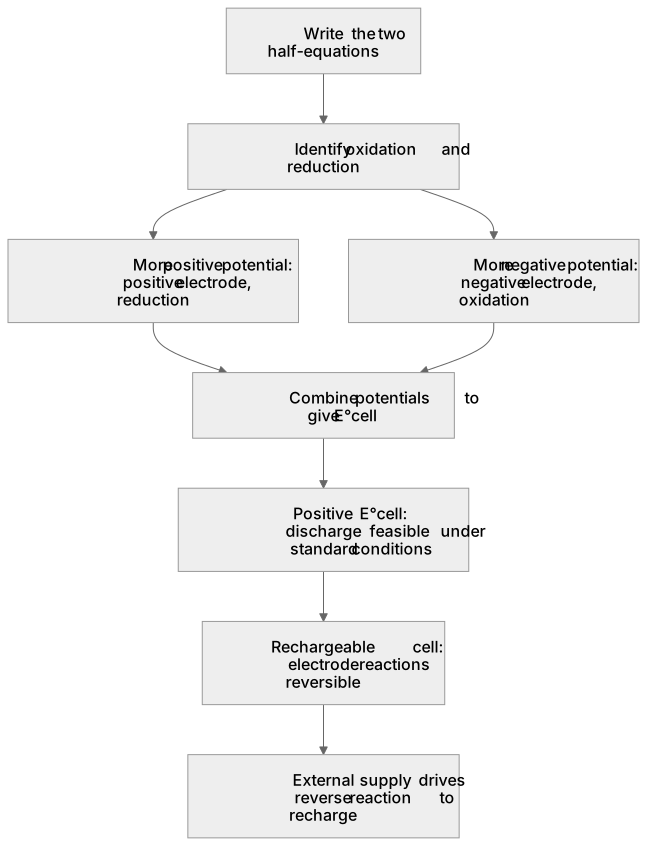
Key words
Say what each word means before you turn the card.
Combining standard electrode potentials
Try answering aloud or in your head before turning the card.
Identifying oxidation and reduction electrodes
Try answering aloud or in your head before turning the card.
Feasibility from the sign of E°cell
Try answering aloud or in your head before turning the card.
Reversibility in rechargeable storage cells
Try answering aloud or in your head before turning the card.
See every definition
- Combining standard electrode potentials
- Writing the two half-equations for the storage cell and combining the standard electrode potentials to give E°cell.
- Identifying oxidation and reduction electrodes
- The more positive electrode potential marks the positive electrode where reduction occurs, and the more negative marks the negative electrode where oxidation occurs.
- Feasibility from the sign of E°cell
- A positive E°cell indicates the discharge reaction is feasible under standard conditions.
- Reversibility in rechargeable storage cells
- The electrode reactions are reversible, so an external supply drives the reverse reaction to recharge the cell.
Label the diagram
Some boxes have lost their names. Pick the right name for each number.
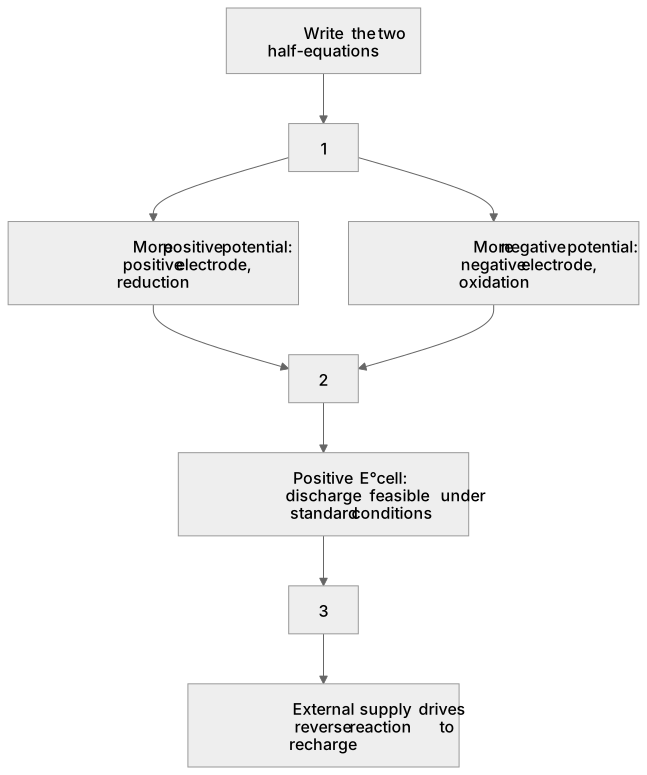
1Box 1
2Box 2
3Box 3
There is more to this lesson
The full lesson goes on to check your understanding and help you earn the marks. Create a free account to carry on, with your progress saved.
A week of Premium from your first lesson · Then the free plan continues · No card, no charge
Test your understanding of Redox and electrode potentials: (j) application of principles of electrode potentials to modern storage cells
Active recall beats re-reading. Take an instant quiz now to test what you’ve learned and lock it into long-term memory.
A week of Premium from your first lesson · Then the free plan continues · No card, no charge