OCR · A-Level · Chemistry
Course version: H432 · Version from Sept 2017
(k) explanation that a fuel cell uses the energy from the reaction of a…
Full specification wording
Redox and electrode potentials: (k) explanation that a fuel cell uses the energy from the reaction of a fuel with oxygen to create a voltage and the changes that take place at each electrode.
A fuel cell converts chemical energy from the reaction of a fuel with oxygen directly into electrical energy, producing a voltage across two electrodes without combustion.
- Point 14 of 14
- 4 key terms
Study notes
From the teaching notes for this specification point.
The idea
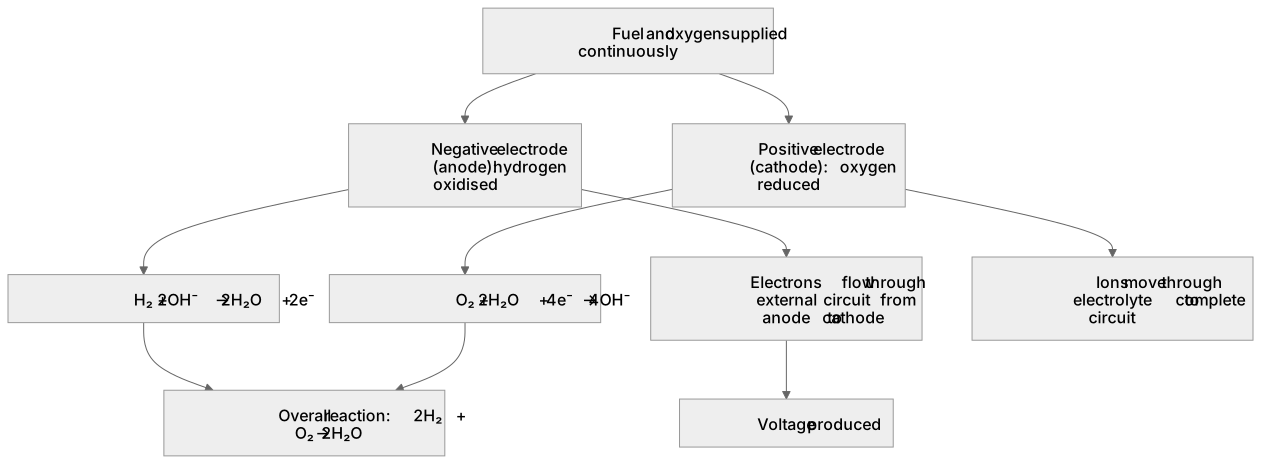
A fuel cell converts chemical energy from the reaction of a fuel with oxygen directly into electrical energy, producing a voltage across two electrodes without combustion. In a hydrogen–oxygen fuel cell with an alkaline electrolyte, hydrogen is oxidised at the negative electrode (anode): H₂ + 2OH⁻ → 2H₂O + 2e⁻. Oxygen is reduced at the positive electrode (cathode): O₂ + 2H₂O + 4e⁻ → 4OH⁻. Electrons flow through the external circuit from anode to cathode, doing electrical work, while ions move through the electrolyte to complete the circuit. The overall reaction is 2H₂ + O₂ → 2H₂O. The cell keeps producing a voltage while fuel and oxygen are supplied, unlike a secondary cell that must be recharged.
What earns the marks
- States that a fuel cell generates a voltage from the reaction of a fuel with oxygen rather than by burning the fuel.
- Identifies oxidation of the fuel at the negative electrode (anode) and reduction of oxygen at the positive electrode (cathode).
- Writes the anode half-equation for an alkaline hydrogen–oxygen fuel cell as H₂ + 2OH⁻ → 2H₂O + 2e⁻.
- Writes the cathode half-equation as O₂ + 2H₂O + 4e⁻ → 4OH⁻.
- Explains that electrons flow through the external circuit from anode to cathode while ions move through the electrolyte.
- States the overall cell reaction as 2H₂ + O₂ → 2H₂O.
- Notes that the cell delivers a voltage continuously while fuel and oxygen are supplied.
Common mistakes and how to put them right
Reverses the electrode polarity.
Put it right: Keep oxidation at the negative anode and reduction at the positive cathode.
Omits the electrons from a half-equation.
Put it right: Balance charge by including the correct number of electrons.
Treats the fuel cell as storing charge like a battery.
Put it right: Describe continuous supply of fuel and oxygen instead.
Writes the overall equation without balancing.
Put it right: Check that atoms and charge balance to give 2H₂ + O₂ → 2H₂O.
Exam tips
- Learn both half-equations and check that they combine to the overall equation with electrons cancelling.
- State clearly which electrode is negative and which is positive before describing the changes there.
- Link the voltage to electron flow in the external circuit and ion movement in the electrolyte.
- Contrast the fuel cell with a rechargeable cell to show why continuous fuel supply matters.
Try the lesson
The start of the Redox and electrode potentials: (k) explanation that a fuel cell uses the energy from the reaction of a fuel with oxygen to create a voltage and the changes that take place at each electrode. lesson, made from teaching notes for this specification point.
Listen
A fuel cell converts chemical energy from the reaction of a fuel with oxygen directly into electrical energy, producing a voltage across two electrodes without combustion. In a hydrogen–oxygen fuel cell with an alkaline electrolyte, hydrogen is oxidised at the negative electrode (anode): H₂ + 2OH⁻ → 2H₂O + 2e⁻. Oxygen is reduced at the positive electrode (cathode): O₂ + 2H₂O + 4e⁻ → 4OH⁻. Electrons flow through the external circuit from anode to cathode, doing electrical work, while ions move through the electrolyte to complete the circuit. The overall reaction is 2H₂ + O₂ → 2H₂O. The cell keeps producing a voltage while fuel and oxygen are supplied, unlike a secondary cell that must be recharged. A strong answer earns marks for these points. States that a fuel cell generates a voltage from the reaction of a fuel with oxygen rather than by burning the fuel. Identifies oxidation of the fuel at the negative electrode (anode) and reduction of oxygen at the positive electrode (cathode). Writes the anode half-equation for an alkaline hydrogen–oxygen fuel cell as H₂ + 2OH⁻ → 2H₂O + 2e⁻. Writes the cathode half-equation as O₂ + 2H₂O + 4e⁻ → 4OH⁻. Exam tip: Learn both half-equations and check that they combine to the overall equation with electrons cancelling.
See it
Key words
Say what each word means before you turn the card.
Fuel cell
Try answering aloud or in your head before turning the card.
Redox at electrodes
Try answering aloud or in your head before turning the card.
Half-equations and electron balance
Try answering aloud or in your head before turning the card.
Continuous operation with fuel supply
Try answering aloud or in your head before turning the card.
See every definition
- Fuel cell
- Uses the energy from the reaction of a fuel with oxygen to create a voltage, producing a voltage while fuel and oxygen are supplied.
- Redox at electrodes
- The fuel is oxidised at the negative electrode (anode) and oxygen is reduced at the positive electrode (cathode).
- Half-equations and electron balance
- The anode half-equation is H₂ + 2OH⁻ → 2H₂O + 2e⁻ and the cathode half-equation is O₂ + 2H₂O + 4e⁻ → 4OH⁻.
- Continuous operation with fuel supply
- The cell keeps producing a voltage while fuel and oxygen are supplied, unlike a secondary cell that must be recharged.
Label the diagram
Some boxes have lost their names. Pick the right name for each number.
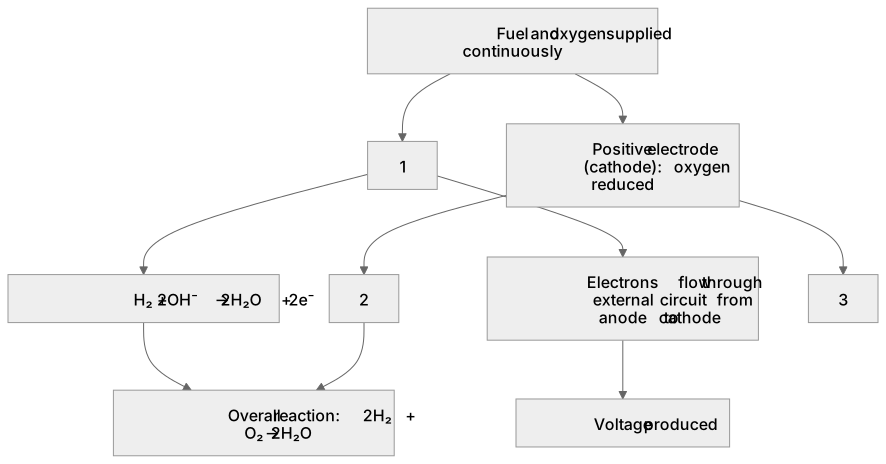
1Box 1
2Box 2
3Box 3
There is more to this lesson
The full lesson goes on to check your understanding and help you earn the marks. Create a free account to carry on, with your progress saved.
A week of Premium from your first lesson · Then the free plan continues · No card, no charge
Test your understanding of Redox and electrode potentials: (k) explanation that a fuel cell uses the energy from the reaction of a fuel with oxygen to create a voltage and the changes that take place at each electrode.
Active recall beats re-reading. Take an instant quiz now to test what you’ve learned and lock it into long-term memory.
A week of Premium from your first lesson · Then the free plan continues · No card, no charge