OCR · A-Level · Chemistry
Course version: H432 · Version from Sept 2017
(c) use of a Roman numeral to indicate the magnitude of the oxidation…
Full specification wording
Redox: (c) use of a Roman numeral to indicate the magnitude of the oxidation number when an element may have compounds/ions with different oxidation numbers
Some transition elements form more than one compound or ion, so the name alone is ambiguous.
- Point 4 of 10
- 4 key terms
Study notes
From the teaching notes for this specification point.
The idea
Some transition elements form more than one compound or ion, so the name alone is ambiguous. A Roman numeral in brackets after the element name states the oxidation number of that element in that particular species. Iron can be +2 or +3, so iron(II) chloride contains Fe²⁺ and iron(III) chloride contains Fe³⁺; copper(I) oxide contains Cu⁺ while copper(II) oxide contains Cu²⁺. The numeral gives the magnitude of the oxidation number, not the number of atoms and not a charge written as a superscript. Read the numeral, assign that oxidation number to the element, then deduce the formula or the ion charge from the other element present.
What earns the marks
- Reads the Roman numeral as the oxidation number of the named element in that species.
- Distinguishes species of the same element that carry different oxidation numbers, such as iron(II) and iron(III).
- Deduces the formula or ion charge consistent with the stated oxidation number and the counter-ion.
- States the oxidation number as a value such as +2 or +3 rather than treating the numeral as an atom count.
Common mistakes and how to put them right
Treats the Roman numeral as the number of atoms of that element.
Put it right: Read it as the oxidation number instead.
Confuses iron(II) with iron(III) when deducing the formula.
Put it right: Match the numeral to the charge on the ion.
Writes the oxidation number as a superscript charge on the symbol in the name.
Put it right: Keep the numeral in brackets after the element name.
Exam tips
- Underline the Roman numeral and convert it immediately to an oxidation number such as +2 or +3.
- Use the counter-ion to check that your formula is consistent with the stated oxidation number.
- Remember the numeral describes one element only, not the whole compound.
Try the lesson
The start of the Redox: (c) use of a Roman numeral to indicate the magnitude of the oxidation number when an element may have compounds/ions with different oxidation numbers lesson, made from teaching notes for this specification point.
Listen
Some transition elements form more than one compound or ion, so the name alone is ambiguous. A Roman numeral in brackets after the element name states the oxidation number of that element in that particular species. Iron can be +2 or +3, so iron(II) chloride contains Fe²⁺ and iron(III) chloride contains Fe³⁺; copper(I) oxide contains Cu⁺ while copper(II) oxide contains Cu²⁺. The numeral gives the magnitude of the oxidation number, not the number of atoms and not a charge written as a superscript. Read the numeral, assign that oxidation number to the element, then deduce the formula or the ion charge from the other element present. A strong answer earns marks for these points. Reads the Roman numeral as the oxidation number of the named element in that species. Distinguishes species of the same element that carry different oxidation numbers, such as iron(II) and iron(III). Deduces the formula or ion charge consistent with the stated oxidation number and the counter-ion. States the oxidation number as a value such as +2 or +3 rather than treating the numeral as an atom count. Exam tip: Underline the Roman numeral and convert it immediately to an oxidation number such as +2 or +3.
See it
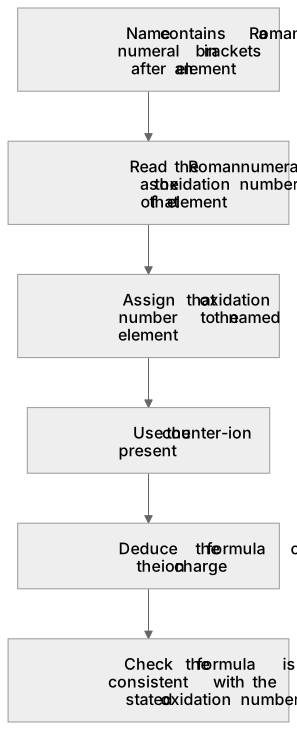
Put it in order
Put these steps in the order they happen.
- 1. Assign that oxidation number to the named element
- 2. Read the Roman numeral as the oxidation number of that element
- 3. Name contains a Roman numeral in brackets after an element
- 4. Check the formula is consistent with the stated oxidation number
- 5. Deduce the formula or the ion charge
- 6. Use the counter-ion present
Key words
Say what each word means before you turn the card.
Roman numerals as oxidation numbers
Try answering aloud or in your head before turning the card.
Variable oxidation numbers of transition elements
Try answering aloud or in your head before turning the card.
Deducing formulae from stated oxidation numbers
Try answering aloud or in your head before turning the card.
Distinguishing compounds of the same element
Try answering aloud or in your head before turning the card.
See every definition
- Roman numerals as oxidation numbers
- A Roman numeral in brackets after the element name states the oxidation number of that element in that particular species.
- Variable oxidation numbers of transition elements
- Some transition elements form more than one compound or ion, so the name alone is ambiguous.
- Deducing formulae from stated oxidation numbers
- Read the numeral, assign that oxidation number to the element, then deduce the formula or the ion charge from the other element present.
- Distinguishing compounds of the same element
- Species of the same element that carry different oxidation numbers, such as iron(II) and iron(III), are told apart by the Roman numeral.
Label the diagram
Some boxes have lost their names. Pick the right name for each number.
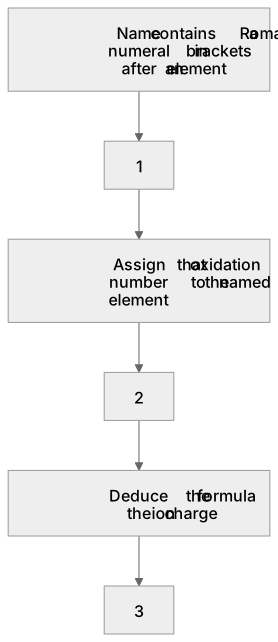
1Box 1
2Box 2
3Box 3
There is more to this lesson
The full lesson goes on to check your understanding and help you earn the marks. Create a free account to carry on, with your progress saved.
A week of Premium from your first lesson · Then the free plan continues · No card, no charge
Test your understanding of Redox: (c) use of a Roman numeral to indicate the magnitude of the oxidation number when an element may have compounds/ions with different oxidation numbers
Active recall beats re-reading. Take an instant quiz now to test what you’ve learned and lock it into long-term memory.
A week of Premium from your first lesson · Then the free plan continues · No card, no charge