OCR · A-Level · Chemistry
Course version: H432 · Version from Sept 2017
Redox: Redox reactions
Redox reactions are electron-transfer processes, and OCR expects you to recognise them from oxidation numbers, from half-equations and from observations.
- Point 5 of 10
- 4 key terms
Study notes
From the teaching notes for this specification point.
The idea
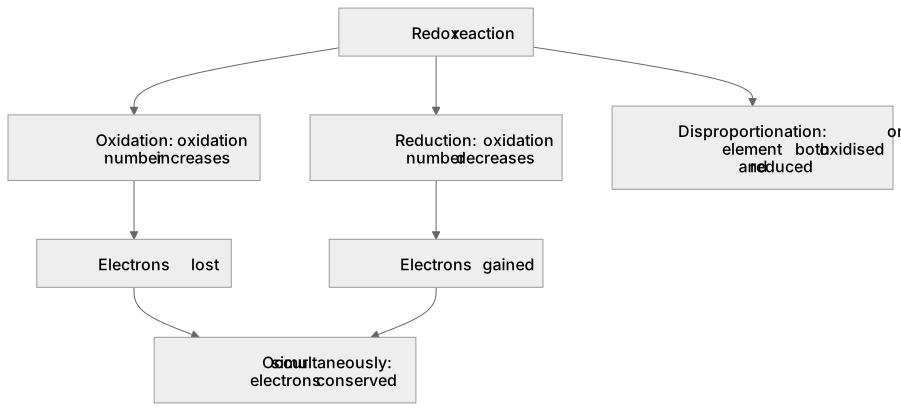
Redox reactions are electron-transfer processes, and OCR expects you to recognise them from oxidation numbers, from half-equations and from observations. Oxidation is an increase in oxidation number, reduction is a decrease, and the two always occur together because the electrons lost by one species are gained by another. For example, in Zn + Cu²⁺ → Zn²⁺ + Cu, zinc's oxidation number rises from 0 to 2⁺ (oxidised) while copper's falls from 2⁺ to 0 (reduced). You must also handle disproportionation, where one element is simultaneously oxidised and reduced, as in chlorine with cold dilute alkali. Practise assigning oxidation numbers using the rules, then check that the changes balance in a full equation.
What earns the marks
- Identifies oxidation as an increase in oxidation number and reduction as a decrease, applying the change to the correct species.
- Assigns oxidation numbers correctly using the standard rules, including elements in their standard state having oxidation number 0.
- Recognises that oxidation and reduction occur simultaneously because electrons transferred are conserved.
- Distinguishes disproportionation, in which one element is both oxidised and reduced in the same reaction.
- Balances a redox half-equation for atoms and charge by adding electrons to the appropriate side.
Common mistakes and how to put them right
Confuses the direction of electron transfer.
Put it right: Loss of electrons is oxidation and gain is reduction.
Assigns oxidation number 0 to an element in a compound.
Put it right: Reserve 0 for uncombined elements.
Treats disproportionation as two separate reactions.
Put it right: Recognise that one element changes to two different oxidation numbers in one reaction.
Omits electrons when balancing a half-equation.
Put it right: Add them so the charge balances on both sides.
Exam tips
- Write the oxidation number above each element before deciding which species is oxidised.
- Check your answer by confirming the total increase in oxidation number equals the total decrease.
- For disproportionation questions, identify the single element that appears at three oxidation numbers.
- Balance half-equations for atoms first, then for charge with electrons.
Try the lesson
The start of the Redox: Redox reactions lesson, made from teaching notes for this specification point.
Listen
Redox reactions are electron-transfer processes, and OCR expects you to recognise them from oxidation numbers, from half-equations and from observations. Oxidation is an increase in oxidation number, reduction is a decrease, and the two always occur together because the electrons lost by one species are gained by another. For example, in Zn + Cu²⁺ → Zn²⁺ + Cu, zinc's oxidation number rises from 0 to 2⁺ (oxidised) while copper's falls from 2⁺ to 0 (reduced). You must also handle disproportionation, where one element is simultaneously oxidised and reduced, as in chlorine with cold dilute alkali. Practise assigning oxidation numbers using the rules, then check that the changes balance in a full equation. A strong answer earns marks for these points. Identifies oxidation as an increase in oxidation number and reduction as a decrease, applying the change to the correct species. Assigns oxidation numbers correctly using the standard rules, including elements in their standard state having oxidation number 0. Recognises that oxidation and reduction occur simultaneously because electrons transferred are conserved. Distinguishes disproportionation, in which one element is both oxidised and reduced in the same reaction. Exam tip: Write the oxidation number above each element before deciding which species is oxidised.
See it
Key words
Say what each word means before you turn the card.
Electron transfer
Try answering aloud or in your head before turning the card.
Oxidation numbers
Try answering aloud or in your head before turning the card.
Half-equations
Try answering aloud or in your head before turning the card.
Disproportionation
Try answering aloud or in your head before turning the card.
See every definition
- Electron transfer
- Redox reactions are electron-transfer processes, and the electrons lost by one species are gained by another.
- Oxidation numbers
- Oxidation is an increase in oxidation number and reduction is a decrease, so the changes show which species is oxidised.
- Half-equations
- A redox half-equation is balanced for atoms and charge by adding electrons to the appropriate side.
- Disproportionation
- One element is simultaneously oxidised and reduced, changing to two different oxidation numbers in one reaction.
Label the diagram
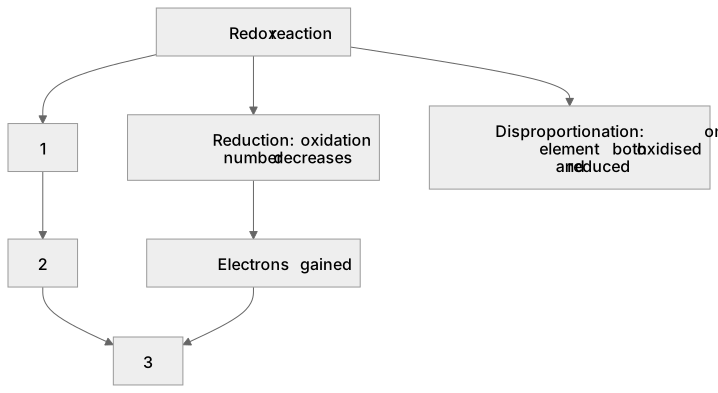
Some boxes have lost their names. Pick the right name for each number.
1Box 1
2Box 2
3Box 3
There is more to this lesson
The full lesson goes on to check your understanding and help you earn the marks. Create a free account to carry on, with your progress saved.
A week of Premium from your first lesson · Then the free plan continues · No card, no charge
Test your understanding of Redox: Redox reactions
Active recall beats re-reading. Take an instant quiz now to test what you’ve learned and lock it into long-term memory.
A week of Premium from your first lesson · Then the free plan continues · No card, no charge