OCR · A-Level · Chemistry
Course version: H432 · Version from Sept 2017
Redox: (d) oxidation and reduction in terms of:
This criterion asks you to describe oxidation and reduction using two complementary frameworks: electron transfer and oxidation number change.
- Point 6 of 10
- 4 key terms
Study notes
From the teaching notes for this specification point.
The idea
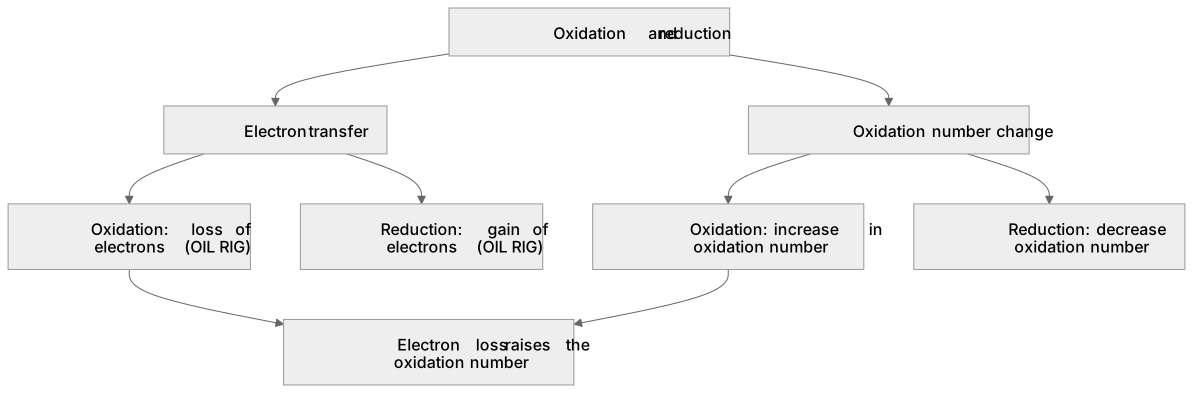
This criterion asks you to describe oxidation and reduction using two complementary frameworks: electron transfer and oxidation number change. In electron-transfer terms, oxidation is loss of electrons and reduction is gain of electrons, summarised by OIL RIG. In oxidation-number terms, oxidation is an increase and reduction a decrease. You should be able to move between the two descriptions for the same reaction. For example, in Fe²⁺ → Fe³⁺ + e⁻, iron loses an electron (oxidation) and its oxidation number rises from 2⁺ to 3⁺. Practise converting a half-equation into an oxidation-number statement and vice versa, and check that electrons appear on the correct side.
What earns the marks
- States oxidation as loss of electrons and reduction as gain of electrons, applying each to the correct species.
- States oxidation as an increase in oxidation number and reduction as a decrease, applying each to the correct species.
- Converts between a half-equation and an oxidation-number description consistently.
- Places electrons on the product side for an oxidation half-equation and on the reactant side for a reduction half-equation.
- Links the two frameworks by showing that electron loss raises the oxidation number.
Common mistakes and how to put them right
Reverses the definitions so that gain of electrons is called oxidation.
Put it right: Use OIL RIG to keep the direction correct.
Places electrons on the wrong side of a half-equation.
Put it right: Oxidation produces electrons as products.
Gives only one framework when the question asks for both electron transfer and oxidation number change.
Miscounts the oxidation number change when a species gains or loses more than one electron.
Exam tips
- Write OIL RIG at the top of your working to anchor the electron-transfer definitions.
- For each species, state both the electron change and the oxidation number change.
- Check that the number of electrons in a half-equation matches the change in oxidation number.
- Read the question to see whether it wants electron transfer, oxidation number, or both.
Try the lesson
The start of the Redox: (d) oxidation and reduction in terms of: lesson, made from teaching notes for this specification point.
Listen
This criterion asks you to describe oxidation and reduction using two complementary frameworks: electron transfer and oxidation number change. In electron-transfer terms, oxidation is loss of electrons and reduction is gain of electrons, summarised by OIL RIG. In oxidation-number terms, oxidation is an increase and reduction a decrease. You should be able to move between the two descriptions for the same reaction. For example, in Fe²⁺ → Fe³⁺ + e⁻, iron loses an electron (oxidation) and its oxidation number rises from 2⁺ to 3⁺. Practise converting a half-equation into an oxidation-number statement and vice versa, and check that electrons appear on the correct side. A strong answer earns marks for these points. States oxidation as loss of electrons and reduction as gain of electrons, applying each to the correct species. States oxidation as an increase in oxidation number and reduction as a decrease, applying each to the correct species. Converts between a half-equation and an oxidation-number description consistently. Places electrons on the product side for an oxidation half-equation and on the reactant side for a reduction half-equation. Exam tip: Write OIL RIG at the top of your working to anchor the electron-transfer definitions.
See it
Key words
Say what each word means before you turn the card.
Electron loss and gain
Try answering aloud or in your head before turning the card.
Oxidation number change
Try answering aloud or in your head before turning the card.
Half-equations
Try answering aloud or in your head before turning the card.
Linking frameworks
Try answering aloud or in your head before turning the card.
See every definition
- Electron loss and gain
- Oxidation is loss of electrons and reduction is gain of electrons, summarised by OIL RIG.
- Oxidation number change
- Oxidation is an increase in oxidation number and reduction is a decrease.
- Half-equations
- Electrons appear on the product side for an oxidation half-equation and on the reactant side for a reduction half-equation.
- Linking frameworks
- The two frameworks are linked by showing that electron loss raises the oxidation number.
Label the diagram
Some boxes have lost their names. Pick the right name for each number.
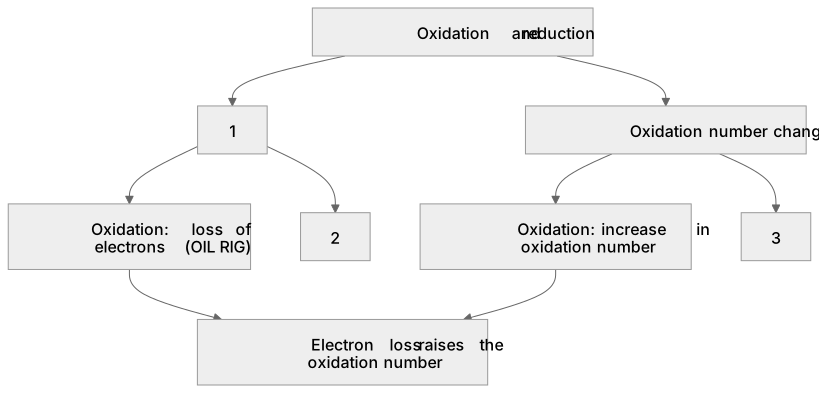
1Box 1
2Box 2
3Box 3
There is more to this lesson
The full lesson goes on to check your understanding and help you earn the marks. Create a free account to carry on, with your progress saved.
A week of Premium from your first lesson · Then the free plan continues · No card, no charge
Test your understanding of Redox: (d) oxidation and reduction in terms of:
Active recall beats re-reading. Take an instant quiz now to test what you’ve learned and lock it into long-term memory.
A week of Premium from your first lesson · Then the free plan continues · No card, no charge